Differential gravitational acceleration, multiplied by the affected mass, across a spatially extended body. In the linear approximation the acceleration difference is , where is the tidal tensor. Stellar tidal forces limit the domain of a circumplanetary orbit; sufficiently strong ones can produce tidal disruption.
To isolate a tidal force, subtract the gravitational acceleration shared by the body as a whole. Let a reference test particle follow , and let another have position . In a translating accelerated reference frame with parallel, nonrotating axes,for a source point mass, when . Here is its standard gravitational parameter and the last term uses Big O notation. This Taylor expansion removes the common inward pull and keeps the spatial variation. The near side has an excess pull toward the source; the far side has a deficit of inward pull, which is an outward relative acceleration. Both sides can stretch apart while both still accelerate toward the source.[ref]
Chapter 7: The Theory of Gravitation. §7–4, discussion of stronger near-side and weaker far-side attraction
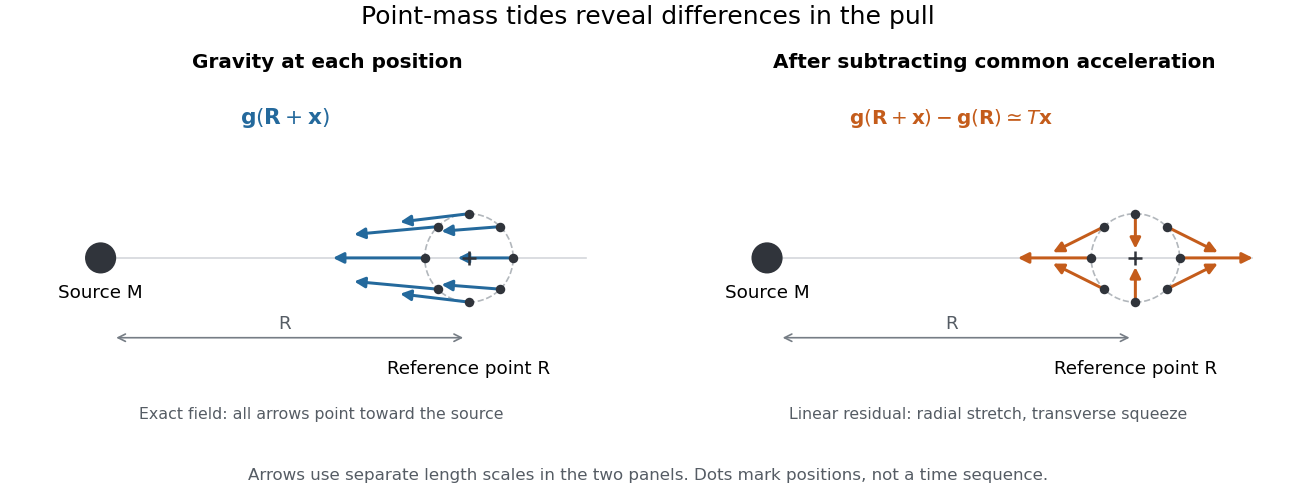
Subtracting common gravitational acceleration reveals radial stretching and transverse squeezing
. Blue arrows show the exact Newtonian gravitational field at several positions near a reference point. Orange arrows show its linear residual, calculated with the tidal tensor. Arrow lengths use separate scales in the two panels; this is a comparison of direction and spatial variation, not two equal-magnitude fields. Details.For a material element of mass , the residual external force in this translating accelerated reference frame is . Actual deformation also depends on elasticity, pressure and self-gravity. A rigid body approximation suppresses deformation but can still have internal forces that resist the tidal force. The point-mass tidal stretching and squeezing pattern describes freely falling, noninteracting test particles, rather than promising the same shape for every solid, star or ocean. A rotating reference frame introduces centrifugal acceleration and Coriolis acceleration, which must be included separately.
A small cohesionless spherical body of radius and density has surface self-gravitational acceleration . The radial stretching of the corotating point-mass tidal field is . Equating them gives the displayed survival-distance estimate. The size cancels because both accelerations are linear in at fixed density. This is a local spherical force-balance estimate, not the exact fluid Roche figure: shape deformation, material strength and nonsynchronous spin can change its numerical coefficient.
A tide is a periodic change in ocean level driven mainly by the differential gravitational forces of the Moon and Sun, together with the Earth's rotation. Their tidal forces act across the extended planet; a uniform acceleration shared by the whole Earth does not by itself generate a tide. Ocean-basin resonance and coastal geometry modify the local response.
A semidiurnal tide has two principal oscillations per day. The dominant lunar constituent has a period of approximately 12 hours 25 minutes; the solar semidiurnal constituent has a period of 12 hours.[ref]
About Harmonic Constituents by National Oceanic and Atmospheric Administration. Examples M2 and S2
A spring tide has an enhanced high-to-low tidal range because the Moon and Sun are approximately aligned as seen from the Earth, so their principal tidal contributions reinforce. Such alignments occur twice in a lunar phase cycle.
A neap tide has a reduced high-to-low tidal range when the directions to the Moon and Sun make approximately a right angle at the Earth. Their principal tidal contributions then partly oppose one another. The solar and lunar contributions are not equal, so this does not mean that tides disappear.
Stipulate a fixed source point mass , two equal test particles of mass , and . This is a chosen model, not a measurement of a particular object. Place the test particles on the outward radial axis at and , with midpoint distance and separation . Neglect their mutual attraction, other sources and all supporting forces.
Each signed radial gravitational acceleration is inward:Their separation has outward relative accelerationThe exact value is . The midpoint tidal tensor predicts , an underestimate of relative to the exact value. For these equal masses, the difference of external forces has the same numerical value in the SI unit of force, the newton. It is not an additional mutual force between the test particles.
The exact formula requires and describes the instantaneous relative acceleration. Because the two sample positions are symmetric about the midpoint, the Taylor expansion error relative to the linear result starts at order ; a one-sided comparison with a reference point generally has relative error of order . If either test particle enters an extended source, use that source's interior Newtonian gravitational field instead of extrapolating the singular point mass model.
For a fixed source point mass, the magnitude of the gravitational acceleration measures the local pull; the radial eigenvalue of the tidal tensor measures how that pull changes across space. Doubling divides by four but by eight. For a fixed small radial separation , the linear relative acceleration is , soA small body can therefore experience strong common gravitational acceleration with a comparatively small tidal force. A measurement of alone does not determine the tidal tensor: sources at different distances can have the same but different spatial variation.
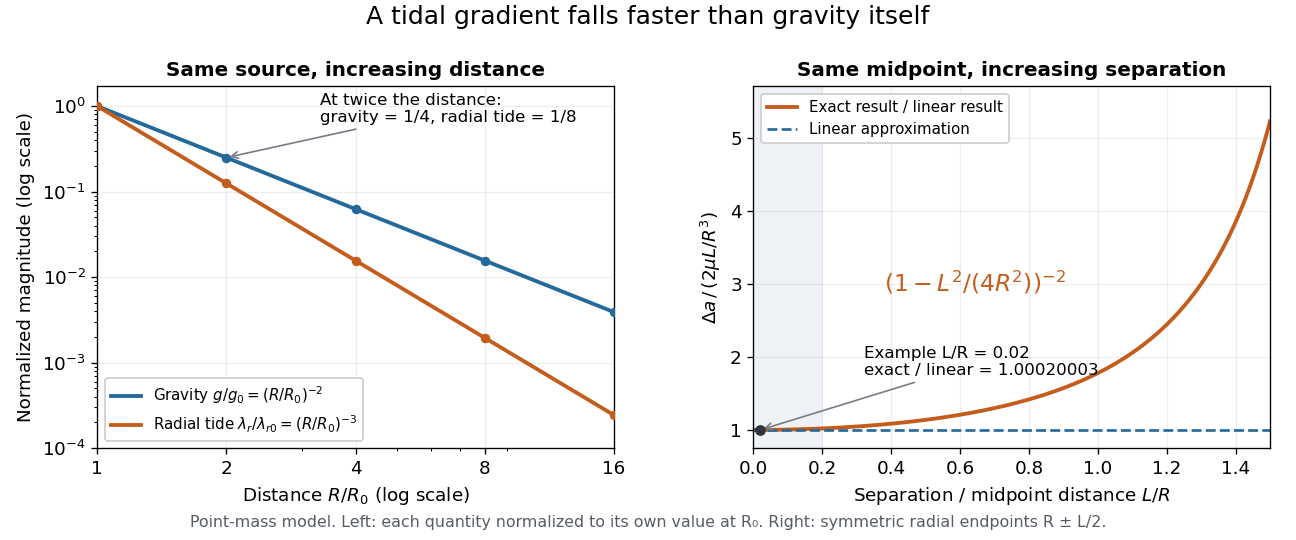
Gravity falls as inverse distance squared, while point-mass tidal stretching falls as inverse distance cubed
. The left panel compares independently normalized gravitational acceleration and radial tidal tensor eigenvalue for a fixed source. The right panel compares exact and linear relative accelerations for two radially separated test particles at a fixed midpoint, showing the finite-separation correction as their separation grows. Details.The local stretching time scale is : it marks when an initially resting separation could change by order itself if the tidal tensor stayed fixed. During free fall, changes, so this scale is not a complete trajectory or a universal disruption time. Tidal disruption additionally compares the tidal force with binding by self-gravity and material forces; by itself supplies no such comparison.
A Love number measures a body's tidal response to an applied potential. The degree-two potential response is sensitive to radial density structure and central concentration, and can complement mass and radius constraints on an exoplanet interior. Inferring it from orbital precession requires separating other contributions and assumptions about rotation and the tidal response.
Articles by others on the same topic



Tidal force refers to the gravitational effect that one celestial body exerts on another due to the differential gravitational pull exerted on different parts of the object being influenced. This force arises from the fact that the gravitational attraction of a massive body, like the Moon or the Sun, varies with distance.