
Use the source's notation for the vanishing-at-zero ideal . It is the kernel of bounded evaluation at zero, hence closed. It is stable under pointwise multiplication and complex conjugation, so inherits the C-star identity and completeness. If it had an identity , multiplication against would give for , contradicting continuity and . Thus is a non-unital C-star subalgebra. This explicit meaning of the notation matters because the usual notation for a compact space has a different convention.
Define the unitization map by . Its inverse is . The specified multiplication and involution are preserved by direct substitution. The pullback norm is a C-star norm, so equals the unique unitization norm supplied in the question. Therefore is a unital isometric C-star isomorphism onto .
For the approximation put on , so is continuous and . The Stone-Weierstrass theorem supplies a polynomial with . Then is a polynomial in the positive even powers of , with zero constant term, andThis gives exactly the required finite form.
A C-star algebra is a complex Banach algebra with a conjugate-linear involution satisfying , and . It is unital when it has an identity for multiplication. For use composition and the Hilbert adjoint. Completeness in the operator norm is given; composition is submultiplicative and the adjoint has the required algebraic properties. For a unit vector ,Taking the supremum and using the opposite bound proves the C-star identity. Its identity is , proving is a unital C-star algebra.
Compact operators form a norm-closed linear space and are stable under composition with bounded operators. They are also adjoint stable. To see this directly, choose a finite -net of the compact image of the unit ball under , and let project orthogonally onto the span of its centers. Then . The finite-rank operator approximates with the same error, so is compact by norm closure. Thus is a C-star algebra, with the inherited norm and operations.
If it has a multiplicative identity , apply to every rank-one operator with arbitrary prescribed range vector . Evaluating that equation on a vector sent to gives . Hence . This identity is compact exactly when is finite dimensional: finite dimension gives compactness of the unit ball, while in infinite dimension an infinite orthonormal sequence has pairwise distance and no convergent subsequence. Therefore is unital exactly in finite dimension, with the zero-algebra convention understood if .
A linear operator has closed graph when is closed in . The closed graph theorem states that an everywhere-defined linear operator between Banach spaces is bounded if and only if it has closed graph. Boundedness gives the closed-graph property by continuity. Conversely a closed graph is Banach in the product norm . Projection of the graph onto is a bounded linear bijection, so the open mapping theorem makes its inverse bounded. Composing that inverse with the second-coordinate projection proves is bounded.
For the composition assertion, suppose and . Boundedness of gives , and boundedness of gives . Injectivity of forces . Hence has closed graph and is bounded by the theorem.
For the derivative bound take with norm , and with its supremum norm; both are Banach. Regard as a map into , and let be inclusion. This inclusion is bounded and injective, and is bounded by hypothesis. The preceding result gives a constant with . In particular uniformly in .
Regard the spaces as real and set . Its real norm equals , since rotating any test vector makes its functional value real and nonnegative without changing its norm. By the allowed real Hahn-Banach theorem extend to a real-linear with that norm, and define . Real linearity gives , so is complex linear. On this formula recovers . Also ; rotating a test vector again gives . The reverse norm inequality follows by restriction to , proving a norm-preserving complex extension.
We use two standard consequences: a point outside a closed subspace can be separated by a bounded functional annihilating that subspace, and the norm of a vector is the supremum of its pairings with dual unit-ball functionals. If annihilates , the scalar holomorphic function vanishes at the prescribed sequence tending to zero. Its identity theorem makes it identically zero. Separation then gives for every .
For extend to with the same norm and put . Then is holomorphic with . For the understood nonzero increments , the Cauchy integral formula on givesTaking absolute values, bounding the contour length by , and each denominator below by , , proves exactly the stated estimate.
Fix and restrict . Taking the supremum over bounds the norm of the difference of the two -valued difference quotients by a fixed constant times . They are therefore Cauchy as . Since is a closed subspace of a Banach space, it is complete. Consequently the derivative exists as a norm limit in . The labelled (a)-(c) are the simultaneous hypotheses, not separate claims to prove.
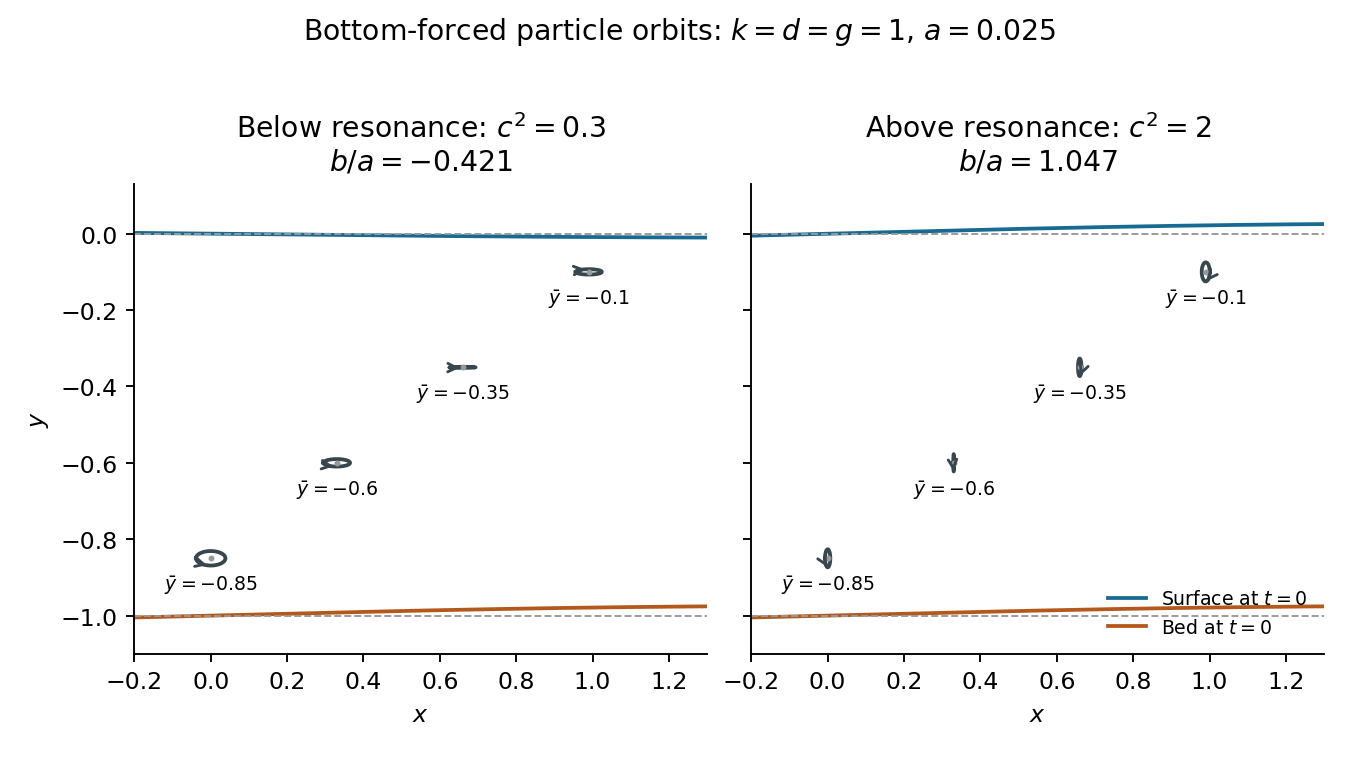
Consider the nonresonant traveling forced solution, with and . Put , , where is the mean position of a fluid element. At linear order, evaluate the velocity field at this mean position: substituting into its spatial arguments would change the already first-order velocity only at second order. With , differentiation of the velocity potential givesSince , integration, with zero mean displacements, yieldsIf both coefficients are nonzero, eliminating the wave phase proves that the pathline is an ellipse:Its principal axes of an ellipse are horizontal and vertical, with respective semi-axesThus the full axis lengths are and . The signed coefficients also determine the direction of traversal. The useful checks and reproduce the vertical displacements of the free surface and bottom.
To identify the major axis without comparing the two expressions separately, use :Consequently the major axis is horizontal if and vertical if ; equality gives circles. If or vanishes at a particular depth, the first-order orbit degenerates to a line segment. These are linearized particle orbits of a bottom-forced gravity wave, not exact closed trajectories at all orders: a higher-order calculation may introduce a mean drift.

There are unlisted articles, also show them or only show them.