
The method of images places an equal line source at , outside the physical upper half-plane. A convenient complex potential of a two-dimensional potential flow isThe two logarithms can be combined locally as ; their branches of the complex logarithm affect only the potential convention, not the single-valued complex velocity. The point source in this two-dimensional problem has the line source normalization: its outward volume flux is per unit span.
Writing , , and using , the velocity field isOn the wall , the vertical components cancel:This is the required no-penetration boundary condition. Tangential slip is permitted. At large distance the velocity decays as , and near its singular part is exactly that of the specified source; the reflected source is regular throughout the fluid. Away from the injection point, this is an incompressible flow and an irrotational flow.
Use the complex velocity . For this steady, constant-mass density, irrotational flow with no body force, the applicable Bernoulli equation iswith a single constant throughout the connected regular fluid region. The body's impermeability makes the velocity tangent to . Thus is real there, givingThe complex force from part (a) iswhere the constant- term vanishes. This proves the Blasius force theorem:For the moment, observe thatTherefore . The constant pressure contribution has zero real part, because . Substituting Bernoulli's principle and the same tangency identity gives the Blasius moment theorem:The real-part operation is essential: itself need not vanish, but its real part does.
Orient counterclockwise around the body. For an arc element , the body-outward unit normal vector obeys . The pressure acts normally into the body, so its force per unit length in the suppressed third direction isIntegrating givesTaking positive torque to mean counterclockwise about the origin, the infinitesimal moment is . HenceAll three expressions are per unit span. They are the normal-pressure contributions assumed by the inviscid model; a viscous traction would require extra terms. A constant pressure contributes zero net force and torque on a closed body, since .
The incident uniform flow has spherical components , . Integrating the Stokes streamfunction formulas, with the additive constant chosen to vanish on the axis, givesIt is regular at the origin. Applying the sphere theorem for a Stokes streamfunction yieldsThe resulting velocity components areTo find the velocity potential, integrate and verify . This givesThe first term is the incident uniform flow, and the second is a potential dipole located inside the excluded sphere. At , the radial velocity vanishes, while the far-field velocity tends to . The poles are stagnation points; the surface tangential speed reaches at the equator. These formulas describe uniform potential flow around a fixed sphere.
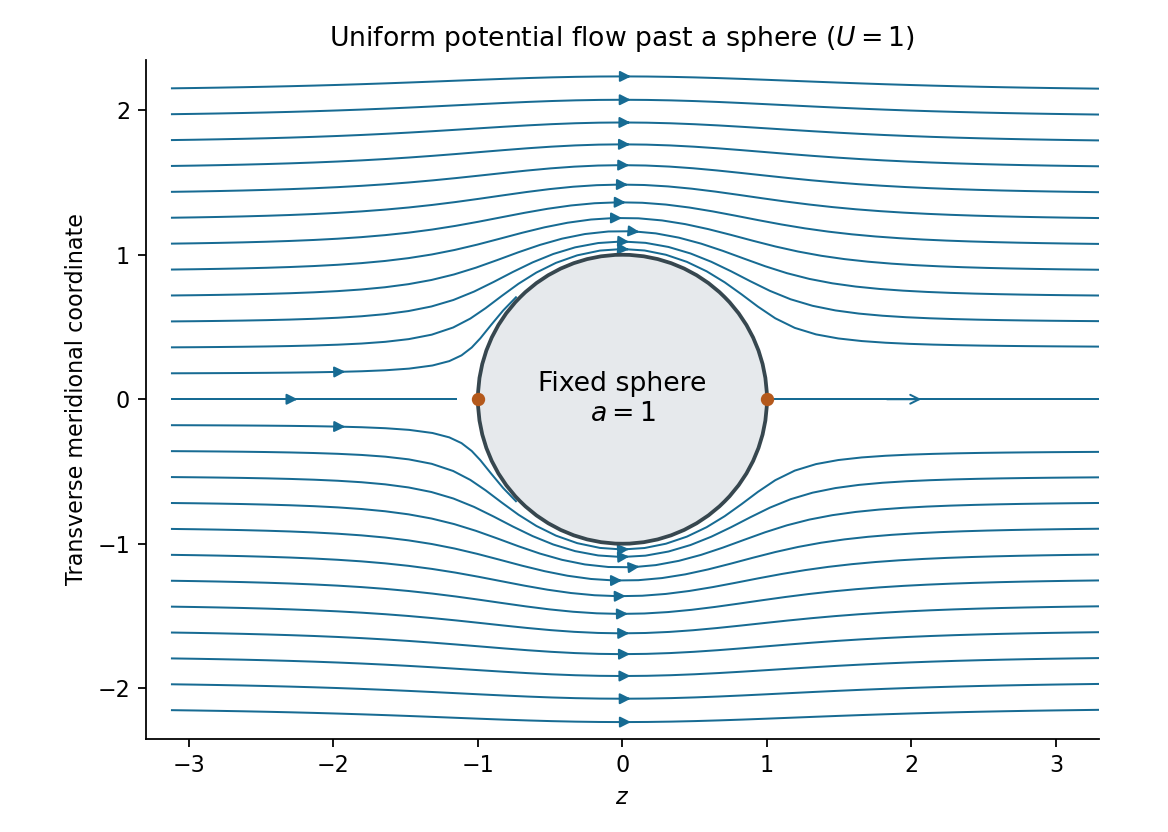
Put and define the image term . The key step is to verify that inversion preserves the Stokes streamfunction equation for irrotational flow. Direct differentiation giveswhere the quantities on the right are evaluated at . HenceBy linearity, obeys the same equation and describes an incompressible flow and an irrotational flow wherever the original exterior flow is regular.
On the sphere, and the two terms cancel identically:Thus the sphere is a stream surface and satisfies the no-penetration boundary condition. Tangential slip is allowed in this potential flow model. For every finite , the image argument satisfies , where has no singularities. The prefactor is regular there. Therefore the construction creates no new finite exterior singularities; any original exterior singularities remain those of the prescribed incident flow. This is the sphere theorem for a Stokes streamfunction.
For the far-field claim, the stated bound givesOne must compare velocities, rather than require the correction to the Stokes streamfunction to tend to zero. Smoothness at the original origin, together with , gives and there. Thus and , and the correction hasThese estimates hold away from the coordinate poles, with the regular-axis limits supplied by the original smooth physical flow. ConsequentlyThe far-field velocity field is unchanged. For a fully smooth incident velocity field at the origin, the usual regular expansion is stronger and makes the sphere disturbance decay as .
Substitute the given Stokes streamfunction representation into the divergence in spherical coordinates. The mixed derivatives cancel:Thus incompressibility is automatic for a smooth Stokes streamfunction. Since this is an axisymmetric flow with no azimuthal velocity, the only possibly nonzero component of its vorticity isDefine the differential operator in the Stokes streamfunction equation for irrotational flowThe stated equation is , and thereforeThe irrotational flow has a velocity potential locally, and globally on a regular simply connected domain. Regularity of the physical velocity field supplies the limiting interpretation on the polar axis, where the coordinate expressions contain in the denominator.
Write the planar velocity field as , with . Expanding the curl givesConsequently, for a piecewise smooth path from the origin to ,The arbitrary additive constant may be set to zero. The integrand is exactly , so the fundamental theorem for line integrals proves path independence immediately: the difference between two paths is the line integral of a gradient around a closed curve, which is zero.
One can also see the local integrability condition from Green's theorem:because the given representation enforces incompressibility. This second proof applies whenever the region between the paths lies in the regular fluid domain. The question already assumes a globally defined streamfunction; without that assumption, incompressibility alone would guarantee a global streamfunction on a simply connected domain, but a hole carrying nonzero volume flux could obstruct it.
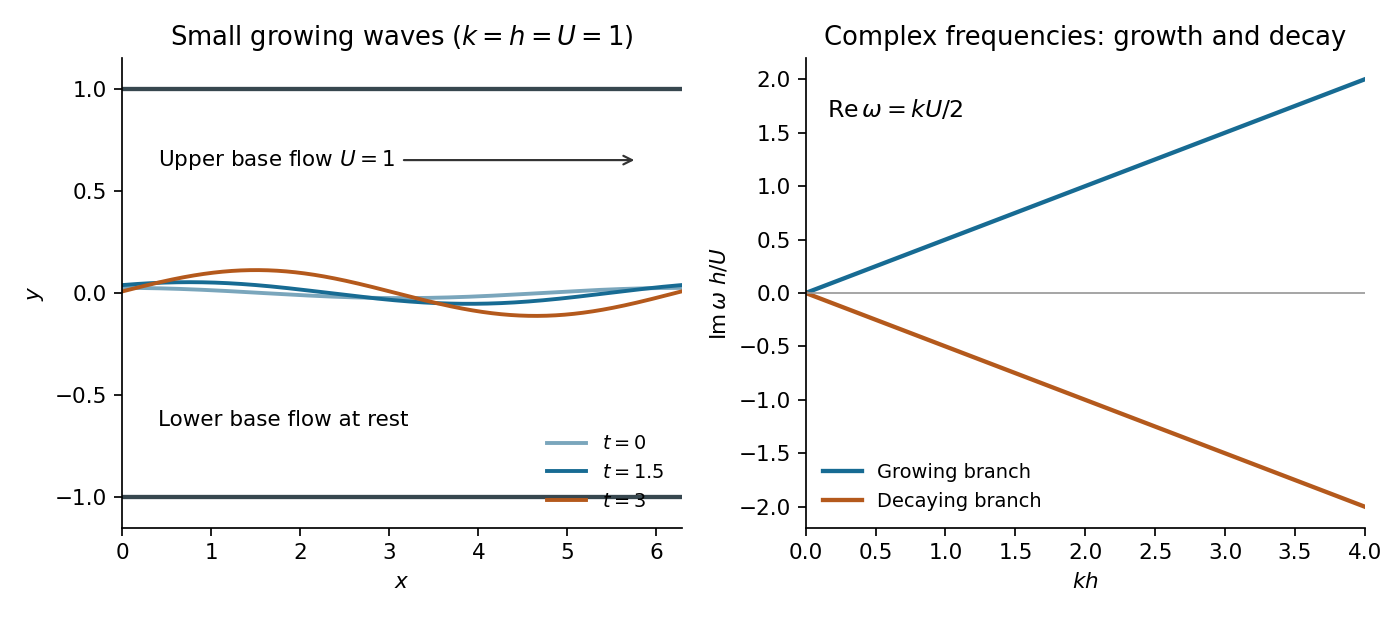
Use complex normal modes and take their real parts at the end. Write , with . The Laplace equation and the wall Neumann boundary conditions give the vertical formsAt , the two kinematic boundary conditions becomeThusThe dynamic condition isSubstituting the two amplitudes and cancelling the common nonzero depth factor gives the dispersion relation for a vortex sheet in a symmetric rigid channel:Equivalently,For the specified , the plus sign gives positive temporal growth rate in the convention . A real growing interface displacement is thereforeThe other branch decays at the same rate. Consequently the interface is linearly unstable, exhibiting Kelvin-Helmholtz instability. There is no nonzero-amplitude mode with a purely real temporal frequency for and ; the paper's sinusoidal notation must allow a complex frequency, with the physical displacement obtained by a real part.
The wave pattern is advected at speed , the mean of the two base velocities. The growth rate is independent of here because both layers have the same mass density and the same depth, making their factors cancel. In an asymmetric channel those inertia factors would differ. In the zero-shear limit , the two roots merge at zero and there is no exponential growth.


The interface is material. Applying the kinematic boundary condition to gives, exactly,The disturbance velocities and are small. Products of two disturbance quantities are second order, and a Taylor expansion moves their evaluation to at linear order. HenceThe extra upper-fluid term is advection of the displaced interface by the base uniform flow.
Use the Unsteady Bernoulli equation separately on each side, with constant mass density . There are no restoring terms specified at this internal interface, and its pressure is continuous. Choose the time-dependent potential gauges so that the undisturbed pressure is on both sides. Subtracting the base values from Bernoulli's principle gives, at linear order,The quadratic disturbance-velocity terms have been discarded, while the cross term with the base velocity is first order and must remain. Equating the perturbation pressures yields the third condition:
The total velocity fields on the two sides areEach base flow is divergence-free. Incompressibility therefore makes both disturbance velocity potentials satisfy the Laplace equation:At the fixed horizontal walls, impermeability requires zero vertical velocity:The discontinuity in tangential base velocity at the interface is a vortex sheet. The assumption of irrotational flow is understood separately in each open fluid region; it cannot hold distributionally across that sheet when .
The complex velocity vanishes where , provided its denominator is nonzero. Thus . Both lie on the unit circle, and since . Mapping these points into the physical plane givesEquivalently, the two stagnation points are the opposite points and on the ellipse. The conformal map preserves the zeros of the complex velocity here because its derivative is finite and nonzero on the boundary.
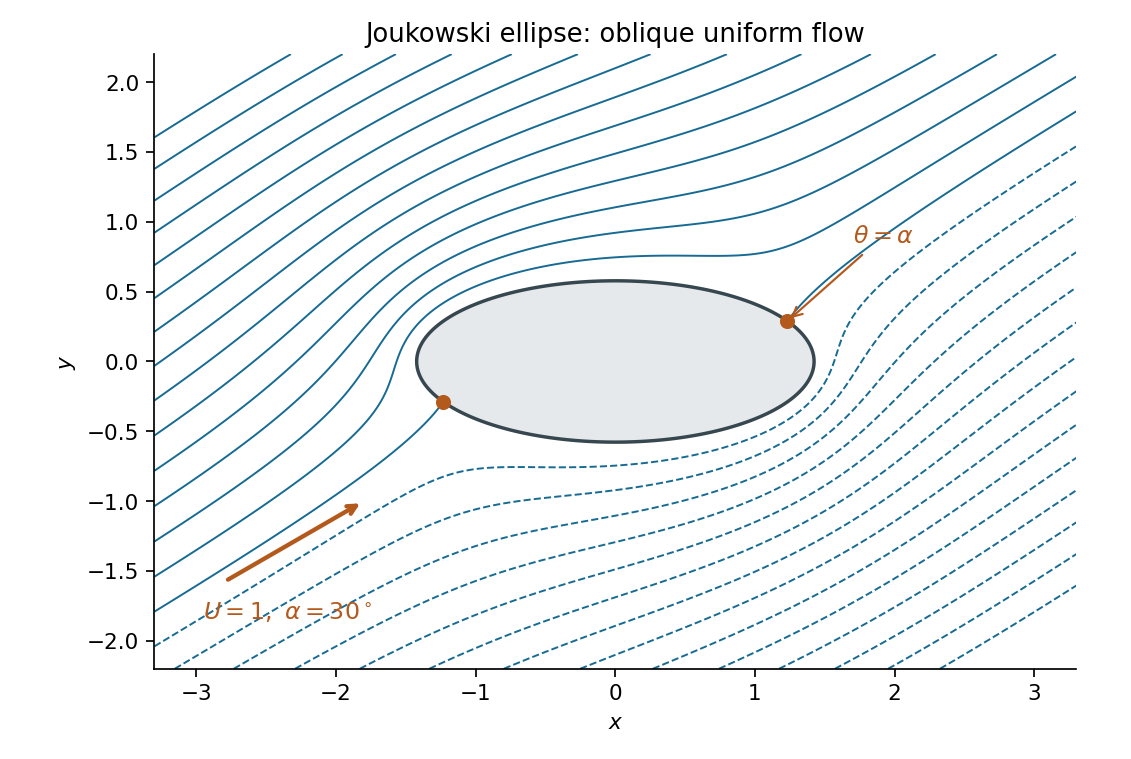

At large , , so the map tends to the identity. Its exterior inverse has the expansion . Therefore the physical complex potential of a two-dimensional potential flow is , withIts leading term is unchanged, so the far-field velocity still has magnitude and inclination .
The chain rule gives the complex velocity:The parameter denotes the unique exterior preimage of . If an expression solely in is desired, takewhere the exterior holomorphic square root is chosen so that at infinity. Its branch points lie inside the ellipse. This is uniform potential flow around an ellipse.
Parameterize the unit circle by . Under the Joukowski map,Consequently its image is the ellipsewith horizontal and vertical semi-axesBoth are positive because . The horizontal axis is the major axis. The derivative is nonzero for . Also, equality of two images implies ; two distinct exterior points cannot satisfy the second factor since . Thus the exterior map is one-to-one, mapping the exterior of the unit circle conformally onto the exterior of the ellipse.
A uniform flow with physical velocity has complex velocity and incident potential . Apply the Milne-Thomson circle theorem with :Indeed, on it is , which is real, so the boundary is a streamline. At infinity, , verifying the specified incoming uniform flow.
The Milne-Thomson circle theorem constructs a circular impermeable boundary in planar potential flow. Suppose is an incident complex potential of a two-dimensional potential flow with no singularities on or inside . Thenis a complex potential of a two-dimensional potential flow outside the circle, with the same exterior singularities and their strengths as the incident flow; the added image singularities lie inside the excluded disk. On , , so is real. Its imaginary part, the streamfunction, is constant on the circle, proving the no-penetration boundary condition. The theorem gives the usual zero-circulation construction; a separately prescribed circulation can be added by its logarithmic vortex potential.
On the translating circular cylinder , the preceding velocity potential and streamfunction giveUsing the boundary integral for kinetic energy of planar potential flow,ThereforeAs a direct check, , and integration over gives the same result.
The fluid kinetic energy has the same dependence on body speed as the kinetic energy of an extra mass carried by the body. Thus is its added mass, here equal to the mass of displaced fluid per unit cylinder length. For a cylinder of physical mass per length , the combined kinetic energy is . Accelerating the body requires accelerating the surrounding fluid, producing the inertial reaction along the direction of motion. This is the added mass of a circular cylinder.
The product rule, the Laplace equation and giveFirst truncate the exterior fluid domain by a large circle . Let point outward from the body into the fluid. The outward normal of the exterior fluid domain at the body is . The planar divergence theorem, equivalently Green's theorem, therefore givesOrient counterclockwise around the body. Then andFor the finite-energy exterior rigid-body flow intended here, the outer boundary term vanishes as . In particular, zero net volume flux and zero circulation eliminate the term in the exterior Laurent series of the complex velocity. Thus and, after choosing the additive potential constant, . The outer integral is then .
Multiplying by half the constant mass density gives the boundary integral for kinetic energy of planar potential flow:The minus sign comes from the fluid's inner-boundary orientation, rather than a negative physical kinetic energy.
There is a necessary qualification to the printed hypotheses. Decaying velocity and zero circulation alone do not ensure a finite kinetic energy: gives , zero circulation, and logarithmically divergent exterior kinetic energy. It carries a nonzero volume flux from the body and is not the flow of an impermeable rigid body. The finite-energy condition for planar exterior potential flow makes explicit the source-free assumption needed to discard the outer boundary term.
Use instantaneous polar coordinates centered on the moving circular cylinder, but measure the fluid velocity in the laboratory frame. Impermeability equates the normal components of body and fluid velocity:Since and , the no-penetration boundary condition isThe velocity potential obeys the exterior Laplace equation, by incompressibility. The boundary data have only the first cosine harmonic. A decaying harmonic potential of this form is . Matching its radial derivative gives , so . The zero circulation condition rules out an angular potential term, and the integrated boundary condition gives zero net volume flux, ruling out a radial logarithmic source term. The remaining decaying harmonics have zero coefficients by the boundary data. HenceUsing the streamfunction in polar coordinates, , , givesOne may also obtain both functions as the real and imaginary parts of , a two-dimensional potential doublet. The velocity decays as and the source of this singular representation lies inside the excluded body. These are the fields used to calculate the added mass of a circular cylinder.
Choose the planar streamfunction convention , . For an irrotational flow, a velocity potential gives . ThusThe streamfunction enforces incompressibility, since . Conversely, incompressibility permits a local streamfunction, while zero curl permits a local velocity potential. These are the Cauchy-Riemann equations for the complex potential of a two-dimensional potential flow .
The gradients of the two functions satisfyEach gradient is normal to its regular level curves. Therefore regular curves of constant velocity potential and constant streamfunction meet orthogonally. At a stagnation point, both gradients vanish and this tangent-direction argument needs a limiting interpretation. The conclusion concerns regular portions of the two families of curves.
Let both solve the variational inequality. Test the inequality for with and the one for with , then add. Writing givessince cosine is Lipschitz with constant one. Since , the fundamental theorem of calculus and Cauchy-Schwarz inequality give ; integrating gives . ThereforeFor , the coefficient is positive, so and the zero boundary value gives . This proves uniqueness with an explicit sufficient smallness condition. More generally any Poincaré inequality constant gives the condition ; optimizing that constant is unnecessary for the requested conclusion. The underlying principle is uniqueness for a strongly monotone variational inequality.
There are unlisted articles, also show them or only show them.