
Past exam of the building infinite groups course of the University of Oxford 2011 3 c Solution 2026-10-31
Let be the subgroup of generated by all its elements of order . The top group is generated by 3-cycles, also when , so .
Take . For any , the conjugate has order , as does . Thus their product belongs to and equalsUsing instead supplies . Since distinct coordinate groups commute,The hypothesis that is perfect says that products of its commutators generate , so . Transitivity of now gives for every coordinate. Hence and , provingThe proof does not require itself to be finitely generated, nor does it require to be perfect for .
Past exam of the building infinite groups course of the University of Oxford 2011 3 b Solution 2026-10-31
Put and let be the rooted tree of finite words over . View as a rooted automorphism: it permutes the first letter by and fixes the suffix. Denote this rooted copy by again.
For , define a directed tree automorphism by putting local permutation at every vertexand identity local permutation at every other vertex. These marked vertices are pairwise incomparable, so the prescribed actions are on disjoint rooted subtrees and define a unique automorphism. Equivalently its root permutation is trivial and its sections areThe map is an injective homomorphism: it is the same copy of acting on each of those disjoint subtrees. Let and defineBoth and are finite, so is finitely generated. For , is a nonabelian simple group and hence perfect. Thus , and because they generate , is perfect.
Every section of either defining generator belongs to , so sections of every element of belong to . Its root permutation belongs to . For a tree automorphism , write , where is its section at input letter . In the semidirect-product convention of part (a), defineComposition of tree automorphisms gives exactly the wreath-product multiplication: this is why is a homomorphism. It is injective because an automorphism is determined by its first-level permutation and all its first-level sections. On the generators,It remains to prove surjectivity; merely writing these recursions would not establish it. Choose , which fixes and sends to . For , the two base tuples and overlap only in their first coordinate. Their commutator is thereforeSince is perfect, products of these commutators give every element of the copy of localized in coordinate . Canceling this first coordinate from then gives , the rooted copy of localized in coordinate . Conjugating by the transitive rooted group supplies both localized and localized in every coordinate. Since , the image contains the full base . It also contains the top . Therefore it is the entire wreath product andFinally is infinite: it contains the nontrivial rooted , and a finite order would satisfy , which is impossible for .
Past exam of the building infinite groups course of the University of Oxford 2011 3 a Solution 2026-10-31
Let , with each a copy of . The permutation group acts on byDefine the permutation wreath product to be the semidirect productExplicitly,Writing for the element with entry in coordinate and identity elsewhere, and writing for , conjugation satisfiesThus the top permutation group permutes the coordinate subgroups in exactly its given action. Distinct coordinate subgroups commute, including when itself is nonabelian.
Past exam of the building infinite groups course of the University of Oxford 2011 2 c Solution 2026-10-31
First establish a stronger form of the coset-counting argument. If is a finitely generated infinite-index subgroup of a finitely generated group of growth at most , choose a finite generating set for , and let bound its lengths in a generating set of . The Schreier graph supplies distinct left-coset representatives of of -length at most . The corresponding translates of are disjoint and lie in . HenceThus an infinite-index finitely generated subgroup has growth at most whenever the ambient upper bound is .
Every finitely generated has infinite index in . Applying this result with gives growth at most . Minimality of among the supposed counterexamples therefore makes each such virtually nilpotent. Here , since a group with a uniform bound on its finite word balls is finite, and finite groups are virtually nilpotent.
For each finitely generated , let be the least nonnegative integer giving a polynomial growth upper bound. It exists and belongs to . Choose for which this integer is maximal. If and is finitely generated, then . Were infinite, the strengthened bound would make have growth at most , contradicting the definition of . If , the same inequality would force the nonempty balls of to have cardinality tending to zero, also impossible. Hence every such overgroup has .
Since is virtually nilpotent, choose a nilpotent finite-index subgroup . It is finitely generated by Schreier's lemma. For any , the subgroup is finitely generated and . Pigeonholing the cosets gives a positive with . Pigeonholing the cosets of in then gives a positive with . ConsequentlyNo normality of in or of in is required. Using least integer upper bounds also avoids needing any further structural theorem about the exact growth degree of a virtually nilpotent group.
Past exam of the building infinite groups course of the University of Oxford 2011 2 b Solution 2026-10-31
Choose finite symmetric generating sets for all , and let bound the -length of their elements. If , the connected locally finite Schreier graph of left cosets of in is infinite. Its radius- ball has at least vertices: otherwise a finite-diameter locally finite connected graph would be finite. Equivalently, we can choose distinct left-coset representatives of , each of -length at most , and hence -length at most .
Past exam of the building infinite groups course of the University of Oxford 2011 2 a Solution 2026-10-31
Let be the least length of a word in representing , and write . Polynomial growth of a group of degree at most means that, for some constant , In particular these balls are finite. For the usual convention is finite; finiteness of would force that in any case.
Past exam of the building infinite groups course of the University of Oxford 2011 1 c Solution 2026-10-31
All commutators of with lie in the central subgroup of . In the standard commutator identities, conjugation by elements of or therefore acts trivially on these commutators. Since is abelian, their order can also be reversed. ConsequentlyThus the map is a homomorphism in each variable separately; this does not assert that it is a homomorphism from the direct product jointly.
It factors through in the first variable and in the second. If these finite quotient groups have representatives and , then the finite collection generates . Let be an exponent of . For every ,Hence is a finitely generated abelian group of bounded exponent, and is finite. For instance its order is at most .
Now suppose is nilpotent and is finite. Induct on the nilpotency class . For , is its own abelianization and is finite. If , the group has smaller class andsince . By induction is finite. Apply the preceding result with and . Their commutator subgroup is . Both relevant centralizer quotients are finite, because their centralizers contain and is finite. Thus is finite. The extension of this finite normal subgroup by the finite quotient is finite. The converse follows because a quotient of a finite group is finite. Therefore
Past exam of the building infinite groups course of the University of Oxford 2011 1 b Solution 2026-10-31
Suppose inductively that . In the quotient , the image of is central. Hence this quotient is generated by the image of together with a central subgroup, so its commutator subgroup lies in the image of . Pulling this back givesThe original assumption now gives . Starting with , induction proves for every . These products are subgroups because each is normal; no normality of is needed.
If is finitely generated, every quotient, including its abelianization , is finitely generated. Conversely, lift a finite generating set of that quotient to , and set . Then . For a nilpotent group, for some , and the established identity gives . Thus
Past exam of the building infinite groups course of the University of Oxford 2011 1 a Solution 2026-10-31
Use the commutator convention , and let denote the subgroup generated by all such commutators with . The lower central series isA central series has for each . We prove the requested inclusion by induction. At , . If and , thenThereforeIn particular . The proof uses the central-series condition directly; no equality of the intermediate terms is claimed.
A bounded holomorphic function of planar Brownian motion is a local martingale up to exit, because its real and imaginary parts are harmonic and Itô's formula has zero drift. Stop before the given . Localization inside compact subdisks gives the local martingale , and makes it bounded. The bounded local martingale criterion therefore gives a true martingale.
Exit from the unit disk is finite almost surely, so is finite too. Taking and using the dominated convergence theorem yieldsThe same proof works for any bounded holomorphic function, after rescaling if needed; it does not require the stopping time itself to be bounded.
The disk automorphism satisfies and maps the unit circle bijectively to itself. Its derivative is bounded above and away from zero on the closed disk. By conformal invariance of planar Brownian motion, the image path up to the exit time is a time-changed planar Brownian motion started at zero. Its exit point is ; the clock changes when it exits, but not where.
The original exit time is finite almost surely. For example, is a martingale, so . Boundedness of makes the image exit clock finite too. By rotational invariance of planar Brownian motion, the image exit angle is uniform on .
Let . Parts (a) and (b) show that modulo is uniform, where is strictly increasing and increases by exactly in one circuit. The one-dimensional change-of-variables formula therefore givesIts integral is one because the total angle change is . This harmonic measure density is the Poisson kernel for the unit disk divided by . It is uniform for and concentrates near the boundary point closest to as increases.
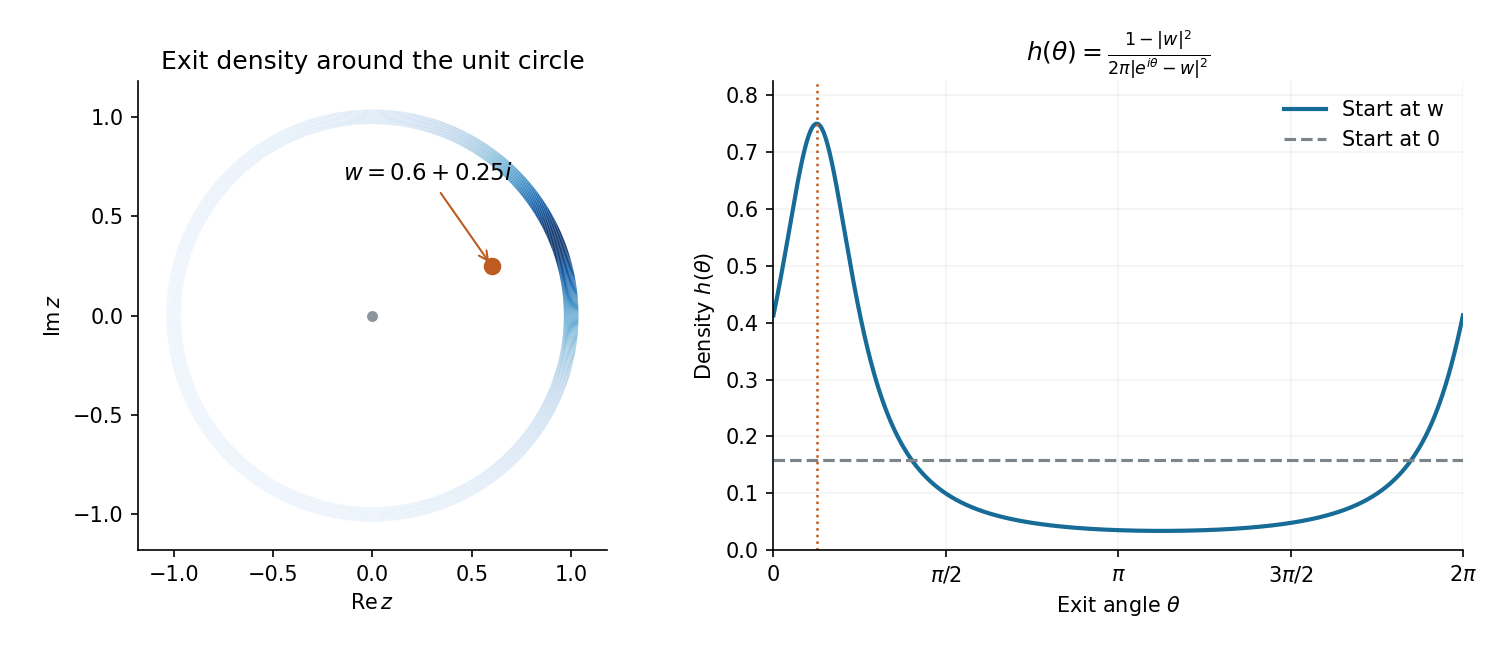

Differentiate the argument through the nonvanishing curve, using . Since ,Also . Subtracting one therefore givesThus the lifted boundary angle is strictly increasing. Its total change around the circle is , because the disk automorphism has boundary degree one. The same total change follows directly from the winding number one of . This is the boundary-angle derivative of a disk automorphism.
Let . It is never zero, since . On the unit circle,Dividing these identities givesAny other continuous lift of the argument differs by an integer multiple of , which leaves the exponential unchanged.
There are unlisted articles, also show them or only show them.