
Past exam of the mathematics course of the University of Cambridge 2015 ii Paper 2 7D b Created 2026-09-24 Updated 2026-09-24
Past exam of the mathematics course of the University of Cambridge 2015 ii Paper 2 7D a Created 2026-09-24 Updated 2026-09-24
Past exam of the mathematics course of the University of Cambridge 2015 ii Paper 2 6B Solution Created 2026-09-24 Updated 2026-10-06
Analytic continuation extends a holomorphic function by holomorphic elements agreeing on overlaps; along a path, a chain of overlapping neighbourhoods transports the initial element. The identity theorem makes compatible continuation unique on connected overlaps, although different paths can lead to different branches.
Choose the principal complex logarithm and the slit domain . On , the functionis holomorphic, with the removable value . The domain is simply connected, so has a primitive and its integral from to is independent of the path in . For , the uniformly convergent power series on compact subdiscs givesTherefore is a single-valued analytic continuation of the dilogarithm to . The apparent problem at is removable; is a genuine branch point, even though the function has a finite one-sided limit there, because its derivative has a logarithmic singularity. Other cuts from to infinity give corresponding branches.
Past exam of the mathematics course of the University of Cambridge 2015 ii Paper 2 5E Solution Created 2026-09-24 Updated 2026-10-06
At a positive spatially homogeneous equilibrium point, and . Hence . The reaction Jacobian matrix there isThe two-dimensional Routh-Hurwitz stability criterion gives strict linear asymptotic stability for , and instability for .
For a spatial mode with , the reaction-diffusion linearization is . When , its trace is negative for every , whileA growing mode exists precisely when this quadratic is negative at some . Its minimum must occur at positive , and must be strictly negative, givingWith , the latter inequality becomes . Selecting the root compatible with yields the Turing instability thresholdThe unstable band isOn a bounded domain a boundary condition must permit a mode in this band. Equality at the threshold gives a neutral mode, not positive growth.
At , the homogeneous linearization has purely imaginary eigenvalues, so it is not strictly linearly asymptotically stable. If “stable” is read as nonlinear stability, the boundary deserves attention. Put , , and , . The exact equations give , , where ,Expanding through cubic order, cancels the quadratic displacement. The correction from the quadratic change in also integrates to zero, because it is proportional to . Since , the Poincaré return map isThis cubic return-map stability of a weak focus shows that is a weak attracting focus. The strict linear range used in the Turing instability calculation is ; the positive homogeneous equilibrium is also nonlinearly asymptotically stable at the boundary . For that boundary, for every nonzero spatial mode. The same strict Turing instability threshold and unstable band therefore also apply there, with the homogeneous mode understood through nonlinear stability.
Past exam of the mathematics course of the University of Cambridge 2015 ii Paper 2 4J Solution Created 2026-09-24 Updated 2026-10-06
Writing for the observed counts, independence of the Poisson distributions gives the log-likelihoodIts score function and negative second derivative areUnless all vanish, , so the log-likelihood is strictly concave. Use Newton method, starting from a finite , withStop when the score function or the change in is small; a reduced step can ensure that the log-likelihood increases. Any finite zero of the score function is the unique maximum-likelihood estimator.
Existence needs a qualification. If the nonzero include both signs, decreases from to , so a finite root exists. If all nonzero are positive, a finite root exists exactly when ; otherwise the supremum is approached as . The corresponding condition for all negative is , with a supremum at otherwise. When all , the parameter is unidentifiable. These cases explain when the iterative algorithm actually has a finite estimate to find.
Past exam of the mathematics course of the University of Cambridge 2015 ii Paper 2 3G Solution Created 2026-09-24 Updated 2026-10-06
The Shannon entropy, in bits, isFor a prescribed alphabet distribution and code alphabet, an optimal code is a uniquely decodable code minimizing expected codeword length. Huffman coding produces an optimal binary prefix code, and its minimum is also the minimum among binary uniquely decodable codes.
Two optimal binary prefix codes, listing words in the order , areTheir length vectors are and , and both have expected length bits. To verify optimality rather than just equal length, run Huffman coding. First combine into a node of weight . Among the resulting three weight- nodes, combining and then combining the remaining weight- node with one weight- node gives the first length vector. Instead combine with the node, then combine that weight- node with , and finally with ; this gives the second. Each step combines two smallest current weights, so both constructions are Huffman coding trees. Ties therefore allow different optimal length profiles.
Past exam of the mathematics course of the University of Cambridge 2015 ii Paper 2 37E b Created 2026-09-24 Updated 2026-09-24
Past exam of the mathematics course of the University of Cambridge 2015 ii Paper 2 37E a Created 2026-09-24 Updated 2026-09-24
Past exam of the mathematics course of the University of Cambridge 2015 ii Paper 2 36B Solution Created 2026-09-24 Updated 2026-10-14
The linear elastic wave equation is . For a shear-horizontal wave, take with no dependence. Its divergence vanishes, andRigid fixed boundaries require at . The modes are with , , andThere is no displacement mode with these clamped boundary conditions. For , the phase velocity and group velocity areThe phase velocity decreases from infinity to , while the group velocity increases from zero to ; their product is .
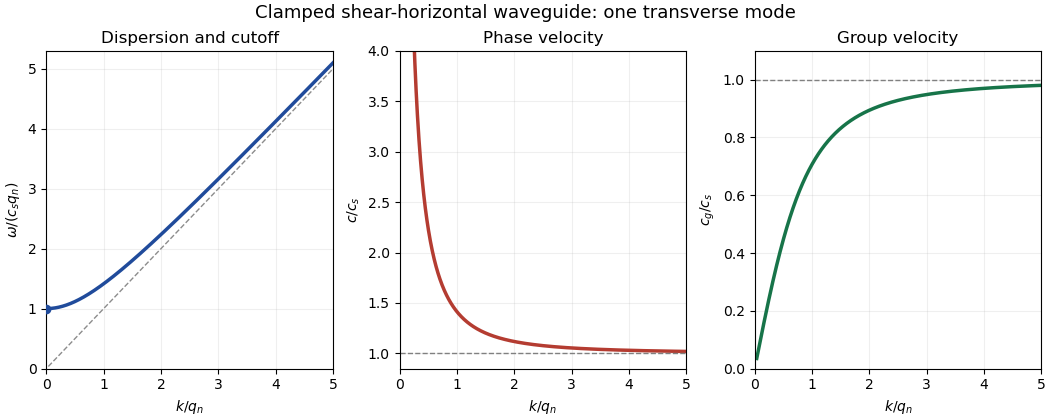

For a mode of frequency , the appropriate time and cross-sectional average is , per unit transverse width. Its average kinetic energy density is . The only nonzero strains are and , while . Thus the elastic energy density is , whose average is . The dispersion relation proves equality of average kinetic and elastic energies.
For the ray asymptotics of a clamped elastic waveguide mode, expand the localized initial displacement in transverse sine modes and Fourier transform in . For a displacement released from rest, each mode evolves with . At the oscillatory phases are . If , one phase has a stationary point withThe stationary phase method gives a generic oscillatory amplitude proportional to for each contributing mode. If the initial Fourier coefficient vanishes at the stationary point, that mode can decay faster; smooth localized data make the modal sum well behaved. If , there is no stationary point. Repeated integration by parts gives rapid decay for smooth rapidly decaying data; for initially compactly supported displacement, finite propagation speed makes the displacement on that ray exactly zero after a sufficiently long time. These are the requested subsonic and super-shear-speed regimes.
Past exam of the mathematics course of the University of Cambridge 2015 ii Paper 2 35E iv Created 2026-09-24 Updated 2026-09-24
Past exam of the mathematics course of the University of Cambridge 2015 ii Paper 2 35E iii Created 2026-09-24 Updated 2026-09-24
Past exam of the mathematics course of the University of Cambridge 2015 ii Paper 2 35E ii Created 2026-09-24 Updated 2026-09-24
Past exam of the mathematics course of the University of Cambridge 2015 ii Paper 2 35E i Created 2026-09-24 Updated 2026-09-24
Past exam of the mathematics course of the University of Cambridge 2015 ii Paper 2 34D c Created 2026-09-24 Updated 2026-09-24
Past exam of the mathematics course of the University of Cambridge 2015 ii Paper 2 34D b Created 2026-09-24 Updated 2026-09-24
Past exam of the mathematics course of the University of Cambridge 2015 ii Paper 2 34D a Created 2026-09-24 Updated 2026-09-24
Past exam of the mathematics course of the University of Cambridge 2015 ii Paper 2 33C d Created 2026-09-24 Updated 2026-09-24
Past exam of the mathematics course of the University of Cambridge 2015 ii Paper 2 33C c Created 2026-09-24 Updated 2026-09-24
Past exam of the mathematics course of the University of Cambridge 2015 ii Paper 2 33C b Created 2026-09-24 Updated 2026-09-24
Past exam of the mathematics course of the University of Cambridge 2015 ii Paper 2 33C a Created 2026-09-24 Updated 2026-09-24
There are unlisted articles, also show them or only show them.