The log-likelihood is the natural logarithm of the likelihood function:For positive finite likelihood, the natural logarithm is a strictly increasing function, so the maximizing parameter values are unchanged. Set ℓ=−∞ where L=0; the same ordering then includes zero-likelihood boundaries whenever a positive finite maximum exists. For independent and identically distributed random variables, a product becomes a sum,This makes derivatives simpler and avoids forming products of tiny numbers in floating-point arithmetic. These equal-maximizer and additive formulas underlie the worked calculations in MIT 18.05, Reading 10b, section 3.1.
ℓ(θ;x)=logL(θ;x).
L(θ;x)=∏i=1nfθ(xi),ℓ(θ;x)=∑i=1nlogfθ(xi).
For the ordered sample of eight successes and two failures in likelihood function, on 0<p<1,The score equation ℓ′(p)=0 gives 8(1−p)=2p, hence p=8/10=0.8. The negative second derivative proves strict concavity, so this is the unique interior maximum. Both counts are positive, so L(0)=L(1)=0, while L(p)>0 inside: the same point is the unique global maximum on [0,1]. Counting only successes adds log45 to the log-likelihood, leaving both derivatives and the MLE unchanged. For all-success or all-failure samples, the boundary analysis in maximum-likelihood estimator applies instead of an interior score equation.
ℓ(p)=8logp+2log(1−p),ℓ′(p)=p8−1−p2,ℓ′′(p)=−p28−(1−p)22<0.
The two panels below compare k=2,5,8 successes out of ten Bernoulli trials. Their peaks are at p=k/10. The left panel uses relative height; the right panel uses the log-likelihood difference from each peak. These are the same comparison on two scales:A difference of −2 means relative height e−2, and a difference of −10 means e−10; the log-likelihood scale makes small relative heights easier to see. Neither vertical axis is a parameter probability density function. The zero likelihood endpoints have log-likelihood −∞ and are outside the finite vertical range in the right panel.
ℓ(p)−ℓ(p)=logL(p)L(p),L(p)L(p)=exp(ℓ(p)−ℓ(p)).
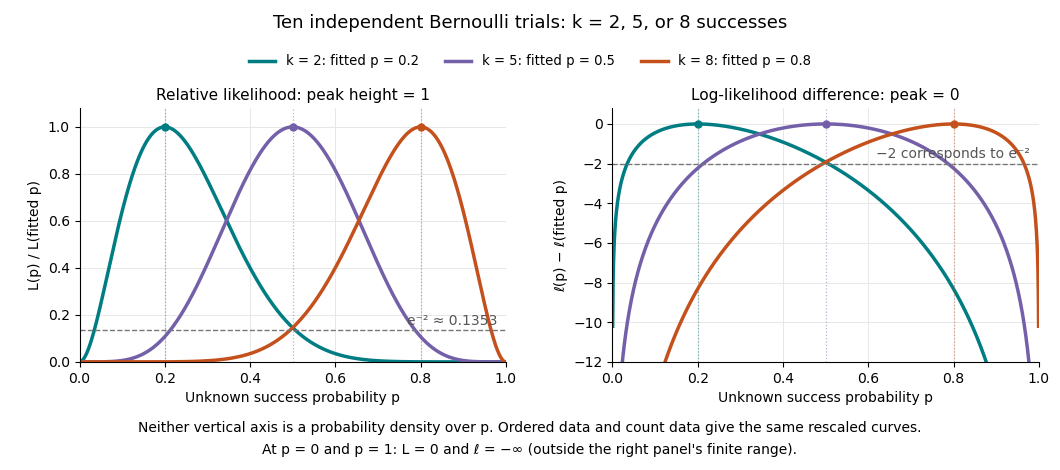
Ten Bernoulli trials: relative likelihood heights and log-likelihood differences share the same peaks
. Details. 
Multiplying a likelihood function by a positive parameter-independent constant adds a constant to its log-likelihood. Subtracting its peak removes that constant. This is why the ordered-data and count-data curves coincide in this figure after rescaling. When differentiable, the gradient of the log-likelihood is the score function; the negative Hessian matrix is the observed information. A solution of a score equation still needs checking against other stationary points and boundaries: maximizing the log-likelihood does not automatically make it concave.
Ancestors (9)
- Likelihood function
- Maximum-likelihood estimator
- Maximum likelihood estimation
- Statistical modelling
- Statistical model
- Probability and statistics
- Area of mathematics
- Mathematics
- Home
Incoming links (245)
- Bayesian deviance
- Bernoulli saturated log-likelihood
- Binomial likelihood-power annealing
- Bradley-Terry likelihood Hessian
- Bradley-Terry maximum-likelihood estimate on a comparison tree
- Bradley-Terry score equation
- Concavity of the Poisson regression likelihood
- Conditional cure-weight equations for paired Poisson counts
- Conditional multinomial sufficient statistics
- Constrained Kaplan–Meier estimator
- Cox–Snell likelihood pseudo-R-squared
- Edge log-ratios in a Bradley-Terry comparison tree
- EM algorithm for zero-inflated Poisson regression
- EM expectation step
- EM for a missing observation in a Gaussian AR1 process
- EM for merged multinomial cells
- EM for zero-inflated negative binomial regression
- EM likelihood monotonicity
- EM maximization step
- Expectation-maximization algorithm
- Exponential rate with a small known additive hazard
- Identical-mean EM trap
- Known-variance Gaussian mixture EM example
- Likelihood-power annealing
- Likelihood-ratio confidence interval
- Likelihood support reduction under censoring
- Log-likelihood
- Maximum likelihood estimation
- Maximum-likelihood estimator
- Observed Fisher information
- Ordered-rate exponential M-step
- Past exam of the chemistry course of the year 4 of the natural sciences course of the University of Cambridge / 2022 / Paper 1 / 15 / c / Solution
- Past exam of the mathematical and Computational Biology course of the University of Cambridge / 2024 / Paper 1 / A1 / c / Solution
- Past exam of the mathematical and Computational Biology course of the University of Cambridge / 2024 / Paper 1 / A1 / d / Solution
- Past exam of the mathematical and Computational Biology course of the University of Cambridge / 2024 / Paper 1 / A1 / h / Solution
- Past exam of the mathematical and Computational Biology course of the University of Cambridge / 2024 / Paper 2 / B4 / a / Solution
- Past exam of the mathematical and Computational Biology course of the University of Cambridge / 2025 / Paper 1 / 2 / b / Solution
- Past exam of the mathematical and Computational Biology course of the University of Cambridge / 2025 / Paper 1 / 2 / c / Solution
- Past exam of the mathematical and Computational Biology course of the University of Cambridge / 2025 / Paper 2 / 4 / b / Solution
- Past exam of the mathematics course of the University of Cambridge / 2001 / ib / Paper 1 / 3D / Solution
- Past exam of the mathematics course of the University of Cambridge / 2001 / ib / Paper 4 / 12D / Solution
- Past exam of the mathematics course of the University of Cambridge / 2001 / iii / Paper 28 / 5 / ii / Solution
- Past exam of the mathematics course of the University of Cambridge / 2001 / iii / Paper 29 / 6 / v / Solution
- Past exam of the mathematics course of the University of Cambridge / 2001 / iii / Paper 30 / 1 / i / Solution
- Past exam of the mathematics course of the University of Cambridge / 2001 / iii / Paper 32 / 6 / iii / Solution
- Past exam of the mathematics course of the University of Cambridge / 2001 / iii / Paper 32 / 6 / ii / Solution
- Past exam of the mathematics course of the University of Cambridge / 2002 / iii / Paper 36 / 2 / ii / Solution
- Past exam of the mathematics course of the University of Cambridge / 2002 / iii / Paper 36 / 2 / i / Solution
- Past exam of the mathematics course of the University of Cambridge / 2002 / iii / Paper 36 / 3 / i / Solution
- Past exam of the mathematics course of the University of Cambridge / 2002 / iii / Paper 36 / 5 / ii / Solution
- Past exam of the mathematics course of the University of Cambridge / 2002 / iii / Paper 36 / 5 / i / Solution
- Past exam of the mathematics course of the University of Cambridge / 2002 / iii / Paper 38 / 1 / Solution
- Past exam of the mathematics course of the University of Cambridge / 2002 / iii / Paper 38 / 2 / Solution
- Past exam of the mathematics course of the University of Cambridge / 2002 / iii / Paper 39 / 1 / i / Solution
- Past exam of the mathematics course of the University of Cambridge / 2002 / iii / Paper 40 / 4 / a / i / Solution
- Past exam of the mathematics course of the University of Cambridge / 2002 / iii / Paper 40 / 4 / b / iii / Solution
- Past exam of the mathematics course of the University of Cambridge / 2002 / iii / Paper 40 / 4 / b / i / Solution
- Past exam of the mathematics course of the University of Cambridge / 2003 / iii / Paper 38 / 3 / a / Solution
- Past exam of the mathematics course of the University of Cambridge / 2003 / iii / Paper 38 / 3 / b / Solution
- Past exam of the mathematics course of the University of Cambridge / 2003 / iii / Paper 38 / 4 / ii / Solution
- Past exam of the mathematics course of the University of Cambridge / 2003 / iii / Paper 38 / 4 / Solution
- Past exam of the mathematics course of the University of Cambridge / 2003 / iii / Paper 40 / 1 / b / iv / Solution
- Past exam of the mathematics course of the University of Cambridge / 2003 / iii / Paper 40 / 1 / b / v / Solution
- Past exam of the mathematics course of the University of Cambridge / 2003 / iii / Paper 41 / 1 / i / Solution
- Past exam of the mathematics course of the University of Cambridge / 2003 / iii / Paper 41 / 2 / Solution
- Past exam of the mathematics course of the University of Cambridge / 2003 / iii / Paper 41 / 3 / Solution
- Past exam of the mathematics course of the University of Cambridge / 2003 / iii / Paper 43 / 3 / c / Solution
- Past exam of the mathematics course of the University of Cambridge / 2003 / iii / Paper 43 / 4 / Solution
- Past exam of the mathematics course of the University of Cambridge / 2004 / iii / Paper 37 / 1 / i / Solution
- Past exam of the mathematics course of the University of Cambridge / 2004 / iii / Paper 37 / 2 / ii / Solution
- Past exam of the mathematics course of the University of Cambridge / 2004 / iii / Paper 40 / 6 / iii / Solution
- Past exam of the mathematics course of the University of Cambridge / 2004 / iii / Paper 40 / 6 / ii / Solution
- Past exam of the mathematics course of the University of Cambridge / 2004 / iii / Paper 40 / 6 / iv / Solution
- Past exam of the mathematics course of the University of Cambridge / 2004 / iii / Paper 42 / 5 / Solution
- Past exam of the mathematics course of the University of Cambridge / 2004 / iii / Paper 42 / 6 / Solution
- Past exam of the mathematics course of the University of Cambridge / 2004 / iii / Paper 43 / 2 / ii / Solution
- Past exam of the mathematics course of the University of Cambridge / 2004 / iii / Paper 43 / 2 / i / Solution
- Past exam of the mathematics course of the University of Cambridge / 2005 / iii / Paper 41 / 2 / Solution
- Past exam of the mathematics course of the University of Cambridge / 2005 / iii / Paper 41 / 4 / Solution
- Past exam of the mathematics course of the University of Cambridge / 2005 / iii / Paper 42 / 1 / Solution
- Past exam of the mathematics course of the University of Cambridge / 2005 / iii / Paper 42 / 3 / Solution
- Past exam of the mathematics course of the University of Cambridge / 2005 / iii / Paper 42 / 6 / iv / Solution
- Past exam of the mathematics course of the University of Cambridge / 2005 / iii / Paper 44 / 1 / c / Solution
- Past exam of the mathematics course of the University of Cambridge / 2005 / iii / Paper 44 / 1 / d / Solution
- Past exam of the mathematics course of the University of Cambridge / 2005 / iii / Paper 44 / 3 / Solution
- Past exam of the mathematics course of the University of Cambridge / 2005 / iii / Paper 44 / 5 / b / Solution
- Past exam of the mathematics course of the University of Cambridge / 2005 / iii / Paper 47 / 6 / Solution
- Past exam of the mathematics course of the University of Cambridge / 2005 / iii / Paper 48 / 5 / c / Solution
- Past exam of the mathematics course of the University of Cambridge / 2005 / ii / Paper 1 / 5I / Solution
- Past exam of the mathematics course of the University of Cambridge / 2005 / ii / Paper 4 / 13I / ii / Solution
- Past exam of the mathematics course of the University of Cambridge / 2006 / iii / Paper 41 / 3 / Solution
- Past exam of the mathematics course of the University of Cambridge / 2006 / iii / Paper 41 / 4 / Solution
- Past exam of the mathematics course of the University of Cambridge / 2006 / iii / Paper 41 / 5 / b / Solution
- Past exam of the mathematics course of the University of Cambridge / 2006 / iii / Paper 41 / 5 / c / Solution
- Past exam of the mathematics course of the University of Cambridge / 2006 / iii / Paper 41 / 5 / Solution
- Past exam of the mathematics course of the University of Cambridge / 2006 / iii / Paper 44 / 2 / a / Solution
- Past exam of the mathematics course of the University of Cambridge / 2007 / ib / Paper 4 / 19C / ii / Solution
- Past exam of the mathematics course of the University of Cambridge / 2007 / ib / Paper 4 / 19C / i / Solution
- Past exam of the mathematics course of the University of Cambridge / 2007 / iii / Paper 43 / 2 / Solution
- Past exam of the mathematics course of the University of Cambridge / 2007 / iii / Paper 44 / 3 / Solution
- Past exam of the mathematics course of the University of Cambridge / 2007 / iii / Paper 44 / 4 / Solution
- Past exam of the mathematics course of the University of Cambridge / 2007 / iii / Paper 46 / 4 / Solution
- Past exam of the mathematics course of the University of Cambridge / 2007 / iii / Paper 73 / 1 / c / Solution
- Past exam of the mathematics course of the University of Cambridge / 2007 / ii / Paper 1 / 27I / Solution
- Past exam of the mathematics course of the University of Cambridge / 2007 / ii / Paper 3 / 5I / Solution
- Past exam of the mathematics course of the University of Cambridge / 2007 / ii / Paper 4 / 5I / Solution
- Past exam of the mathematics course of the University of Cambridge / 2008 / ib / Paper 4 / 19H / i / Solution
- Past exam of the mathematics course of the University of Cambridge / 2008 / iii / Paper 41 / 3 / Solution
- Past exam of the mathematics course of the University of Cambridge / 2008 / iii / Paper 46 / 3 / b / i / Solution
- Past exam of the mathematics course of the University of Cambridge / 2008 / iii / Paper 46 / 3 / b / Solution
- Past exam of the mathematics course of the University of Cambridge / 2008 / iii / Paper 47 / 5 / a / ii / Solution
- Past exam of the mathematics course of the University of Cambridge / 2008 / iii / Paper 47 / 6 / a / Solution
- Past exam of the mathematics course of the University of Cambridge / 2008 / iii / Paper 47 / 6 / b / iii / Solution
- Past exam of the mathematics course of the University of Cambridge / 2008 / iii / Paper 47 / 6 / b / ii / Solution
- Past exam of the mathematics course of the University of Cambridge / 2008 / iii / Paper 47 / 6 / b / i / Solution
- Past exam of the mathematics course of the University of Cambridge / 2008 / ii / Paper 1 / 5J / Solution
- Past exam of the mathematics course of the University of Cambridge / 2009 / ib / Paper 1 / 7H / Solution
- Past exam of the mathematics course of the University of Cambridge / 2009 / iii / Paper 34 / 1 / b / Solution
- Past exam of the mathematics course of the University of Cambridge / 2009 / iii / Paper 40 / 6 / a / Solution
- Past exam of the mathematics course of the University of Cambridge / 2009 / iii / Paper 40 / 6 / c / Solution
- Past exam of the mathematics course of the University of Cambridge / 2009 / iii / Paper 40 / 6 / d / Solution
- Past exam of the mathematics course of the University of Cambridge / 2009 / ii / Paper 1 / 13I / Solution
- Past exam of the mathematics course of the University of Cambridge / 2009 / ii / Paper 1 / 5I / Solution
- Past exam of the mathematics course of the University of Cambridge / 2010 / iii / Paper 32 / 1 / Solution
- Past exam of the mathematics course of the University of Cambridge / 2010 / iii / Paper 32 / 2 / 2 / Solution
- Past exam of the mathematics course of the University of Cambridge / 2010 / iii / Paper 32 / 2 / Solution
- Past exam of the mathematics course of the University of Cambridge / 2010 / iii / Paper 33 / 2 / Solution
- Past exam of the mathematics course of the University of Cambridge / 2010 / iii / Paper 34 / 3 / b / Solution
- Past exam of the mathematics course of the University of Cambridge / 2010 / iii / Paper 34 / 5 / Solution
- Past exam of the mathematics course of the University of Cambridge / 2010 / iii / Paper 36 / 2 / a / Solution
- Past exam of the mathematics course of the University of Cambridge / 2010 / iii / Paper 36 / 3 / b / Solution
- Past exam of the mathematics course of the University of Cambridge / 2010 / iii / Paper 37 / 1 / Solution
- Past exam of the mathematics course of the University of Cambridge / 2010 / iii / Paper 37 / 3 / b / Solution
- Past exam of the mathematics course of the University of Cambridge / 2010 / iii / Paper 37 / 5 / c / Solution
- Past exam of the mathematics course of the University of Cambridge / 2010 / ii / Paper 1 / 13J / Solution
- Past exam of the mathematics course of the University of Cambridge / 2010 / ii / Paper 1 / 5J / Solution
- Past exam of the mathematics course of the University of Cambridge / 2010 / ii / Paper 2 / 5J / Solution
- Past exam of the mathematics course of the University of Cambridge / 2012 / iii / Paper 36 / 4 / a / Solution
- Past exam of the mathematics course of the University of Cambridge / 2012 / iii / Paper 36 / 4 / c / Solution
- Past exam of the mathematics course of the University of Cambridge / 2012 / iii / Paper 37 / 1 / a / Solution
- Past exam of the mathematics course of the University of Cambridge / 2012 / iii / Paper 37 / 4 / a / Solution
- Past exam of the mathematics course of the University of Cambridge / 2012 / iii / Paper 37 / 4 / b / Solution
- Past exam of the mathematics course of the University of Cambridge / 2012 / iii / Paper 37 / 6 / e / Solution
- Past exam of the mathematics course of the University of Cambridge / 2013 / iii / Paper 30 / 2 / a / Solution
- Past exam of the mathematics course of the University of Cambridge / 2013 / iii / Paper 30 / 4 / c / Solution
- Past exam of the mathematics course of the University of Cambridge / 2013 / iii / Paper 32 / 1 / b / Solution
- Past exam of the mathematics course of the University of Cambridge / 2013 / iii / Paper 32 / 7 / i / Solution
- Past exam of the mathematics course of the University of Cambridge / 2013 / iii / Paper 34 / 1 / f / Solution
- Past exam of the mathematics course of the University of Cambridge / 2013 / iii / Paper 64 / 2 / Solution
- Past exam of the mathematics course of the University of Cambridge / 2014 / iii / Paper 30 / 1 / Solution
- Past exam of the mathematics course of the University of Cambridge / 2014 / iii / Paper 33 / 1 / Solution
- Past exam of the mathematics course of the University of Cambridge / 2014 / iii / Paper 33 / 6 / a / Solution
- Past exam of the mathematics course of the University of Cambridge / 2014 / iii / Paper 39 / 5 / Solution
- Past exam of the mathematics course of the University of Cambridge / 2015 / iii / Paper 33 / 6 / a / Solution
- Past exam of the mathematics course of the University of Cambridge / 2015 / iii / Paper 33 / 6 / b / Solution
- Past exam of the mathematics course of the University of Cambridge / 2015 / iii / Paper 33 / 6 / c / Solution
- Past exam of the mathematics course of the University of Cambridge / 2015 / iii / Paper 35 / 3 / e / Solution
- Past exam of the mathematics course of the University of Cambridge / 2015 / ii / Paper 2 / 25J / Solution
- Past exam of the mathematics course of the University of Cambridge / 2015 / ii / Paper 2 / 4J / Solution
- Past exam of the mathematics course of the University of Cambridge / 2015 / ii / Paper 3 / 24J / Solution
- Past exam of the mathematics course of the University of Cambridge / 2016 / ib / Paper 3 / 20H / a / Solution
- Past exam of the mathematics course of the University of Cambridge / 2016 / iii / Paper 205 / 4 / Solution
- Past exam of the mathematics course of the University of Cambridge / 2016 / iii / Paper 206 / 2 / a / Solution
- Past exam of the mathematics course of the University of Cambridge / 2016 / iii / Paper 206 / 4 / b / Solution
- Past exam of the mathematics course of the University of Cambridge / 2017 / iii / Paper 206 / 1 / b / Solution
- Past exam of the mathematics course of the University of Cambridge / 2017 / iii / Paper 206 / 1 / e / Solution
- Past exam of the mathematics course of the University of Cambridge / 2017 / iii / Paper 206 / 1 / f / Solution
- Past exam of the mathematics course of the University of Cambridge / 2017 / iii / Paper 206 / 2 / a / Solution
- Past exam of the mathematics course of the University of Cambridge / 2017 / iii / Paper 206 / 4 / b / Solution
- Past exam of the mathematics course of the University of Cambridge / 2017 / iii / Paper 206 / 4 / c / Solution
- Past exam of the mathematics course of the University of Cambridge / 2017 / iii / Paper 206 / 6 / e / Solution
- Past exam of the mathematics course of the University of Cambridge / 2017 / iii / Paper 207 / 3 / b / ii / Solution
- Past exam of the mathematics course of the University of Cambridge / 2017 / iii / Paper 207 / 3 / b / i / Solution
- Past exam of the mathematics course of the University of Cambridge / 2017 / ii / Paper 3 / 5J / Solution
- Past exam of the mathematics course of the University of Cambridge / 2017 / ii / Paper 4 / 27K / a / Solution
- Past exam of the mathematics course of the University of Cambridge / 2018 / iii / Paper 216 / 4 / b / Solution
- Past exam of the mathematics course of the University of Cambridge / 2018 / iii / Paper 218 / 1 / d / Solution
- Past exam of the mathematics course of the University of Cambridge / 2018 / iii / Paper 218 / 3 / d / Solution
- Past exam of the mathematics course of the University of Cambridge / 2018 / iii / Paper 218 / 4 / a / Solution
- Past exam of the mathematics course of the University of Cambridge / 2018 / iii / Paper 218 / 4 / b / Solution
- Past exam of the mathematics course of the University of Cambridge / 2018 / iii / Paper 218 / 5 / d / Solution
- Past exam of the mathematics course of the University of Cambridge / 2018 / iii / Paper 219 / 1 / v / Solution
- Past exam of the mathematics course of the University of Cambridge / 2019 / ib / Paper 1 / 7H / a / Solution
- Past exam of the mathematics course of the University of Cambridge / 2019 / ib / Paper 4 / 19H / a / Solution
- Past exam of the mathematics course of the University of Cambridge / 2019 / ii / Paper 2 / 28J / a / Solution
- Past exam of the mathematics course of the University of Cambridge / 2019 / ii / Paper 3 / 28J / a / Solution
- Past exam of the mathematics course of the University of Cambridge / 2019 / ii / Paper 3 / 5J / a / Solution
- Past exam of the mathematics course of the University of Cambridge / 2020 / ii / Paper 2 / 28J / Solution
- Past exam of the mathematics course of the University of Cambridge / 2020 / ii / Paper 3 / 5J / a / Solution
- Past exam of the mathematics course of the University of Cambridge / 2021 / ib / Paper 4 / 17H / a / Solution
- Past exam of the mathematics course of the University of Cambridge / 2021 / ii / Paper 1 / 29J / a / Solution
- Past exam of the mathematics course of the University of Cambridge / 2021 / ii / Paper 3 / 28J / a / Solution
- Past exam of the mathematics course of the University of Cambridge / 2022 / iii / Paper 218 / 1 / b / Solution
- Past exam of the mathematics course of the University of Cambridge / 2022 / iii / Paper 218 / 3 / c / Solution
- Past exam of the mathematics course of the University of Cambridge / 2022 / iii / Paper 219 / 1 / c / Solution
- Past exam of the mathematics course of the University of Cambridge / 2022 / ii / Paper 1 / 29K / b / Solution
- Past exam of the mathematics course of the University of Cambridge / 2022 / ii / Paper 2 / 5J / c / Solution
- Past exam of the mathematics course of the University of Cambridge / 2022 / ii / Paper 3 / 5J / Solution
- Past exam of the mathematics course of the University of Cambridge / 2023 / ib / Paper 4 / 17H / b / Solution
- Past exam of the mathematics course of the University of Cambridge / 2023 / iii / Paper 216 / 1 / b / Solution
- Past exam of the mathematics course of the University of Cambridge / 2023 / iii / Paper 218 / 1 / a / Solution
- Past exam of the mathematics course of the University of Cambridge / 2024 / iii / Paper 218 / 1 / a / Solution
- Past exam of the mathematics course of the University of Cambridge / 2025 / iii / Paper 207 / 5 / a / Solution
- Past exam of the mathematics course of the University of Cambridge / 2026 / iii / Paper 207 / 6 / a / Solution
- Past exam of the mathematics course of the University of Cambridge / 2026 / iii / Paper 219 / 1 / b / Solution
- Past exam of the mathematics course of the University of Oxford / 2015 / Prelims / Mathematics III / 7 / b / i / Solution
- Past exam of the mathematics course of the University of Oxford / 2023 / Prelims / Mathematics III / 7 / a / iii / Solution
- Past exam of the mathematics course of the University of Oxford / 2023 / Prelims / Mathematics III / 8 / a / i / Solution
- Past exam of the multisensory perception: attention, integration, and development course of the University of Oxford / 2022 / 6 / Solution
- Past exam of the options I course of the University of Oxford / 2006 / O / O1 / i / Solution
- Past exam of the options I course of the University of Oxford / 2009 / O / O2 / i / Solution
- Past exam of the options I course of the University of Oxford / 2011 / O / 1 / b / Solution
- Past exam of the options I course of the University of Oxford / 2012 / O / O1 / a / Solution
- Past exam of the options I course of the University of Oxford / 2013 / O / 1 / a / Solution
- Past exam of the options II course of the University of Oxford / 2009 / O / O5 / Solution
- Past exam of the options II course of the University of Oxford / 2010 / O / O4 / b / i / Solution
- Past exam of the perception course of the year 2 of the psychology (experimental) course of the University of Oxford / 2022 / 2 / Solution
- Past exam of the probability, statistics and options I course of the University of Oxford / 2011 / O / 1 / b / Solution
- Past exam of the Probability, statistics and options II course of the University of Oxford / 2011 / O / O4 / a / Solution
- Past exam of the Probability, statistics and options II course of the University of Oxford / 2011 / O / O4 / b / Solution
- Past exam of the Probability, statistics and options II course of the University of Oxford / 2011 / O / O5 / a / Solution
- Past exam of the simulation and statistical programming course of the University of Oxford / 2021 / 3 / c / ii / Solution
- Past exam of the simulation and statistical programming course of the University of Oxford / 2021 / 3 / c / i / Solution
- Past exam of the statistics course of the University of Oxford / 2014 / 1 / a / iii / Solution
- Past exam of the statistics course of the University of Oxford / 2015 / 2 / a / Solution
- Past exam of the statistics course of the University of Oxford / 2015 / 2 / b / i / Solution
- Past exam of the statistics course of the University of Oxford / 2015 / 2 / c / Solution
- Past exam of the systems biology course of the University of Cambridge / 2024 / Paper 3 / 2 / b / ii / Solution
- Poisson observation
- Poisson regression margin-matching score equations
- Poisson surrogate for a conditional multinomial model
- Positive and negative phases of Boltzmann learning
- Profile log-likelihood
- P-star density for two exponential rates
- Quasi-complete separation
- Residual deviance
- Saturated statistical model
- Score equation
- Score factorization implies parameter orthogonality
- Separation in logistic regression
- Shifted Poisson data fidelity
- Sigmoid-softmax network gradients
- Simulated annealing
- Two-spin Boltzmann learning
- Uniform-alternative binomial Bayes factor
Synonyms (1)
Discussion (0) New discussion
There are no discussions about this article yet.
Articles by others on the same topic (0)
There are currently no matching articles.