
Past exam of the mathematics course of the University of Cambridge 2010 ii Paper 2 19F i Created 2026-09-24 Updated 2026-10-14
Past exam of the mathematics course of the University of Cambridge 2010 ii Paper 2 18H Solution Created 2026-09-24 Updated 2026-10-14
For the first field, set . Its field extension degree is four, since is real and adjoining doubles its degree. The polynomial is irreducible over : a reducible cubic would have a root in , but every root has degree three over by Eisenstein criterion, impossible by the tower law because . Thus
For the second field, put . The splitting field is and has degree eight, since is Eisenstein and is real. Define automorphisms and . They satisfy and , and give eight distinct automorphisms. Hence .
The Galois correspondence gives all the subfields in the following table. The middle column records generators, not merely their degrees.Each displayed generator is fixed by the indicated subgroup. The two last quartic generators have fourth power , so their degree is four by Eisenstein criterion; the other quartic degrees are immediate. These are all the subgroups of and hence all the subextensions.
Past exam of the mathematics course of the University of Cambridge 2010 ii Paper 2 17F iv Created 2026-09-24 Updated 2026-09-24
Past exam of the mathematics course of the University of Cambridge 2010 ii Paper 2 17F iii Created 2026-09-24 Updated 2026-09-24
Past exam of the mathematics course of the University of Cambridge 2010 ii Paper 2 17F ii Created 2026-09-24 Updated 2026-09-24
Past exam of the mathematics course of the University of Cambridge 2010 ii Paper 2 17F i Created 2026-09-24 Updated 2026-10-14
Past exam of the mathematics course of the University of Cambridge 2010 ii Paper 2 16G Solution Created 2026-09-24 Updated 2026-10-14
The map is strictly increasing and continuous at limit ordinals. Also , so the set is nonempty and bounded by . If is a successor, it is already in ; if it is a limit, continuity gives . Thus has a greatest element .
The initial segment of the well-order of order type leaves a tail of some order type , giving . For fixed left summand, ordinal addition is strictly increasing in its right argument, so this is unique.
Maximality gives . Choose the least positive integer such that . Then and . If , monotonicity of ordinal addition would give , a contradiction. Hence . If is not a power of , both and are nonzero and smaller than , proving decomposability.
Conversely, prove by transfinite induction that any two ordinals below have sum below . For the only smaller ordinal is zero. For , choose finite with and . Monotonicity gives . For limit , choose sufficiently large that , and apply the induction hypothesis. Thus the nonzero indecomposable ordinals are exactly the powers of .
Past exam of the mathematics course of the University of Cambridge 2010 ii Paper 2 15D Solution Created 2026-09-24 Updated 2026-10-14
Take as the inclination of the symmetry axis to the upward vertical, as its azimuth, and as rotation of the body about that axis relative to the line of nodes. The kinetic energy and potential energy areThe cyclic coordinates and time independence give three conserved quantities:Their meanings are the component of angular momentum along the body axis, the component along the vertical, and the total energy.
For a vanishingly small perturbation of the upright spinning state, , , and . Eliminating gives the limiting effective potentialIts quadratic change near zero is . Thus if , zero is a strict local minimum and a sufficiently small perturbation remains near it.
In the unstable case, the limiting energy equation becomesAt the nonzero turning point the bracket vanishes, yieldingThe approximation is the small-perturbation limit, not an assertion that arbitrary disturbances preserve the upright state's exact conserved quantities.
Past exam of the mathematics course of the University of Cambridge 2010 ii Paper 2 14E Solution Created 2026-09-24 Updated 2026-10-14
Choose with . The cut's upper and lower banks have , , and giveThe small circle about zero vanishes for . On the unit circle put . Since , its contribution isUsing gives the required decomposition.
The only enclosed pole is ; the other root is outside. The residue theorem, including the factor in front of the contour integral, givesHere the positive real logarithm defines the power, so this expression is an entire function of . The finite-interval integral is also entire, by differentiation under the integral on compact sets. Therefore is an analytic continuation valid on the whole complex plane. Outside it is this continuation, rather than the unregularized cut integral, that defines .
Past exam of the mathematics course of the University of Cambridge 2010 ii Paper 2 13A Solution Created 2026-09-24 Updated 2026-10-14
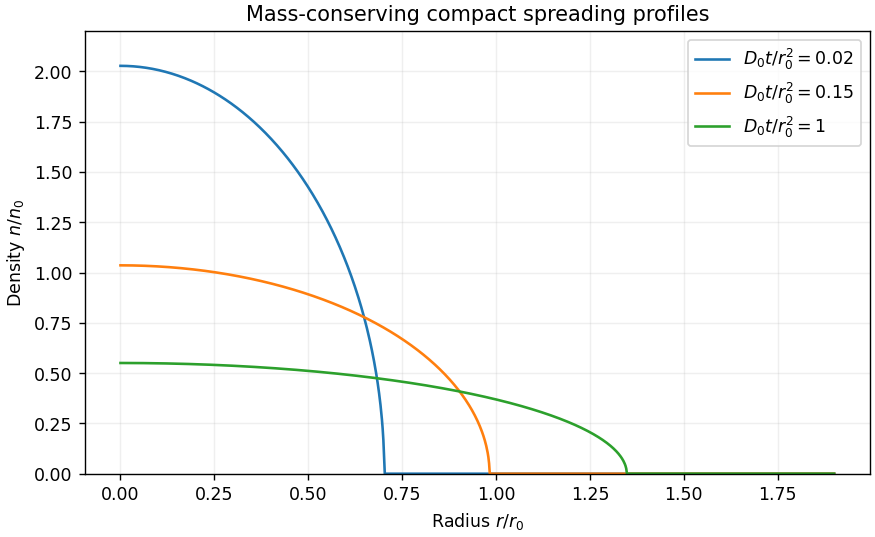
Put and . Direct differentiation givesThus the partial differential equation reduces to an ordinary differential equation precisely when . The profile then satisfies . Regularity and zero radial flux at the origin make the integration constant zero. Wherever , , so using . Requiring the front at selects . Point release requires , givingAlthough diverges at the front, tends to zero, so this compactly supported profile satisfies the equation in the weak solution sense.
The compact radial cubic-diffusion profile conserves the total population:Consequently . The front radius grows as , while the central density decays as . The conserved mass concentrates at the origin as .
Past exam of the mathematics course of the University of Cambridge 2010 ii Paper 2 12H Solution Created 2026-09-24 Updated 2026-10-14
The Vandermonde determinant isIndeed, the determinant is an alternating polynomial, hence divisible by every . Both sides have degree , and comparison of the coefficient of gives constant one. This is an identity over the integers, so reducing its coefficients modulo a prime number preserves it. For , two residues coincide and the determinant vanishes. For , choose all elements of once to obtain a nonzero determinant.
For the ordering , this determinant is . If is odd, put . Wilson theorem gives . Pairing the factors with indices and , and leaving unpaired, givesEvery distinct ordering changes the determinant by its permutation sign; repeated residues give zero. Thus the possible values are for odd , and for .
Use Shamir's secret sharing: choose independent uniform , and engrave the shares , where and the are distinct nonzero field elements. We may take ; otherwise use a sufficiently large finite field extension and an agreed integer encoding. Any shares determine by polynomial interpolation and hence . Given any shares and any proposed , their equations in the coefficients have a unique solution: the coefficient matrix has determinant times a nonzero Vandermonde determinant. Since the coefficients were uniform, the observed shares have the same distribution for every . Thus they give no information about the secret.
For the fake, reduce its integers to field elements and first check that its abscissa is distinct and nonzero. Random collisions or a zero abscissa are immediately detectable and have probability ; the following conclusions concern the overwhelmingly likely distinct-abscissa case.
With shares, there is always a unique degree-at-most- interpolating polynomial. If all shares are genuine it gives the correct secret. If one is fake, it normally gives the wrong secret, with probability conditional on a uniform fake ordinate, but the inconsistency is undetectable from those shares. The data do not certify which case has occurred.
With shares, genuine shares are consistent with one such polynomial. A fake is inconsistent with probability , so it is usually detected as an inconsistency. However, omitting each of the shares in turn gives possible polynomials. If the data are inconsistent, their constant terms are distinct: two candidate polynomials with the same constant term agree at zero and at their common abscissae, hence agree identically, which would make all the data consistent. The secret is narrowed to possibilities, but the fake is not identified.
With shares, at least are genuine. There is a unique degree-at-most- polynomial agreeing with at least shares: two candidates would agree on at least abscissae and hence coincide. Find it by deleting each share and checking consistency. The secret is recovered uniquely, and the fake is identified unless it happens to lie on the genuine polynomial, in which case it is harmless.
Past exam of the mathematics course of the University of Cambridge 2010 ii Paper 2 11F iv Created 2026-09-24 Updated 2026-09-24
Past exam of the mathematics course of the University of Cambridge 2010 ii Paper 2 11F iii Created 2026-09-24 Updated 2026-09-24
Past exam of the mathematics course of the University of Cambridge 2010 ii Paper 2 11F ii Created 2026-09-24 Updated 2026-09-24
Past exam of the mathematics course of the University of Cambridge 2010 ii Paper 2 11F i Created 2026-09-24 Updated 2026-09-24
Past exam of the mathematics course of the University of Cambridge 2010 ii Paper 2 10D Solution Created 2026-09-24 Updated 2026-10-14
The photon number density is obtained by integrating the Planck photon distribution. With ,The integral converges, since its integrand is of order near zero and decays exponentially at infinity. Hence , with independent of temperature.
For equilibrium radiation undergoing adiabatic expansion, the total entropy in a comoving volume is constant. Since the entropy density is , this means is constant. A comoving volume scales as the cube of the scale factor, soThis agrees with the cosmological redshift of each photon frequency. The conclusion uses entropy conservation during the expansion.
Past exam of the mathematics course of the University of Cambridge 2010 ii Paper 1 9D Solution Created 2026-09-24 Updated 2026-11-05
In Lagrangian mechanics, the energy balance for an autonomous Lagrangian uses . For the stationary vector potential the velocity-linear magnetic term cancels in this expression, leaving kinetic energy. In cylindrical coordinates,Time independence and the cyclic angular coordinate give two constants:The three Euler-Lagrange equations areThe supplied angular velocity is . Set , and use this constant angular velocity. The radial right-hand side is , the angular momentum is constant, and the vertical equation vanishes when . These equations and the initial data therefore giveFor nonzero radius and charge this is the requested circular orbit.
Past exam of the mathematics course of the University of Cambridge 2010 ii Paper 1 8E Solution Created 2026-09-24 Updated 2026-10-14
The real part of a holomorphic function is real analytic and has a local complexification in its two real coordinates. Define . On real ,and the same identity holds after analytic continuation to complex . Substituting and gives and , henceThe conjugation on the final constant is present in the PDF but was lost in the converted TeX. Without it the formula already fails when and is not real.
Now has the specified real part. Thus the complete family isAny two such holomorphic functions differ by a holomorphic function with zero real part; the Cauchy-Riemann equations make its imaginary part constant on a connected neighborhood.
Past exam of the mathematics course of the University of Cambridge 2010 ii Paper 1 7D Solution Created 2026-09-24 Updated 2026-10-14
The nullclines are and . At a nonzero fixed point, cancellation of yields . The latter function attains its maximum at . HenceFor , and .
The Jacobian matrix isAt the distinct eigenvalues are , so the origin is a stable node. At a nonzero fixed point its trace is andThe discriminant is . Thus is a saddle and is a stable node, never a focus.
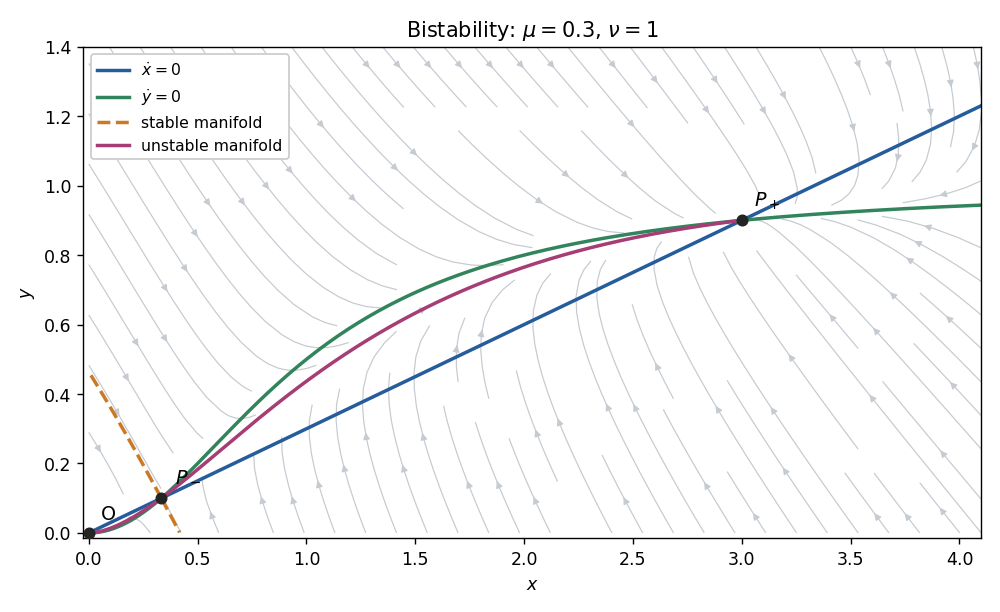


Above the straight nullcline ; below it . Below the curved nullcline ; above it . At the saddle, an eigenvector can be chosen as : the stable eigenvalue gives negative slope, and the unstable eigenvalue gives positive slope. The stable manifold is the basin boundary. The two branches of the unstable manifold lead respectively to the origin and the positive stable node, as illustrated for representative parameters.
The nonnegative quadrant is forward invariant. Since , stays bounded, and then also bounds . Moreover the divergence is the negative constant , excluding periodic or homoclinic loops by the Bendixson-Dulac criterion. The Poincaré-Bendixson theorem then leaves convergence to a fixed point. Initial data on the saddle's stable manifold approach the saddle; data in the two open basins approach extinction at or persistence at , respectively.
Past exam of the mathematics course of the University of Cambridge 2010 ii Paper 1 6A Solution Created 2026-09-24 Updated 2026-10-14
The positive steady state satisfies , soWith , the linearization isIts characteristic polynomial is , where . The roots are inside the unit disk precisely when : when they are real they are positive with sum one, and when complex conjugate their common modulus is . Therefore the fixed point is linearly asymptotically stable for and unstable for . At ,This proves period six for the neutral linearized oscillations. The stronger printed claim of a nonlinear period-six branch is not valid for the stated recurrence. It is important to distinguish these two assertions.
Here is a local obstruction, which also checks that the qualification is not merely absence of a proof. Normalize by the moving fixed point, let , , and definePut , , and for . The quadratic and cubic terms of 's second component are . Composing six times givesIn particular the quadratic terms cancel, while the cubic components are and . If a small nonzero were a period-six point, invertibility of and the norm of this equation would imply . Taking its determinant with then givesSince , this is impossible for sufficiently small nonzero . Thus no nontrivial nonlinear six-cycle bifurcates locally at . At the threshold the same expansion gives , so the fixed point is actually locally asymptotically stable nonlinearly, with slow decay. The valid intended linear-stability conclusion is the period-six neutral oscillation above; a literal nonlinear assertion requires a changed model or wording. This is an example of the distinction between linear resonance and nonlinear periodic bifurcation.
There are unlisted articles, also show them or only show them.