
A projective variety is a Zariski-closed subset of projective space , equivalently the common zero set of homogeneous polynomials. Homogeneity makes their vanishing independent of the nonzero scalar used to represent a projective point.
A morphism is a map locally given by regular coordinate functions in affine charts. Equivalently, near each point of a projective source embedded in , a morphism to can be writtenusing homogeneous polynomials of a common degree that are not all zero on that neighbourhood. The expressions must agree on overlaps, and for a specified target variety their values must lie in it. A single global tuple is a sufficient description when available, but is not part of the general definition.
The parametrization lands on the curve because . Its pullback has imageEvery monomial in this subalgebra has exponent for nonnegative integers . No such exponent is one, so no linear combination of these monomials is . Thus is not surjective and is not an isomorphism.
It is nevertheless bijective on points. Away from the origin, and gives and using ; the origin comes only from . The rational inverse cannot extend regularly at the origin: if with , then has a nonzero degree-one term, whereas has none.This distinguishes a set-theoretic bijection from an isomorphism of varieties in every characteristic.
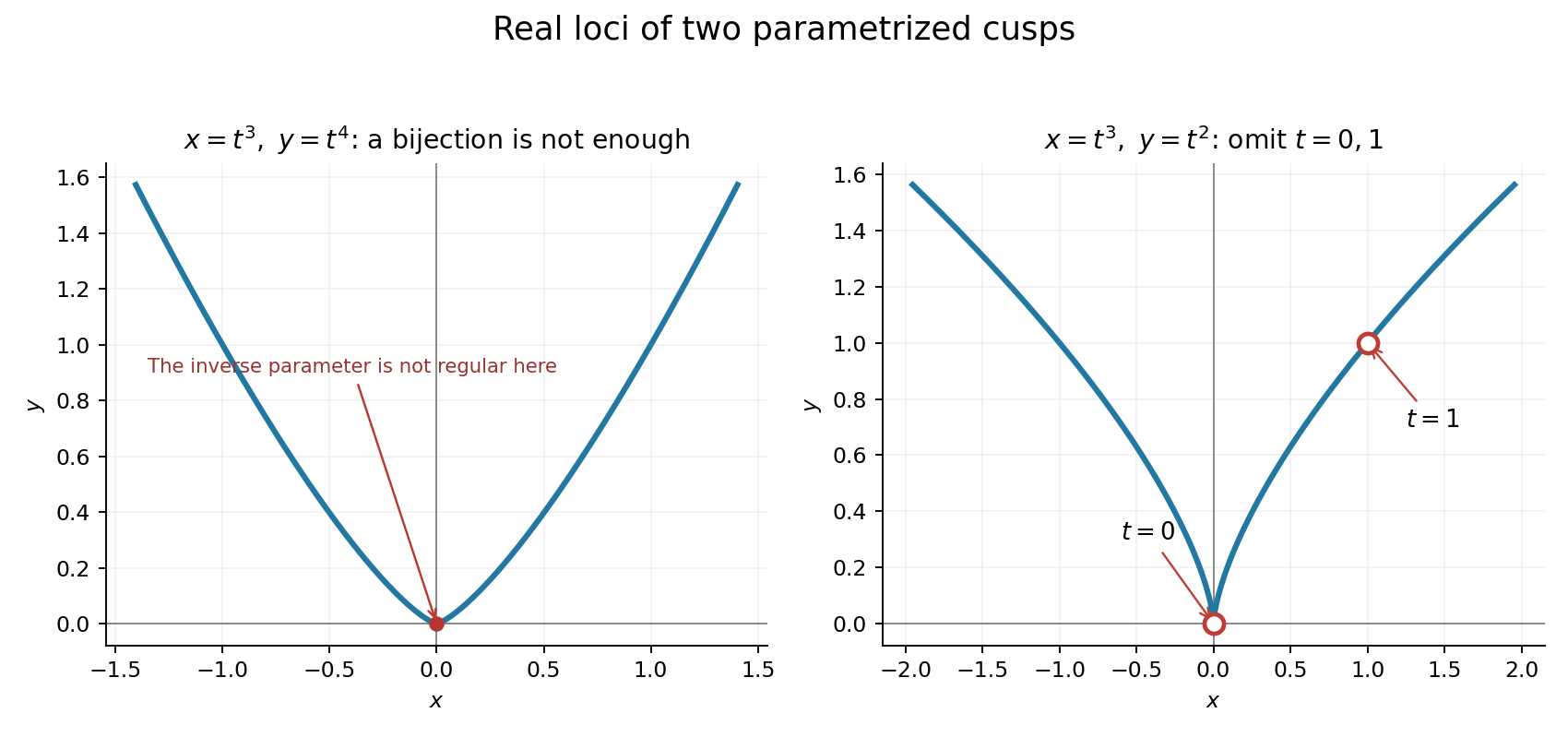
Cusp parametrizations reveal which rational coordinates fail to be regular
. The left curve uses x=t cubed and y=t to the fourth; recovering t fails regularly at its origin. The right curve uses x=t cubed and y=t squared; the open subset used later omits the parameter values zero and one, marked with hollow circles. Details.
Here subvariety means a closed affine subvariety. Suppose first that is onto, and write , . Put and . Choose with and let have components .
Let the components of be polynomial functions on . For each target coordinate , the element has zero pullback, hence belongs to . It vanishes on , giving . Both maps have polynomial components, so is an isomorphism onto the closed subvariety .
Conversely, if is an isomorphism onto a closed subvariety, restriction is surjective, and the pullback of that isomorphism is an isomorphism. Their composition is , provingThe word closed matters: an isomorphism onto a merely locally closed subset need not induce a surjective coordinate-ring map. For example induces .
Part (b) immediately gives . For the reverse inclusion, let . The case is immediate, so assume . Noetherianity gives finite generators .
Use the Rabinowitsch trick: in the polynomial ring with one auxiliary variable, formApply the assumed maximal-ideal description to polynomial rings, including this ring in variables. If were proper, it would lie in the maximal ideal of some point . Then and , impossible because vanishes on . Therefore is the whole ring, and there is an identitySubstitute in the localization . The last term vanishes; clearing the finitely many powers of from the remaining denominators yields for some . Thus andThis proves the strong Hilbert Nullstellensatz from the polynomial-ring weak form by converting nonvanishing into an extra equation.
The radical of an ideal isThe ideal is radical if . Its zero set is , an affine variety by definition.
An affine variety in is the common zero set of a collection of polynomials in , with its Zariski topology. We use the convention of this question that such a variety need not be irreducible. Its vanishing ideal and coordinate ring areThe quotient identifies polynomials that give the same function on , so its elements are exactly polynomial functions on .
For affine embeddings and , a morphism of affine varieties is a map with and image in . Pullback of polynomial functions defines the contravariant homomorphismIt is well defined because any polynomial vanishing on pulls back to zero on , and it preserves addition, multiplication, one, and the constants in .
Over , the first nonzero column of an invertible matrix has choices and the second has choices. The surjective determinant homomorphism onto has kernel . ThusIt acts on the nine one-dimensional subspaces of , namely the projective line , by fractional linear transformations. Any element acting trivially fixes , which forces it to be scalar. A scalar matrix in has ; in characteristic two this implies . Thus the action is faithful.
The action is transitive: any nonzero vector can be completed to a determinant-one basis, so any line can be reached. The stabilizer of isOn finite points this is . Squaring permutes the seven nonzero field elements, so these are exactly the affine maps . In particular translations act transitively on all eight finite points. Thus the full action is doubly transitive. The point stabilizer has order , and all point stabilizers are conjugate.
The identity column gives the group order as the sum of squared irreducible character degrees:By column orthogonality, the squared norm of a column is the corresponding centralizer order. In source order these orders and the resulting conjugacy class sizes areFor example the fourth column has squared norm , while the seventh has squared norm .
An element's order divides its centralizer order. Cauchy's theorem for finite groups provides an involution, and only has an even centralizer order. Hence that entire class consists of involutions. The last three classes consist of elements of order seven. In the possibilities are three and nine. The three real numbers are roots of , which has no rational root and is irreducible over . A real character value at an element of order three belongs to . Therefore the irrational real entries in rule out order three there. Cubing any of these order-nine elements produces an element of order three, which must belong to the sole remaining class . ThusThe three deductions below give nine Sylow subgroups for with pairwise trivial intersections. Their conjugation action is transitive. Fix one, . If , put . The product is a -subgroup, so maximality of gives . Trivial intersection then gives . Thus the orbit of under has size eight, exhausting the other eight points. The point stabilizer is therefore transitive on the remaining points: the action is doubly transitive.
For a doubly transitive action, its permutation character has the form with irreducible. Here , and the unique degree-eight row is . Therefore the numbers of fixed points are the entries ofEvery nonidentity element consequently fixes at most two points. This also shows that the action is faithful.
The quaternion group of order eight has a unique involution, which generates its center of a group. A nontrivial intersection is a nontrivial finite -group, so by Cauchy's theorem for finite groups it contains an involution. This must be both the unique involution of and the unique involution of . Thus .
It follows that . But is a normal Sylow subgroup of its normalizer, so it is that normalizer's unique Sylow subgroup. Hence . Distinct Sylow subgroups therefore intersect trivially. From the preceding result,Of , only is congruent to modulo . Therefore , so is normal in .
If with , a Sylow subgroup for has order . Let be two such subgroups. The action of by left translation on has orbits of powers of , while is prime to . There is a fixed coset , giving ; equality follows from their orders. Thus all Sylow -subgroups are conjugate.
Let now act by conjugation on their set. If it fixes , then , so is a subgroup of -power order and must equal ; hence . The unique fixed point is itself and all other orbits have size divisible by . Consequently .
For the strengthened conclusion, the stabilizer of is . The product is a subgroup of -power order, so . If distinct Sylow subgroups meet trivially, then . Every other orbit therefore has the full size , givingConjugacy also gives , a divisor of .
A two-dimensional indecomposable module over is exactly for some . Write its operator as with and . On restriction of scalars,For this is the zero operator on a two-dimensional space, which splits as two one-dimensional submodules. For , its nilpotent part is nonzero of square zero, so it is one Jordan block and is indecomposable. Therefore the full list isDifferent give nonisomorphic -modules; the restricted -modules for and are isomorphic.
The universal property of the polynomial ring gives the unique complex algebra homomorphismDistinct monomials are linearly independent, so is injective. Restriction of scalars defines for and ; its module axioms follow from those of the original action and the algebra homomorphism. In particular acts as the square of the operator defining the action.
There are unlisted articles, also show them or only show them.