
Huffman sibling property Created 2026-09-24 Updated 2026-10-14
For a finite source alphabet of symbols with positive weights , choose any two least weights, breaking ties arbitrarily. There exists an optimal prefix code over the binary output alphabet whose chosen symbols occupy sibling leaves in a code tree at maximum leaf depth in a code tree. Weights may be counts or probabilities: dividing every weight by gives the same minimizers. The existence statement is what makes the first merge of Huffman coding safe. It does not say that every optimal prefix code already has the chosen pair together.[ref]
A Method for the Construction of Minimum-Redundancy Codes by David A. Huffman. p. 1099: Derived Coding Requirements and Optimum Binary Code
An exchange makes the idea tangible. Take probabilities . The prefix code , , , has expected codeword length bits. Exchange only the symbols at their existing leaves: the available codewords and code tree shape stay fixed, but the codeword lengths in symbol order become . The new expected codeword length is bits, and the two least probabilities, those of , now occupy deepest sibling leaves in a code tree. The saving is bit per source symbol.
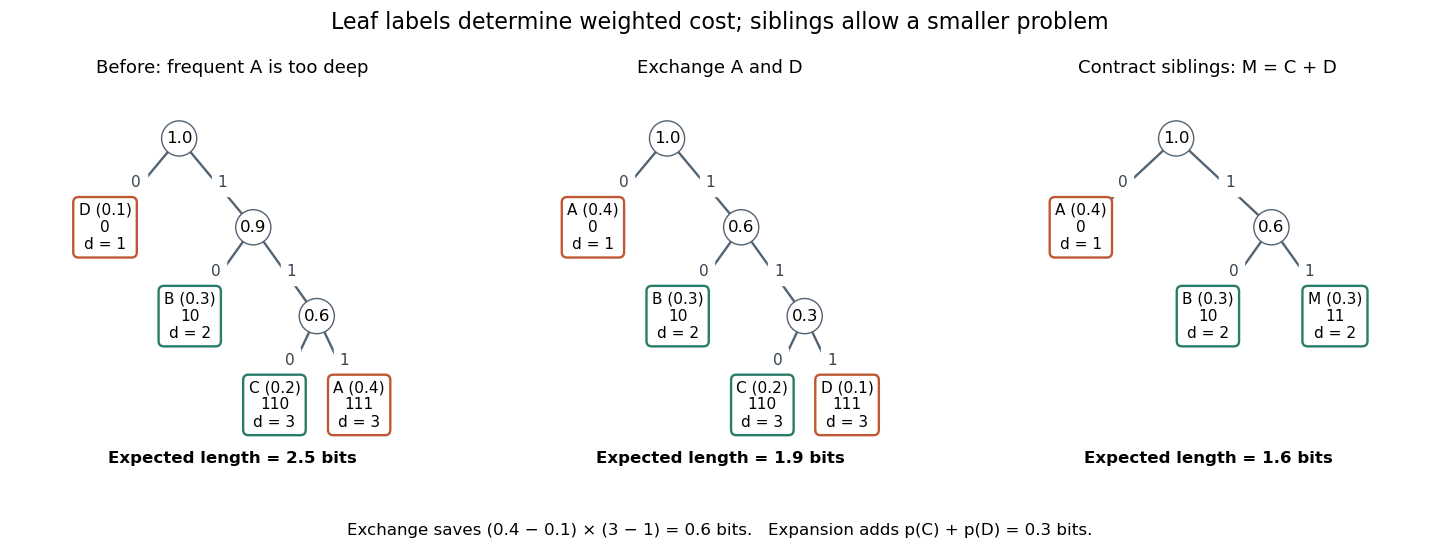
Exchanging two leaf labels reduces expected length from 2.5 to 1.9 bits; contracting the least-probability siblings leaves cost 1.6
. Details. 
Here is the short proof outline. An optimal prefix code with positive weights has a full binary tree as its code tree: suppressing a vertex with only one child shortens every codeword in that subtree and strictly reduces cost. A deepest leaf therefore has a leaf as its sibling, giving the deepest sibling property of an optimal prefix code. Put the two chosen least weights at these positions by successive exchanges of leaf labels. Moving a weight from leaf depth in a code tree to a deepest position , occupied by , changes the weighted sum byFix one chosen weight there, then move the other into the neighbouring deepest position; if it is already there, no exchange is needed. The prefix code condition survives because the set of codewords is unchanged. Starting from an optimal prefix code, the cost cannot decrease below the minimum, so these exchanges preserve optimality. Strictly unequal weights at unequal depths would give a strict decrease, explaining probability monotonicity of optimal prefix-code lengths. Equal weights or equal depths allow cost-neutral exchanges. [ref]
Hubble flow Created 2026-09-24 Updated 2026-10-14
The velocity-distance relation is Hubble's law; a peculiar velocity is a departure from this homogeneous flow.
Hubble friction Created 2026-09-24 Updated 2026-09-24
Horseshoe from two closed covering walks Created 2026-09-24 Updated 2026-10-14
If a directed covering graph of an interval map has two distinct closed walks of the same length , based at the same interval and with different first edges, successive use of the interval covering relation produces two subintervals with disjoint interiors that maps across the base interval. Hence has a horseshoe for an interval map.
Subcritical Hopf bifurcation Created 2026-09-24 Updated 2026-10-14
In a subcritical Hopf bifurcation, the small periodic orbit repels within the critical centre manifold and lies on the side where the equilibrium point attracts within that manifold. With the critical eigenvalue real part increasing through zero, the positive cubic sign gives the exact radial Hopf normal formFor , the nonzero radius is . Radii below shrink to zero, whereas radii above it grow. The radial derivative at the cycle is , proving that the periodic orbit repels. For example, gives an unstable circle of radius : a radius of decays while one of grows. The unstable circle shrinks into zero as ; at , already drives every small positive radius outward.
For there is no nonzero constant radius in this cubic model, and zero repels. In a general dynamical system, this says only that the nearby orbits leave the local neighbourhood. It does not guarantee a distant attracting limit cycle, a jump to a particular amplitude, or hysteresis. Additional nonlinear or global information is needed; the quintic radial Hopf equation illustrates one possible stabilizing extension. Reversing the parameter orientation reverses which numerical side contains the branch, so the defining distinction between supercritical Hopf bifurcation and subcritical Hopf bifurcation is their reduced stability and their relation to the equilibrium point, rather than the bare sign of an arbitrarily named parameter.
Winding-number proof of the no-retraction theorem Created 2026-09-24 Updated 2026-09-24
If a continuous retraction from a closed disc to its boundary existed, applying it to a contraction of the boundary circle inside the disc would give a homotopy in from a loop of winding number one to a constant loop of winding number zero. Homotopy invariance of winding number rules this out.
Winding-number proof of the fundamental theorem of algebra Created 2026-09-24 Updated 2026-09-24
For a polynomial of positive degree, on a sufficiently large circle its leading term dominates the remaining terms. The dominated-perturbation lemma therefore gives winding number to the loop . If had no zero, radial contraction of the input circle would map under to a homotopy with a constant loop in , which has winding number zero. This contradiction proves the Fundamental theorem of algebra.
Dominated perturbation preserves winding number Created 2026-09-24 Updated 2026-09-24
If closed continuous paths satisfy for every , then never vanishes. It is therefore a homotopy through closed paths in , and
Steenrod square Created 2026-09-24 Updated 2026-11-05
The Steenrod squares are natural mod-two cohomology operationsThey satisfy , for , and the top-square identity . The Cartan formula computes squares of products, while the Adem relations constrain compositions. They are stable cohomology operations, so they retain information after suspension.
For the degree-one generator of the mod-two cohomology ring of real projective space, the Cartan formula giveswith coefficients modulo two and powers above the space's dimension set to zero. For example, and when those degrees exist. The operation is the mod-two Bockstein homomorphism. The higher squares therefore extend familiar cup-square and coefficient-sequence information into a natural family of finer information preserved by homotopy equivalences.[ref]
Algebraic Topology by Allen Hatcher. section4.L, Steenrod square axioms and projective-space examples
Serre spectral sequence Created 2026-09-24 Updated 2026-11-05
For a Serre fibration over a path-connected CW complex, the cohomological Serre spectral sequence starts withThe fibre cohomology groups form a local coefficient system through the fundamental group action. For a simply connected base, it is constant. The stable terms are successive quotients of a finite filtration of each ; reconstructing the cohomology groups can require solving group extensions. With commutative ring coefficients, the cup product makes the construction multiplicative.[ref]
The Serre Spectral Sequence by Allen Hatcher. Theorem1.14 and §1.2
For the Hopf fibration with integer coefficients, the only nonzero positions on are , each a copy of . Since , the map must be an isomorphism. The survivors at and give the cohomology in degrees zero and three. This example shows how twisting changes the answer from the cohomology of a Cartesian product.
Simplicial homotopy theory Created 2026-09-24 Updated 2026-09-24
Loop space Created 2026-09-24 Updated 2026-09-24
The loop space is the space of based loops in . It is the homotopy fiber of the inclusion of the base point into .
Homotopy pullback Created 2026-09-24 Updated 2026-11-05
For continuous maps and , a homotopy pullback is modelled byUse the compact-open topology on the path coordinate. A continuous map gives continuous maps , together with a chosen homotopy from to . Thus agreement in the target is remembered by a path, rather than required as literal equality.
The ordinary pullback maps to by constant paths. If one of is a Serre fibration in the usual CW complex setting, this comparison is a weak homotopy equivalence. More generally, replace one map by a fibration before taking the ordinary pullback.
For the two basepoint maps , the ordinary pullback is a point, whereas is the loop space , whose path components are indexed by the winding number in . The paths in the model preserve information that the strict equality condition loses.
Homotopy fiber sequence Created 2026-09-24 Updated 2026-10-14
A homotopy fiber sequence identifies , up to homotopy, with the homotopy fiber of . It induces a long exact sequence of homotopy groups.
Homotopy group Created 2026-09-24 Updated 2026-09-24
The th homotopy group consists of based homotopy classes of maps . It is a group for and an abelian group for .
Homotopy extension property Created 2026-09-24 Updated 2026-09-24
Retract Created 2026-09-24 Updated 2026-10-03
Homotopy equivalence Created 2026-09-24 Updated 2026-09-29
Contractible space Created 2026-09-24 Updated 2026-10-14
Null-homotopic map Created 2026-09-24 Updated 2026-10-05
There are unlisted articles, also show them or only show them.