
Interval covering relation Created 2026-09-24 Updated 2026-09-24
For closed intervals and , write under when . The intermediate value theorem implies that there is a closed subinterval with .
Periodic point of an interval map Created 2026-09-24 Updated 2026-10-14
A point is periodic for an interval map when for some positive integer . Its least such is its period, and the finite setis its periodic orbit.
For an interval map, this is the usual periodic point condition. Its least positive return time is the period.
Normal bundle Created 2026-09-24 Updated 2026-09-24
Degree of a projective scheme Created 2026-09-24 Updated 2026-10-14
For a pure -dimensional projective scheme , its degree is times the leading coefficient of its Hilbert polynomial, equivalently .
Chern class Created 2026-09-24 Updated 2026-11-05
For a complex vector bundle of rank , its Chern classes are integral cohomology classesThey are natural under pullback and obey the Whitney sum formula for Chern classes. For a complex line bundle, is the Euler class of its underlying oriented real two-plane bundle; generally is the Euler class of the underlying real bundle.[ref]
Characteristic Classes by John Milnor and James D. Stasheff. Chapter 14, definition and product theorem
For example, if on Complex projective space, the Euler sequence gives , truncated above degree . For an algebraic vector bundle on a smooth variety, algebraic Chern classes instead belong to the Chow groups; the cycle class map recovers the topological classes over the complex numbers.
Algebraic cycle Created 2026-09-24 Updated 2026-10-05
A -cycle on a scheme is a finite integer linear combination of integral closed subschemes of dimension . Their free abelian group is denoted .
Resonant trapping of dust Created 2026-09-24 Updated 2026-09-25
During inward migration, dust can be captured into an exterior mean-motion resonance with a planet. A phase-shifted conjunction then lets planetary torque replace angular momentum lost to Poynting–Robertson drag.
Poynting–Robertson drag Created 2026-09-24 Updated 2026-09-24
Poynting–Robertson drag is the tangential component of stellar radiation force caused by aberration in an orbiting dust grain's frame. It removes orbital energy and angular momentum and drives the grain inward.
Radiation-pressure coefficient Created 2026-09-24 Updated 2026-10-06
The radiation-pressure coefficient is the ratio of outward stellar radiation pressure to inward stellar gravity on a dust grain. The grain therefore feels effective gravitational parameter .
Two-stage stability exchange in a symmetric planar system Created 2026-09-24 Updated 2026-09-24
Successive symmetry-breaking bifurcations can pass stability from one boundary branch to an interior branch and then to a second boundary branch.
Force on a pipe junction Created 2026-09-24 Updated 2026-11-05
The force on a pipe junction follows from vector momentum conservation for the fluid inside the junction. In steady flow, the sum of outward momentum fluxes minus inward momentum fluxes equals the external resultant on that fluid. A section with nearly uniform velocity contributes mass flow rate times its velocity vector, with the appropriate inlet or outlet sign.
Pressure also pushes on every cut section: with an outward normal , the pressure force on the control-volume fluid is . Adding gravity and the unknown wall force gives a solvable balance once flow rates, directions and pressures are specified. The force of the fluid on the pipe is the opposite of the wall force on the fluid.
Integral extension Created 2026-09-24 Updated 2026-10-07
Bézout domain Created 2026-09-24 Updated 2026-11-05
A Bézout domain is an integral domain in which every finitely generated ideal is principal. Equivalently, every pair has a greatest common divisor satisfying a Bézout identity . A Noetherian Bézout domain is a principal ideal domain because all its ideals are finitely generated.
Principal ideal domain Created 2026-09-24 Updated 2026-11-05
Greatest-common-divisor domain Created 2026-09-24 Updated 2026-11-05
A greatest-common-divisor domain is an integral domain in which every two nonzero elements have a greatest common divisor, defined up to multiplication by a unit.
Irreducible element Created 2026-09-24 Updated 2026-11-05
A nonzero nonunit in an integral domain is irreducible when every factorization has at least one unit factor.
Prime element Created 2026-09-24 Updated 2026-11-05
Field discriminant Created 2026-09-24 Updated 2026-09-29
The field discriminant is the discriminant of any integral basis and controls the index of every suborder.
Action-angle variables Created 2026-09-24 Updated 2026-10-14
For a one-degree-of-freedom closed orbit, action-angle coordinates make the Hamiltonian a function and give , .
Gram-Schmidt process Created 2026-09-24 Updated 2026-11-05
The Gram-Schmidt process turns a finite ordered family of linearly independent vectors in an inner product space over the real numbers into an orthonormal basis of their linear span. It keeps every successive linear span, so the first new vectors describe exactly the same directions as the first inputs. Its idea is geometric: remove the orthogonal projection onto directions already found, then divide the remaining vector by its norm. This makes a complicated basis easier to use without changing the vector subspace it describes.[ref]
Start with and . At step , use the previously obtained orthonormal set to defineThe sum is the orthogonal projection onto a finite-dimensional subspace , and is the orthogonal projection residual. Linear independence ensures : otherwise would already be a linear combination of earlier inputs. If the input family is linearly dependent, use only the retained orthonormal vectors in the sum and omit an input whenever its remainder is the zero vector; do not divide by zero. The retained outputs still form an orthonormal basis of the original linear span, but their number can be smaller than .
For a short verification, orthonormality makes every earlier inner product vanish:Also is minus a linear combination of earlier vectors, while is plus that same linear combination. These two inclusions, followed by division by a nonzero norm, giveThe argument also works in an inner product space over the complex numbers with the existing inner product convention, linear in the first argument: the coefficients remain . With the convention linear in the second argument, write instead.
For a first picture, take and in with the ordinary dot product. ThenSubtracting the diagonal component leaves an orthogonal direction; dividing by its norm makes its length one. If the second input were instead, its orthogonal projection would be the entire input and , revealing linear dependence.
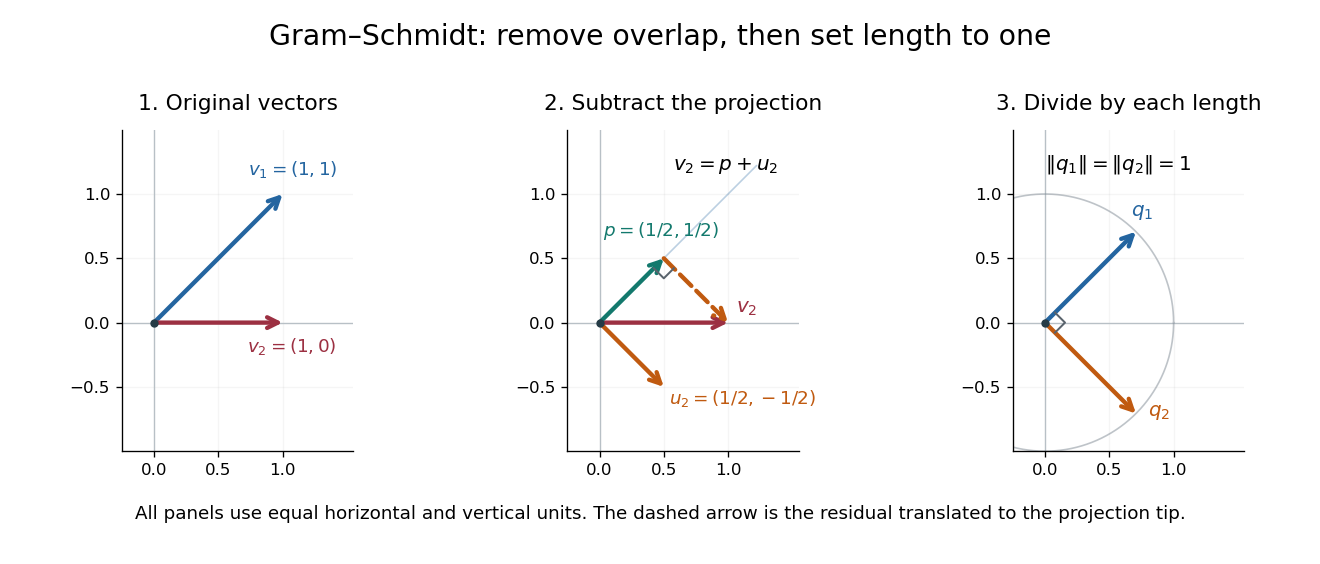
Gram-Schmidt orthogonalization in : input vectors, subtraction of an orthogonal projection, and an orthonormal basis
. Details. 
For a full three-dimensional calculation, use the ordinary dot product and the input vectorsThe first two steps giveAt the third step, the inner products are and . ConsequentlyThe three numerator vectors have pairwise dot products and squared Euclidean norms . Thus the displayed outputs are indeed an orthonormal basis, and the three nonzero remainders also confirm linear independence of the inputs. Keeping the removed coefficients produces the QR decomposition below.
An immediate reward is a reusable orthogonal projection: once an orthonormal basis of a vector subspace is known, any vector hasFor the linear span of just the first two inputs in the three-dimensional example, gives . Its orthogonal projection residual is , visibly in the missing orthogonal direction. This is the geometry behind the linear least-squares problem.
The formulas above describe exact arithmetic. With floating-point arithmetic, subtracting an orthogonal projection nearly equal to the input can leave a small remainder; dividing by its small norm can magnify existing roundoff error. The classical Gram-Schmidt and modified Gram-Schmidt arrangements agree in exact arithmetic but can give different rounded results. Exact linear dependence and a small computed remainder therefore require different judgments in a numerical implementation.[ref]
https://nhigham.com/wp-content/uploads/2023/10/high95m.pdf. Higham, The Test Matrix Toolbox for Matlab, §8, p. 22
There are unlisted articles, also show them or only show them.