
Translation in a group Created 2026-09-24 Updated 2026-11-05
Left and right multiplication by a fixed group element are bijections, called left and right translations.
Both translations are bijections because the inverse element gives the inverse multiplication operation.
Group operation Created 2026-09-24 Updated 2026-11-05
A group operation is the associative binary operation of a group. It has an identity element, and every element has an inverse element.
Inverse element Created 2026-09-24 Updated 2026-10-14
An inverse element of in a monoid is an element satisfying , where is the identity element. Its notation is . Some elements of a monoid can lack an inverse element; a group requires one for every element. Associativity makes a two-sided inverse element unique: if both invert , then .
For the full transformation monoid, a self-map has an inverse element exactly when it is a bijection; that element is its inverse function. On , the swap is its own inverse element, while a constant function has none because it merges the two inputs.
Identity element Created 2026-09-24 Updated 2026-10-14
An identity element for a binary operation satisfies for every element of the underlying set. It is a two-sided identity: merely satisfying one of the two equations is insufficient. It is unique when it exists, since two candidates satisfy . This uniqueness does not require the associative property.
Zero is the identity element for addition of integers, one for multiplication of integers, and the identity function for function composition of self-maps. The empty word is the identity element for concatenation. An associative operation with an identity element makes a monoid; inverse elements are an additional requirement for a group.
Nontrivial group Created 2026-09-24 Updated 2026-09-24
A nontrivial group has more than one element.
Finite group Created 2026-09-24 Updated 2026-10-14
A finite group is a group whose underlying set has finitely many elements. Its order of a finite group is the number of elements, counting the identity element. The group operation still has to satisfy all the group axioms: merely having a finite list of states does not make a group.
For example, the six congruence classes modulo six form a finite cyclic group under addition, whereas the permutations of three objects form the symmetric group , also with six elements. The first is an abelian group; the second is a non-abelian group. Thus the order of a finite group is a useful first measurement, but the composition rule contains information that the count alone loses.
Finiteness makes group structure accessible to exact calculation. A Cayley table for a finite group of order has entries, and every group element eventually returns to the identity element when repeated. Lagrange's theorem strengthens this observation: the order of a group element, being the size of its cyclic subgroup, divides . The cyclic group of order four and Klein four-group give a small example of how that constraint can distinguish different composition rules.
Green's third identity Created 2026-09-24 Updated 2026-11-05
For a bounded smooth domain and , let , normalized by . For an interior point , Green's third identity isIt represents the function through its volume PDE source term, boundary values and outward normal derivative. For a harmonic function the volume term vanishes, so boundary data alone reconstruct the interior.
To derive it, apply Green's second identity on . The inner sphere has the outward normal of the punctured domain, pointing toward . Its singular fundamental solution term tends to as , giving the stated signs. Replacing by the Dirichlet Green function makes its boundary value zero and leaves the Poisson kernel multiplying the boundary values of . Thus the identity connects Green functions, boundary integral representations and Dirichlet problems.
Coprime integers Created 2026-09-24 Updated 2026-11-05
Two integers are coprime when their greatest common divisor is one:For positive integers, this says that the only positive common divisor is one. For signed integers, use , with absolute values; changing either sign leaves coprimality unchanged. With the convention , zero is coprime precisely to , because . Both are coprime to every integer. [ref]
Floor and arithmetic functions by Darij Grinberg. Darij Grinberg, MIT 18.781, Section 1.2: greatest common divisors and coprimality
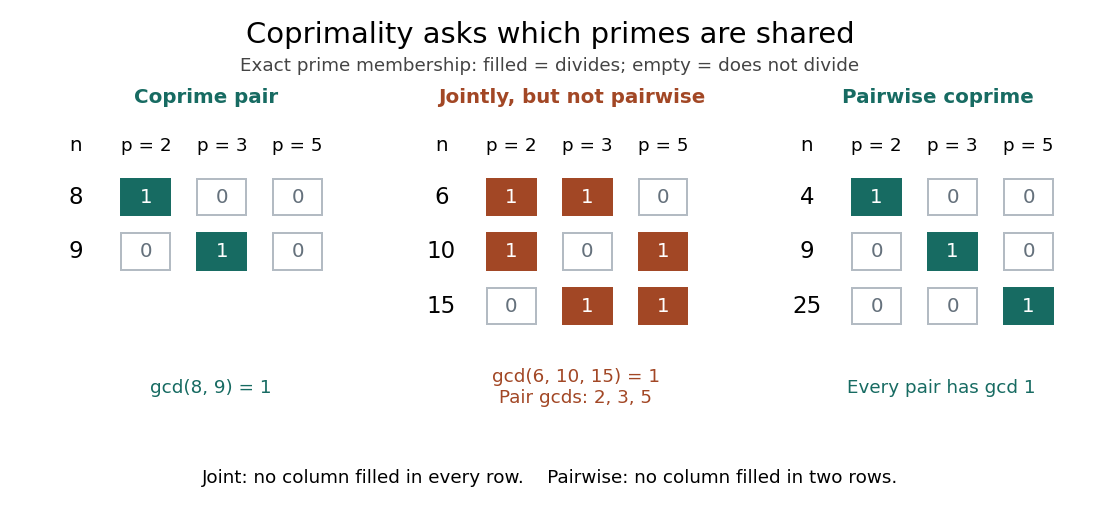
The word concerns shared prime factors, not whether either input is a prime number. For instance and are coprime composite numbers, even though neither is a square-free integer. Conversely, and are square-free integers but are not coprime. Consecutive integers are always coprime: any common divisor of divides their difference one. Thus provide another pair of coprime composite numbers.
For positive integers, let be the prime support of an integer. The equivalent test isThe set intersection of the two prime supports of an integer must be the empty set. Indeed, any positive common divisor greater than one has a prime factor, and any shared prime factor is a common divisor greater than one. Hence coprimality depends on which prime factors occur, rather than on their prime valuations; replacing either input by its radical of an integer preserves coprimality.
For a list of at least two integers, distinguish pairwise coprimality, requiring every pair to be coprime, from joint coprimality, requiring only the greatest common divisor of the entire list to be one. For example,No prime factor belongs to all three prime supports of an integer, yet each pair shares one. By contrast, have pairwise coprimality. The distinction is presented by Poritz under the names pairwise and mutually relatively prime. [ref]
https://math.libretexts.org/Bookshelves/Combinatorics_and_Discrete_Mathematics/Yet_Another_Introductory_Number_Theory_Textbook_-_Cryptology_Emphasis_(Poritz)/01:_Well-Ordering_and_Division/1.05:_The_Greatest_Common_Divisor. Jonathan A. Poritz, Yet Another Introductory Number Theory Textbook, Section 1.5
One use is simplifying fractions. For a fraction with integer entries and , divide its numerator and denominator by to obtain a reduced fraction with coprime entries. For example, since , and uses the same . A further common divisor would make too small, so the reduction is complete. In particular, the reduced fraction for zero is .
Another use is reversible modular arithmetic: for an integer modulus , an integer has a modular inverse precisely when are coprime. The proof outline uses Bézout's identity: makes a modular inverse, and any inverse relation forces every common divisor to divide one. For example, gives , whereas has no modular inverse modulo . Thus coprimality is the exact condition allowing division by a residue in modular arithmetic. [ref]
https://ocw.mit.edu/courses/18-200-principles-of-discrete-applied-mathematics-spring-2024/mit18_200_s24_lec15.pdf. Ankur Moitra, MIT 18.200, Lecture 15, Lemmas 1–2 and modular inverses
Shearing sheet Created 2026-09-24 Updated 2026-10-14
The shearing sheet is a local Cartesian approximation to a differentially rotating disk. It retains Coriolis force, linearized tidal gravity, and a background linear shear.
Grassmannian as projection matrices Created 2026-09-24 Updated 2026-10-14
Closed graph theorem Created 2026-09-24 Updated 2026-09-28
Common neighbour Created 2026-09-24 Updated 2026-10-03
Laplacian spectrum of a complete graph Created 2026-09-24 Updated 2026-10-14
The Graph Laplacian of the complete graph has eigenvalue zero on the constant vector and eigenvalue on the -dimensional subspace whose coordinates sum to zero.
Homomorphism density Created 2026-09-24 Updated 2026-10-14
For finite graphs , the homomorphism density is the probability that a uniformly random map is a graph homomorphism. For bipartite graphs with prescribed vertex classes, the random map is chosen separately and uniformly into the corresponding classes.
Graph diameter Created 2026-09-24 Updated 2026-10-14
Path metric Created 2026-09-24 Updated 2026-11-05
Given positive edge lengths on a graph, define the distance between two vertices bywhere ranges over finite graph paths. An absent path gives distance . On a finite connected graph, this is a metric: reversing and concatenating routes gives symmetry and the triangle inequality, while the least edge length bounds every nonempty path away from zero. It is also a metric on a connected locally finite graph, since every path leaving a fixed vertex pays at least the positive minimum of its finitely many incident edge lengths.
Positive edge lengths alone do not guarantee a metric on an arbitrary infinite graph. Join two vertices through intermediate vertices , with both edges having length . Then for every , so distinct vertices have distance zero. On each finite-distance component the general construction is a pseudometric; its zero-distance classes give a metric quotient.
Chromatic polynomial Created 2026-09-24 Updated 2026-10-14
The chromatic polynomial turns a graph coloring problem into a counting problem: how many choices remain when adjacent vertices must have different colours? For a finite simple graph and a positive integer , is the number of proper vertex colorings using a fixed, distinguished palette of colours. A colouring need not use every available colour, and exchanging two palette colours generally gives a different colouring. Although is a polynomial, its values at arbitrary noninteger arguments are not counts of colourings.
Consider the three-vertex path graph ----. Choose in ways, then in ways, then in ways: and may agree because they are not adjacent. The multiplication principle givesAdding the edge makes the three-vertex complete graph . Now must avoid both preceding colours, soWith three available colours, the path graph has 12 colourings, whereas the triangle has 6. With two colours the counts are and : the extra constraint makes the triangle impossible to colour.
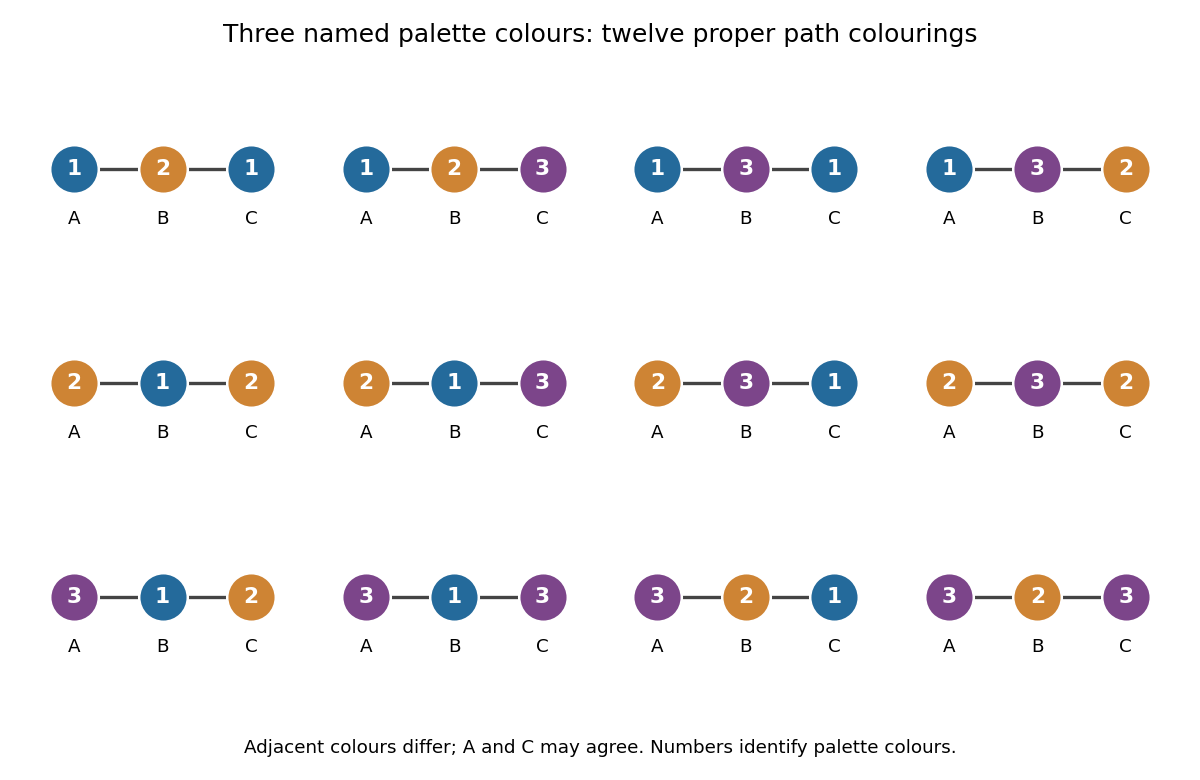


For a nonempty graph, the chromatic number records only the first positive integer for which . The chromatic polynomial also counts the choices for every larger palette. For the path the chromatic number is , and for the triangle it is . Counting assignments also gives a useful interpretation for scheduling: if adjacent vertices represent tasks that must use different slots, the chromatic polynomial counts the valid assignments to named slots. Adding a conflict edge can only remove assignments.
The chromatic polynomial also remembers some of the graph's structure. For a simple graph with vertices and edges, its leading terms are ; its degree of a polynomial gives the number of vertices, and its next coefficient gives the number of edges. It does not determine the graph completely. A four-vertex path graph and a four-vertex star graph are not related by a graph isomorphism, but both are trees and have chromatic polynomial .
The early connection to map colouring appears in George D. Birkhoff's article [ref]
https://www.jstor.org/stable/1967597. A Determinant Formula for the Number of Ways of Coloring a Map, Annals of Mathematics 14 (1912–1913), pp. 42–46
. For a derivation of the counting recurrence and its leading coefficients, see Paul Johnson's MAS 341 lecture on chromatic polynomials. Edge chromatic number Created 2026-09-24 Updated 2026-10-14
The edge chromatic number is the least number of colours required to colour edges so that incident edges receive different colours.
Chromatic number Created 2026-09-24 Updated 2026-10-14
For a nonempty finite simple graph , the chromatic number is the least positive integer for which has a proper vertex graph coloring with at most colours. To establish an exact chromatic number, give a colouring using that many colours and explain why fewer cannot suffice. A colouring alone gives only an upper bound.[ref]
Mathematics for Computer Science by Eric Lehman and others. Lehman, Leighton and Meyer, Mathematics for Computer Science, Definition 11.7.1
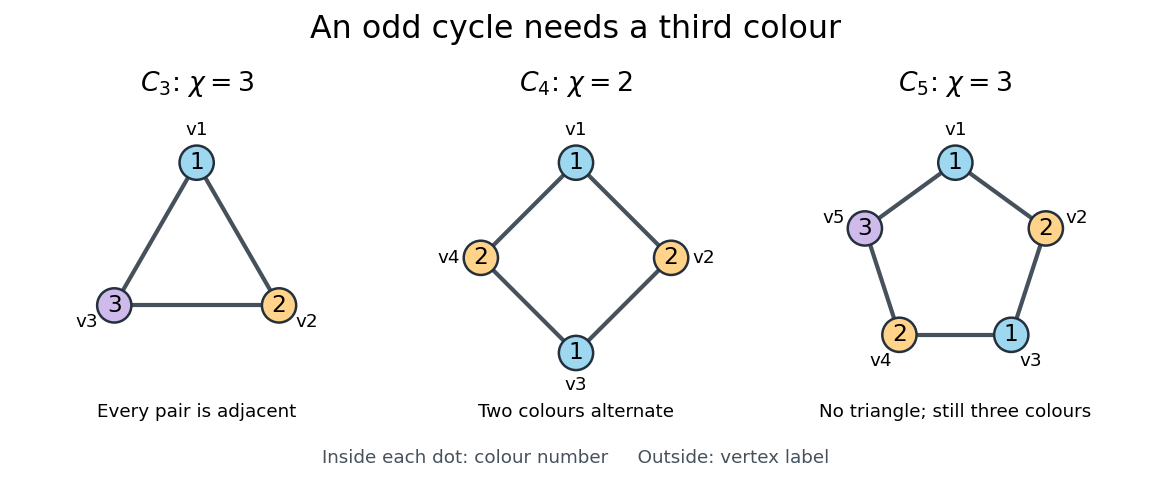

These small graphs show why the chromatic number measures more than the presence of triangles in a graph:
- The cycle graph , also the complete graph , has chromatic number three. Every pair of vertices is adjacent, so three distinct colours are necessary and sufficient.
- The cycle graph has chromatic number two. Around the graph cycle, the assignment is proper, and a single colour would violate every edge.
- The cycle graph has chromatic number three. With two colours, alternation around the graph cycle would force the first and fifth vertices to have the same colour despite their joining edge. The assignment works. Thus a triangle-free graph can still require more than two colours.
- The complete graph has chromatic number : all vertices are pairwise adjacent, so each must have its own colour.[ref]
For a cycle graph of even length, alternating two colours closes consistently; for an odd cycle, it does not, and a third colour on the final vertex suffices. More generally, the two-colourability criterion for bipartite graphs says that exactly when is a bipartite graph, and the odd-cycle characterization of bipartite graphs identifies the obstruction as an odd cycle. A nonempty graph with no edges has chromatic number one; a bipartite graph with at least one edge has chromatic number exactly two.
In the pairwise-conflict scheduling model of graph coloring, is the least number of interchangeable slots needed. This turns a drawing into an optimization question: how many groups of compatible activities are unavoidable? Greedy coloring constructs a valid grouping quickly, but its number of colours can exceed the chromatic number.
Triangle in a graph Created 2026-09-24 Updated 2026-10-14
There are unlisted articles, also show them or only show them.