
Galton-Watson extinction fixed point Created 2026-09-24 Updated 2026-10-14
For a Galton-Watson process with one ancestor and offspring probability generating function , the branching extinction probability is the smallest fixed point of in . A direct way to find it is to compute extinction by generation :Zero is an absorbing state, so extinction by generation is exactly the event . [ref]
https://ocw.mit.edu/courses/18-445-introduction-to-stochastic-processes-spring-2015/27aaeb9eb9a9cecce93d9ad74413ddf5_MIT18_445S15_lecture19.pdf. Hao Wu, MIT 18.445, Lecture 19, slide 4
For , the equation isBoth and are fixed points, but iteration from zero selects . The first values are , , , and . Iteration started at would stay at forever and would give the wrong extinction answer for this offspring distribution.
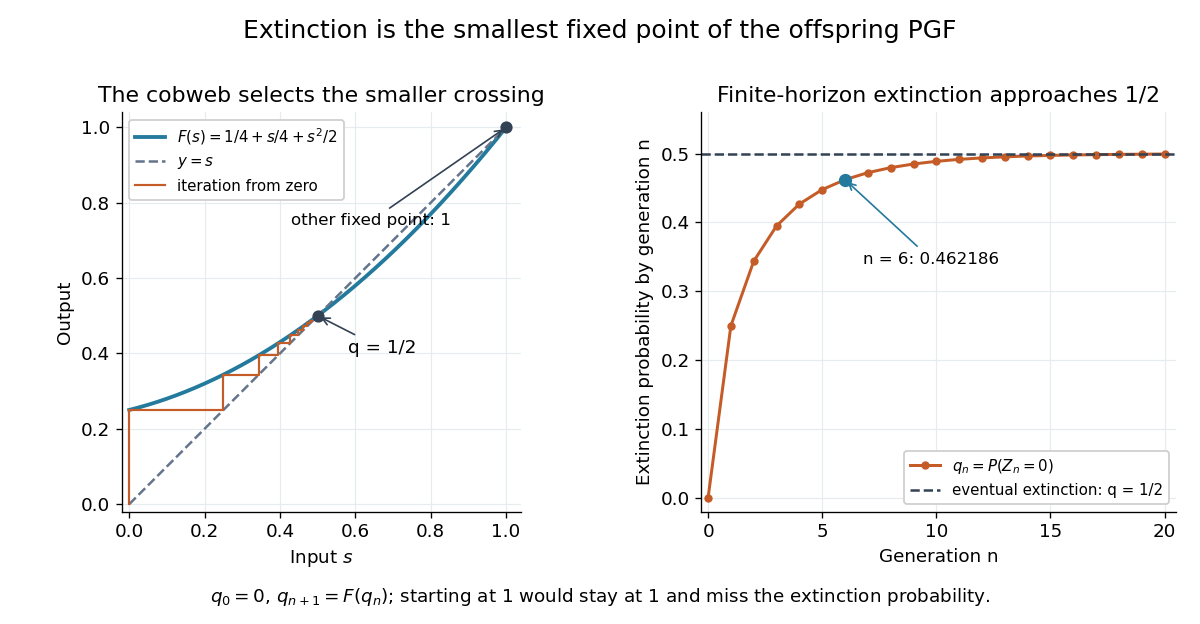
The smallest extinction fixed point selected by iteration from zero
. Details. 
The vertical steps in the figure apply the offspring probability generating function; horizontal steps return to the diagonal to start the next iteration. This gives a useful numerical calculation even when solving explicitly is difficult. For the displayed law, every finite iteration is a lower bound for the eventual branching extinction probability; at generation six, about additional extinction probability remains beyond the current empty families.
Why the smallest fixed point? The ancestor's children's descendant families are independent; given children, all are empty generations later with probability . Averaging gives . The increasing extinction events give the limit , and continuity of the probability generating function yields . For any other fixed point , and monotonicity of imply at every step; hence . [ref]
https://www.uni-muenster.de/Stochastik/lehre/WS1011/SpezielleStochastischeProzesse/Ch_1.pdf. University of Münster branching-process notes, Section 1.4, Theorem 1.7
Characteristic-two cubic resolvent Created 2026-09-24 Updated 2026-11-05
Let be the roots of the separable polynomial in characteristic two. The cyclic sumsare the distinct roots ofEven root permutations fix , while odd permutations interchange them. The cubic Galois group is therefore contained in exactly when this quadratic splits over the base field.
Galois group of an irreducible cubic Created 2026-09-24 Updated 2026-11-05
A separable irreducible cubic over a field of characteristic other than two has Galois group when its discriminant is a square and otherwise.
Solvability by radicals Created 2026-09-24 Updated 2026-11-05
Over a field of characteristic zero, a polynomial is solvable by radicals when its roots lie in a tower obtained by adjoining successive roots; equivalently, its Galois group is solvable.
Lagrange resolvent for a cubic Created 2026-09-24 Updated 2026-11-05
For roots of a depressed cubic over a field of characteristic zero, choose a primitive cube root of unity . Its Lagrange resolvent for a cubic consists of the Fourier combinationsCyclically permuting the roots multiplies these combinations by cube roots of unity, so their cubes are fixed by the cyclic subgroup. Direct expansion gives and . Their cubes are therefore the roots of the cubic resolvent .
Since the roots sum to zero, . The quadratic equation for the cubes, followed by compatible cube roots, gives the mechanism of the Cardano formula. A primitive root is required: choosing would make both combinations vanish.
Polynomial discriminant Created 2026-09-24 Updated 2026-11-05
Galois correspondence Created 2026-09-24 Updated 2026-11-05
For a finite Galois extension, subgroups correspond in reverse order to intermediate fields by taking fixed fields and field-fixing subgroups.
Artin fixed-field theorem Created 2026-09-24 Updated 2026-11-05
If a finite group acts faithfully by automorphisms on a field , then is Galois, has degree , and has Galois group .
This theorem constructs a Galois extension from a finite group of field automorphisms; it is not an alternative name for the extension itself.
Fixed field Created 2026-09-24 Updated 2026-11-05
For a group of automorphisms of a field , the fixed field isFor one automorphism , it is also written .
Constructible field extension Created 2026-09-24 Updated 2026-11-05
A finite real extension is constructible when it is contained in a towerEquivalently, every element of can be obtained from rational numbers by field operations and successive square roots.
Cyclotomic polynomial Created 2026-09-24 Updated 2026-11-05
is the monic polynomial whose roots are the primitive th roots of unity. It belongs to and is irreducible over .
Dedekind factorization cycle test Created 2026-09-24 Updated 2026-11-05
Let be monic and separable over . If its reduction modulo a prime number is squarefree, factor it into distinct irreducible polynomials of degrees . The Galois group of a polynomial then contains an element with cycle lengths : a Frobenius automorphism at a prime of the splitting field acts on the reduced roots in precisely those orbits.
The squarefree-reduction condition, equivalently , ensures that reduction distinguishes the roots. Merely assuming that is unramified in the number field generated by a root is insufficient for an arbitrary generator. For example, has repeated reduction modulo two even though two is unramified in ; its power basis has index two. For a good prime, a quadratic times an irreducible cubic therefore gives a permutation with one 2-cycle and one 3-cycle, a useful constraint on the Galois group.
Frobenius cycle type Created 2026-09-24 Updated 2026-11-05
Over , Frobenius acts on roots of an irreducible degree- polynomial as an -cycle. Factor degrees therefore give its cycle type.
Irreducible factors after Frobenius substitution Created 2026-09-24 Updated 2026-11-05
Let be monic, irreducible and separable in characteristic , and put . Every monic irreducible factor of is either itself or separable. Indeed, if were inseparable, then ; divisibility of into forces , hence and .
Galois group of a polynomial Created 2026-09-24 Updated 2026-11-05
The Galois group of a separable polynomial acts faithfully on its roots; this action is transitive exactly when the polynomial is irreducible.
Kummer extension of rational function fields Created 2026-09-24 Updated 2026-11-05
If a field has characteristic prime to and contains all th roots of unity, then is a cyclic Galois extension of degree , with automorphisms .
Roots of unity in a finite field Created 2026-09-24 Updated 2026-10-03
The multiplicative group is cyclic of order , so it contains all th roots of unity when divides and the characteristic does not divide .
Finite Galois extension Created 2026-09-24 Updated 2026-11-05
Field automorphism Created 2026-09-24 Updated 2026-11-05
A field automorphism is a bijective ring homomorphism from a field to itself. The automorphisms fixing a specified subfield form a Galois group when the extension is Galois.
Splitting field Created 2026-09-24 Updated 2026-11-05
The splitting field of a polynomial over is the smallest field extension of in which the polynomial is a product of linear factors.
There are unlisted articles, also show them or only show them.