
Path in a graph Created 2026-09-24 Updated 2026-10-31
Edge of a graph Created 2026-09-24 Updated 2026-11-05
An edge of a graph joins endpoints in a graph. For a simple graph it is an unordered pair of distinct vertices of a graph; for a directed graph its endpoints are ordered.
Leaf of a graph Created 2026-09-24 Updated 2026-11-05
Graph Created 2026-09-24 Updated 2026-10-18
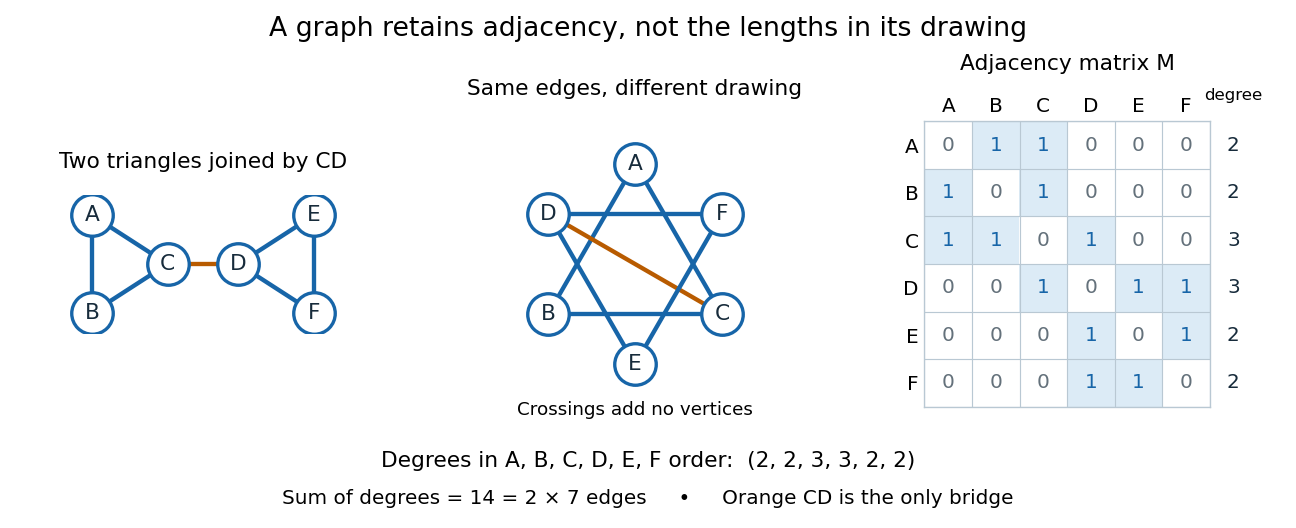

A graph describes objects, called vertices, and pairwise connections, called edges. Its vertex set tells us what the objects are; records their connections. The basic abstraction retains graph adjacency while discarding positions, angles and Euclidean distances: moving the dots in a drawing changes none of the edges. A crossing of two drawn lines is not an extra vertex unless explicitly designated as one. Even the labels can change: a graph isomorphism is a relabelling that preserves graph adjacency in both directions.[ref]
This makes graphs useful when the question concerns possible connections rather than physical shape. For example, model locations by vertices and direct links by edges; a graph path answers whether one location can reach another. Alternatively, let vertices be activities and edges represent conflicts: a graph coloring then assigns compatible time slots. These are mathematical models, so one must decide which pairwise relationship an edge means before applying graph theory.[ref]
Our running simple graph haswhere abbreviates the unordered pair . It consists of two triangles in a graph, and , joined by . The two drawings above have identical graph adjacency, even though their apparent lengths differ. What counts is that and are adjacent, whereas and are not.
Route questions require precise vocabulary. A walk is a sequence of consecutive adjacent vertices, permitting repetitions; its length counts traversed edges. A trail is a walk that repeats no edge; a graph path repeats no vertex. For a multigraph, the walk must also specify which parallel edge each step uses. For instance, is a length-five walk but not a trail, since it uses twice. The length-three graph path is a shortest route: crossing between the two triangles in a graph requires , with at least one edge before it and one after it. Thus in graph distance, regardless of the drawing.[ref]
https://ocw.mit.edu/courses/6-1200j-mathematics-for-computer-science-spring-2024/mit6_1200j_s24_lec13.pdf. MIT, Connectivity and Trees, Section 1
An Eulerian trail uses every edge exactly once, allowing repeated vertices; a Hamiltonian path visits every vertex exactly once, without needing every edge. Here is an Eulerian trail of length seven, whereas is a Hamiltonian path of length five. The first repeats ; the second omits . Calling an Eulerian trail an "Eulerian path" must not be taken to impose our graph path convention.[ref]
https://ocw.mit.edu/courses/6-1200j-mathematics-for-computer-science-spring-2024/mit6_1200j_s24_lec13.pdf. MIT, Connectivity and Trees, Section 3
The classic historical example is Euler's Königsberg bridge problem: represent the four land regions by vertices and the seven bridges by distinct edges, giving a multigraph. Their degrees of vertices are . In a trail using every edge, arrivals and departures pair at every internal vertex, so at most the two endpoints can have odd vertex degree. Four odd degrees of vertices therefore rule out such a route. This early foundational example of graph theory needs neither bridge lengths nor a geographical map. Euler's paper is conventionally associated with 1736, the volume's nominal year; the Euler Archive records its writing in 1735 and publication in 1741.[ref][ref]
https://la.wikisource.org/wiki/Solutio_problematis_ad_geometriam_situs_pertinentis. Euler, original Latin text and edition details
Binomial random graph Created 2026-09-24 Updated 2026-10-05
The binomial random graph has vertex set and includes each of the possible edges independently with probability .
Grand potential Created 2026-09-24 Updated 2026-10-14
Grand canonical partition function Created 2026-09-24 Updated 2026-11-05
The grand canonical partition function is
Horseshoe for an interval map Created 2026-09-24 Updated 2026-11-05
In an open-interval convention, a continuous interval map has a horseshoe if there are an open interval and two disjoint open intervals with . Each of the two branches can therefore be followed by either branch on the next step.
For the full tent map on , choose , and . Either branch maps onto . Successive preimages specify a binary itinerary; when branches are monotone they have ordinary inverse branches, while more general continuous covering arguments use the intermediate value theorem to select subintervals.
Open endpoints require care: for example, the all-left limiting itinerary of the tent map selects the boundary point zero. Compact symbolic realizations include suitable endpoints and account for boundary coding ambiguities. The branch-covering geometry nevertheless supplies arbitrarily long binary itineraries and is the mechanism used by interval exactness produces a horseshoe and three-cycle forces a two-iterate interval horseshoe.
Ice sheet dynamics Created 2026-09-24 Updated 2026-11-05
Ice sheet dynamics combines mass conservation with the forces driving and resisting ice flow. For thickness and depth-integrated horizontal flux , a simple fixed-bed budget is , where is net accumulation in ice-equivalent units. A local increase in thickness can therefore come from accumulation or convergent transport.
Surface slopes supply gravitational driving stress, resisted by internal deformation, basal sliding laws and lateral or longitudinal stresses. The shallow-ice approximation and shallow-shelf approximation retain different balances. Near a grounding line, flotation and contact with the bed must be included when connecting an inland ice sheet to an ice shelf.
Maximum-entropy derivation of equilibrium ensembles Created 2026-09-24 Updated 2026-10-24
Maximizing the Gibbs entropy under normalization alone gives a uniform distribution. Adding a fixed mean-energy constraint gives the Boltzmann distribution .
Equatorial wave Created 2026-09-24 Updated 2026-11-05
An equatorial wave is trapped near the equator by the sign change of the Coriolis parameter. Its meridional structures are Gaussian-weighted Hermite polynomials.
Rossby wave Created 2026-09-24 Updated 2026-11-05
A Rossby wave is a low-frequency wave restored by the spatial variation of planetary or background potential vorticity. On a beta plane its phase commonly propagates westward.
Ocean circulation Created 2026-09-24 Updated 2026-11-05
Geostrophic adjustment Created 2026-09-24 Updated 2026-11-05
Geostrophic adjustment is the radiation of inertia-gravity waves from an unbalanced disturbance, leaving a slower flow in geostrophic balance while conserving linearized potential vorticity.
Quasi-geostrophic approximation Created 2026-09-24 Updated 2026-11-05
The quasi-geostrophic approximation describes slowly evolving, nearly geostrophic flow with small Rossby number. Its dynamics are governed by advection and forcing of potential vorticity.
Rotating fluid Created 2026-09-24 Updated 2026-11-05
A rotating fluid is described in a rotating reference frame, where the Coriolis acceleration and centrifugal acceleration supplement the physical forces.
Boussinesq approximation Created 2026-09-24 Updated 2026-11-05
Properly discontinuous group action Created 2026-09-24 Updated 2026-10-14
An action is properly discontinuous when every compact set meets only finitely many of its translates. For an isometric action on a proper metric space, this gives the finiteness needed to extract a constant group element from a sequence with bounded source and target.
For a discrete group action on a locally compact space, a standard proper-discontinuity condition is that only finitely many group elements translate a given compact set to meet itself.
Cocompact group action Created 2026-09-24 Updated 2026-11-05
A group action on a topological space is cocompact when its quotient space is compact. If a compact subset has translates covering , then its quotient image covers , proving cocompactness.
Conversely, for an action by homeomorphisms on a Hausdorff space that is also a locally compact space, compactness of the quotient supplies such a compact . Choose an open neighborhood with compact closure at each point. The quotient map is open, because the inverse image of the image of is the open union . Finitely many quotient images cover the compact quotient. The union of the corresponding finitely many closures is a compact subset whose translates cover .
For example, the integer lattice acts cocompactly on Euclidean space by translations, with . Cocompactness controls coverage of the space. A properly discontinuous group action adds a separate finiteness condition on translates.
Proper metric space Created 2026-09-24 Updated 2026-09-24
There are unlisted articles, also show them or only show them.