
Both terms and are nonnegative, and they vanish simultaneously only at . That point satisfies . Consequentlyand the global minimum is unique. No Lagrange multiplier calculation is needed: nonnegativity gives a lower bound attained at a feasible point.
Here the constraint surface is compact and regular, so a global minimum exists and satisfies the Lagrange multiplier equationsKeep the zero-coordinate cases. If , the two points are , with value . If , the two points are , with value . If both coordinates are nonzero, the equations give . The constraint becomes , whose only positive solution is . These are the four points , all with value .
These cases exhaust the stated eight constrained stationary points. Comparing their values givesFor additional classification, substituting gives , withIt decreases from to and increases from to . Thus the two -axis points are constrained local maxima, the two -axis points are global maxima, and the four mixed-coordinate points are global minima.
Use and . Every feasible point has , so cannot vanish. The Lagrange multiplier equations areThe first gives . If , the second would give , a contradiction. Therefore , and the constraint gives . The only constrained stationary points are .
Assume and are continuously differentiable near the point. At a regular feasible point, meaning and , a differentiable constrained local extremum satisfies the Lagrange multiplier equationsThey arise by differentiating the optimization Lagrangian with respect to all coordinates and the multiplier. Geometrically, the objective has zero derivative along the tangent space of the constraint surface, so its gradient must lie in the normal direction.
Solve these equations for candidates, examine feasible points where the regularity condition fails separately, and compare objective values or use a second-order test restricted to feasible directions. The equations locate stationary points; they do not by themselves establish which are minima or whether a global minimum is attained.
Let for the limit . Quadratic convergence means that eventually for a fixed constant ; exact asymptotic order two has with .
For this iteration and , direct algebra givesUsing the stipulated convergence , the ratio of successive squared errors isThus the convergence is quadratic. The iteration is well defined here: , and thereafter implies . The initial point is not already the limit, so the error ratio is meaningful.
Prove the stronger statement with a nonempty subset. Order the integers as , and form the prefix sumsThere are such sums but only residue classes modulo . The pigeonhole principle gives indices with . Their difference satisfiesThe selected elements form a nonempty subset of , proving the claim. Neither positivity nor distinct values in a general ordered sequence are needed for the consecutive sum divisible by the sequence length argument; distinctness merely makes the present input a set.
For five points, partition the unit square into four squares of side . Assign boundary points to just one neighbouring piece. By the pigeonhole principle, two of the points lie in one piece, whose diameter is its diagonal, .
For eight points, use seven smaller-diameter pieces rather than eight rectangles. Start with the convex pentagonTake its four reflected copies at the corners of the square. The remaining pieces are the left triangle with vertices , its right-hand reflection, and the central diamond with vertices . These seven polygons cover the square with disjoint interiors. To verify coverage directly, for the two bottom pentagons split the horizontal section at . For , the five successive sections have endpoints and belong respectively to the left triangle, bottom-left pentagon, diamond, bottom-right pentagon and right triangle. Reflection gives the top half.
The diameter of a finite convex hull is the greatest distance between its vertices: if two points are convex combinations of vertices, their difference is a convex combination of vertex differences, and the triangle inequality bounds its norm by the largest such distance. Checking the five vertices of gives diameter ; reflections preserve that value. Each remaining triangle and the diamond has diameter , which is smaller. After assigning shared boundaries to one piece, eight points in these seven pieces force a pair in a common piece. Hence some pair is at distance at most .
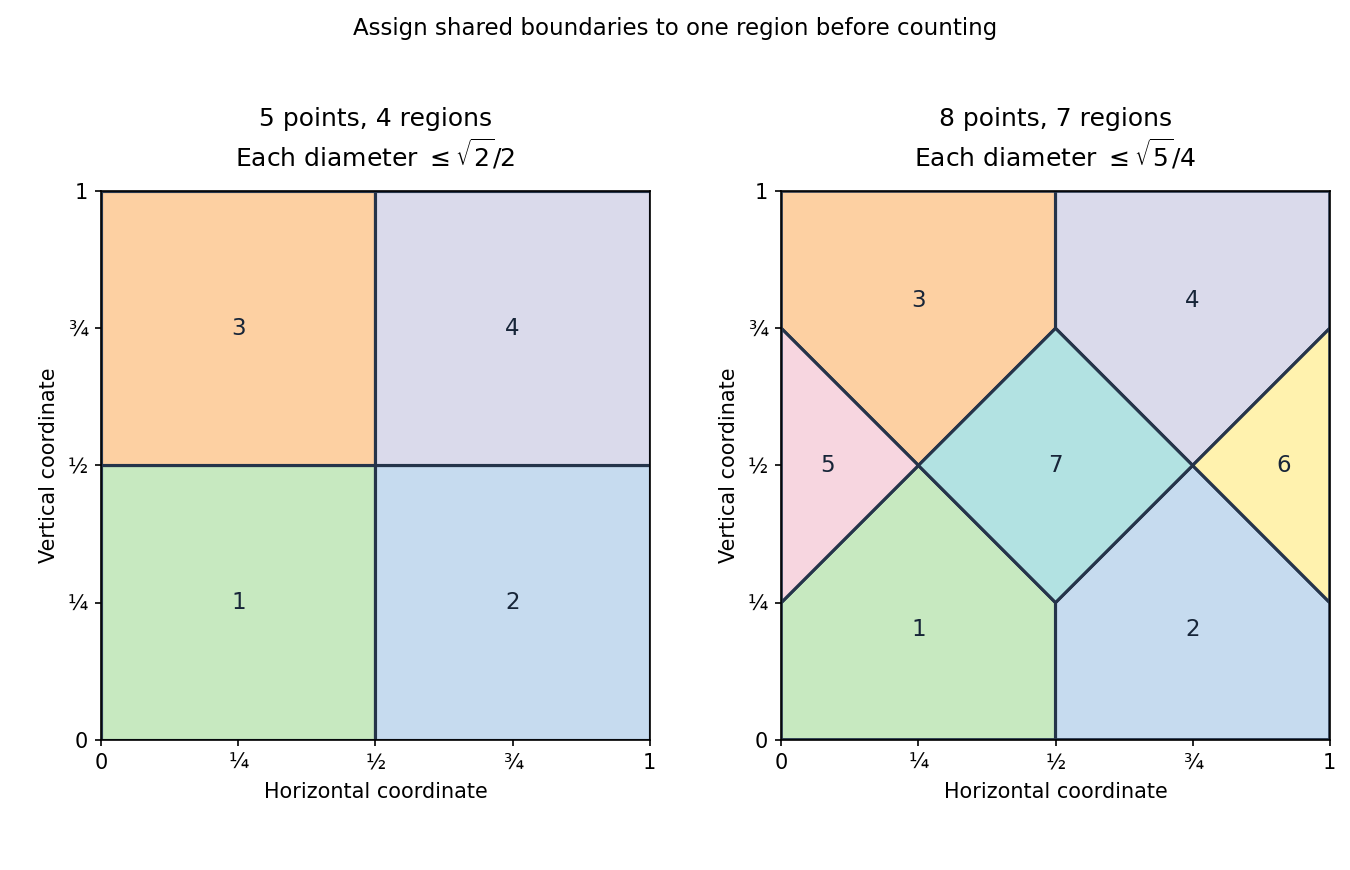
Four and seven regions give the two distance bounds by the pigeonhole principle
. Details. 
Both arguments are instances of a pigeonhole distance bound from a partition.
The pigeonhole principle states that if more than objects are placed in boxes, with , at least one box contains two or more objects. Equivalently, a function from a finite set of more than elements to a set of elements cannot be injective: if every box held at most one object, there would be at most objects altogether.
The Euclidean algorithm givesThe last nonzero remainder is . Back-substitution produces its Bézout coefficients:Thus is a requested pair. The final equality independently checks the calculation.
The integer congruence means : the difference is an integer multiple of the positive modulus . Write and for integers . Thenso addition preserves integer congruence. For multiplication,The final coefficient is an integer, so multiplication also preserves integer congruence. These properties make addition and multiplication well defined on residue classes.
There are unlisted articles, also show them or only show them.