
Lecture notes in Math 221, Matrix Computations, Fall 2009, dated 10 November 2009 in the heading. The page has no explicit author byline. James Demmel is the verified course instructor; the University of California, Berkeley EECS faculty website hosts the notes. No separate publication date or institutional authorship is asserted.
Cited passages: Basic iterative methods, splitting and recurrence (*); spectral-radius lemmas and convergence-for-all-starts theorem; Jacobi and Gauss-Seidel component loops; strict row diagonal dominance, Theorem 1 and proof; 1D Dirichlet Poisson matrix and sine eigenvectors.
Additional cited passages: opening solver building blocks; Gauss-Seidel component loop, splitting, ordering remark and red-black scheduling; Theorem 1, strict row diagonal dominance; Theorem 3, SOR convergence for symmetric positive-definite matrices with the ω = 1 specialization. The lecture date and instructor association above remain distinct from author bylines and publication dates.
List of materials scientists Created 2026-10-18 Updated 2026-10-20
Aston velocity focusing 2026-10-18
In Mass spectra and isotopes by Francis William Aston, printed pp. 10–12, Fig. 1, Francis William Aston describes successive electric and magnetic deflections in one plane, with opposite senses. This geometry focuses a range of ion speeds; it does not require the straight-through cancellation of a velocity selector.
The reason compensation is possible follows from the Lorentz force. In a short region of length , a small electric deflection angle has magnitude : the transverse acceleration acts for a time , and the deflection angle is the acquired transverse velocity divided by . A short magnetic region of length gives , since the magnetic force already contains one factor of speed. Slower ions therefore receive a disproportionately larger electric deflection.
An original local approximation makes the focusing idea explicit. At fixed mass-to-charge ratio, replace each region by a small angular kick and include the drift distances in two positive constants and . With , write the detector coordinate asChoosing the geometry and fields so that eliminates the first-order speed sensitivity. Indeed,A fractional speed error then contributes only at order in this approximation. This is a local thin-kick explanation, not Aston's exact pole geometry, focal-plane equation, or a prediction of its measured mass resolution. Finite slit widths, initial directions, and field boundaries still matter. Unlike a velocity selector, focusing can collect nearby speeds into a narrow image instead of discarding all but a narrow accepted range.
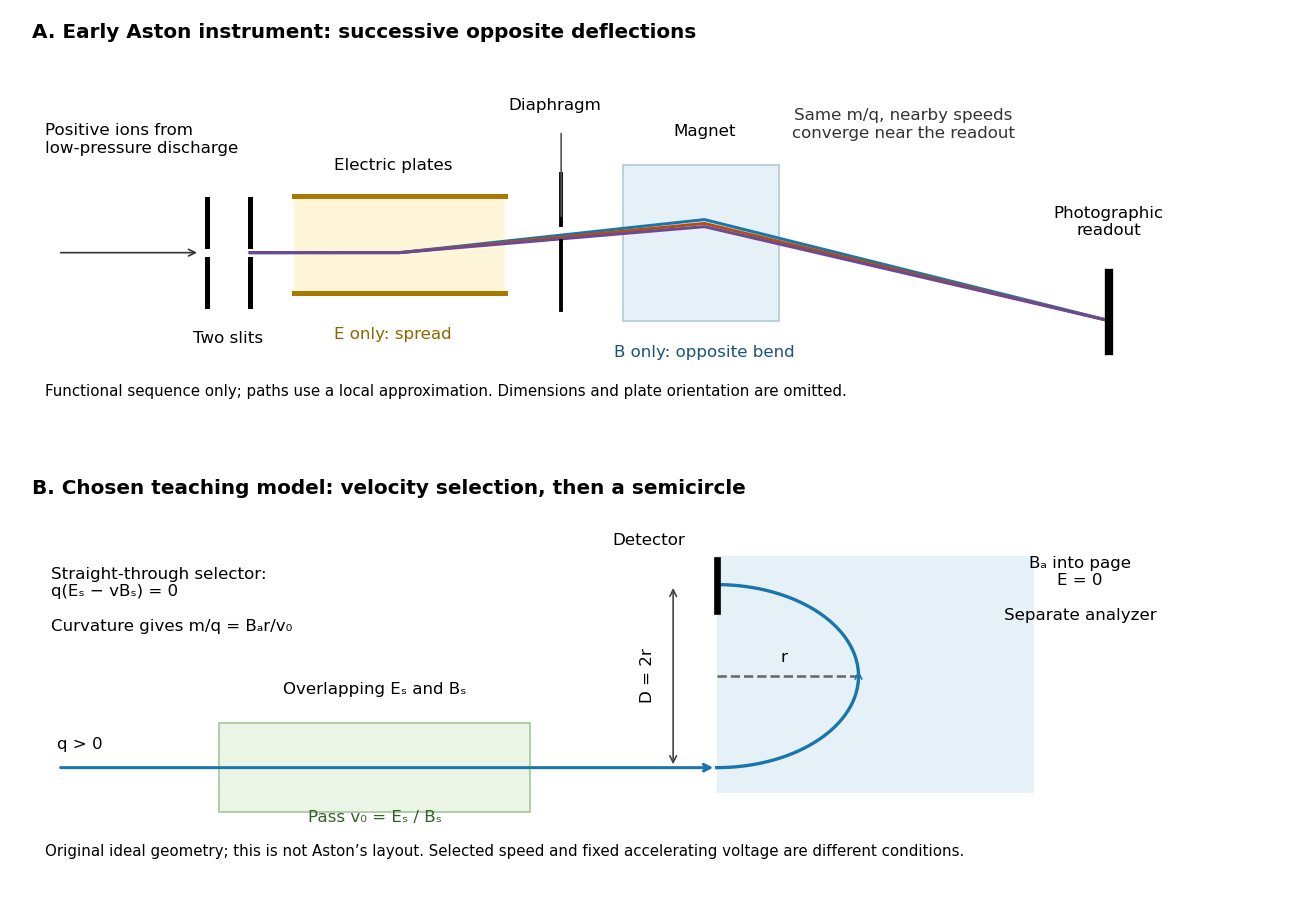
Successive opposite deflections in an early mass spectrograph, compared with a chosen velocity selector and magnetic analyzer
. Top: functional schematic of the sequence described by Francis William Aston; colored paths indicate one mass-to-charge ratio at nearby speeds. Paths use the local thin-kick illustration, and dimensions and plate orientation are not a reconstruction. Bottom: an independently chosen teaching geometry has overlapping selector fields followed by a separate semicircular magnetic path. Both diagrams show positive ions; the Thomson charge-to-mass experiment gives the corresponding negative-electric charge example. Details.
Work by Masayuki Senoh 2026-10-18
Work by Masao Ono 2026-10-18
Work by Masahiro Kito 2026-10-18
Work by Marwan K. Al-Shawi 2026-10-18
Work by Marc Ferrari 2026-10-18
Work by M. Tinkham 2026-10-18
Work by M. P. Nightingale 2026-10-18
Work by M. Nobili 2026-10-18
Work by M. Kohmoto 2026-10-18
Work by M. J. Berger 2026-10-18
Work by M. Ferray 2026-10-18
Work by M. den Nijs 2026-10-18
Work by M. Breidenbach 2026-10-18
Work by M. A. Zucker 2026-10-18
Work by Lund University 2026-10-18
Work by Luke Dixon 2026-10-18
There are unlisted articles, also show them or only show them.