
If a regression response is observed but covariate is sometimes missing, likelihood inference requires a joint model: for example . An incomplete record contributes to the observed-data likelihood. Missing at random with distinct parameters allows the missingness mechanism to be omitted; it does not remove the need to integrate over .
Mean free path Created 2026-10-06 Updated 2026-10-14
The mean free path is the average distance travelled between collisions. For dilute targets with number density and effective collision cross-section , ; identical-particle conventions introduce factors such as .
For a negative fundamental discriminant , primitive positive definite integral binary quadratic forms of discriminant , modulo proper equivalence, correspond bijectively to the ideal class group of . The displayed ideal gives one conventional choice of this correspondence. Reduced positive definite binary quadratic forms give unique class representatives with the usual boundary sign convention, making class-number computations finite.
The ideal-form correspondence for imaginary quadratic fields and the reduction bound give exactly the forms , and . Thus the class number is three and the ideal class group is cyclic of order three.
Narrow ideal class group Created 2026-10-06 Updated 2026-10-14
The narrow ideal class group of a number field is the group of nonzero fractional ideals modulo principal fractional ideals generated by totally positive elements. It is the ray class group for the modulus consisting of all real Archimedean places and trivial finite part. The forgetful map to the ordinary ideal class group is surjective, with kernel under the unit signature map.
Uniform hypergraph 2026-10-06
A hypergraph is -uniform if each hyperedge has exactly vertices. Ordinary simple graphs are 2-uniform hypergraphs. Its average hypergraph vertex degree is .
Hypergraph vertex degree 2026-10-06
The degree of a vertex in a hypergraph is the number of hyperedges containing . For a uniform hypergraph, summing degrees counts each hyperedge once for each of its vertices, so . In a multihypergraph, incidences are counted with multiplicity.
Hypergraph independent set 2026-10-06
A subset of the vertices of a hypergraph is independent when no hyperedge lies wholly inside . This generalizes an independent set in an ordinary graph. If a hypergraph has ordinary graph edges as its vertices and forbidden copies as its hyperedges, these independent sets encode graphs without those forbidden copies.
Multihypergraph 2026-10-06
A multihypergraph has a multiset of hyperedges, allowing the same subset of vertices to appear more than once. Its hypergraph vertex degrees and hypergraph codegrees count multiplicity. Such multiplicity is important when several original hyperedges produce the same link in a hypergraph container theorem.
Extremal hypergraph theory 2026-10-06
Extremal hypergraph theory studies the largest or smallest possible size of a hypergraph under prescribed forbidden-subhypergraph or covering conditions. It generalizes extremal graph theory. The Turán density describes the asymptotic maximum edge proportion for a fixed uniform forbidden hypergraph.
Polychromatic coloring of a hypergraph Created 2026-10-06 Updated 2026-10-14
A polychromatic coloring of a hypergraph assigns colors to vertices so that every hyperedge contains all colors. It is stronger than merely requiring each hyperedge to be nonmonochromatic. Independently random colors and the Lovász local lemma can construct such colorings when edges are sufficiently large relative to their overlap degrees.
Hyperbolic side-side-side congruence 2026-10-06
Three corresponding side lengths determine a hyperbolic triangle up to an isometry of the hyperbolic plane. First match an ordered pair of vertices by an isometry. The third vertex lies at the intersection of two prescribed hyperbolic distance circles. There are at most two choices, interchanged by reflection in the geodesic through the matched pair; either choice can therefore be matched.
Hyperbolic side-side-angle ambiguity Created 2026-10-06 Updated 2026-10-14
Two corresponding side lengths and an equal nonincluded angle need not determine a hyperbolic triangle. Set , , . The hyperbolic law of cosines has two distinct positive solutions . The two triangles share but have different third sides. An included angle instead determines the third side by the cosine rule.
Hyperbolic collar 2026-10-06
Length spectrum Created 2026-10-06 Updated 2026-10-07
The unmarked length spectrum of a compact hyperbolic surface is the multiset of lengths of its closed geodesics, with a consistent convention for primitive curves and orientation. The marked version labels lengths by free homotopy classes. The Selberg trace formula relates the unmarked multiset to the Laplace-Beltrami operator spectrum.
Hyperbolic disc Created 2026-10-06 Updated 2026-10-14
A hyperbolic disc consists of points within a specified hyperbolic distance of its centre. In the Poincare disc model, the disc centred at zero with radius has Euclidean radius ; an isometry transports this description to any other centre.
Non-Hopfian group 2026-10-06
A non-Hopfian group admits a surjective endomorphism which is not injective. The Baumslag-Solitar group has such an endomorphism , : its image contains and , while the nonidentity commutator lies in its kernel by Britton's lemma.
Hopf normal form Created 2026-10-06 Updated 2026-10-14
The Hopf normal form is a local normal form of a dynamical system on the critical two-dimensional centre manifold. After shifting the equilibrium point and changing coordinates, its cubic truncation can be writtenwhere is the critical eigenvalue real part, , , and . Smooth parameter dependence of the cubic coefficients and higher-order terms are omitted in this truncation. The real coefficient controls radial saturation; the imaginary coefficient changes the angular frequency with amplitude. This finite-order reduction, rather than literal equality to a cubic equation everywhere, is the meaning of the Hopf normal form for a general system.[ref]
https://www.ma.imperial.ac.uk/~dturaev/bif_theory3.pdf. Dmitry Turaev's bifurcation-theory notes, section 3, parameter-dependent complex normal form
In the cubic truncation, whenever . Substituting into the angular equation gives . For the full smooth system, the leading normal form radius satisfies and the period tends to . The exact circle and exactly constant angular frequency of the special model , , are conveniences of that model. In the original coordinates the small periodic orbit need not be a circle. Radial scaling can normalize a nonzero to or , so is a normalized leading amplitude, not a universal physical radius.
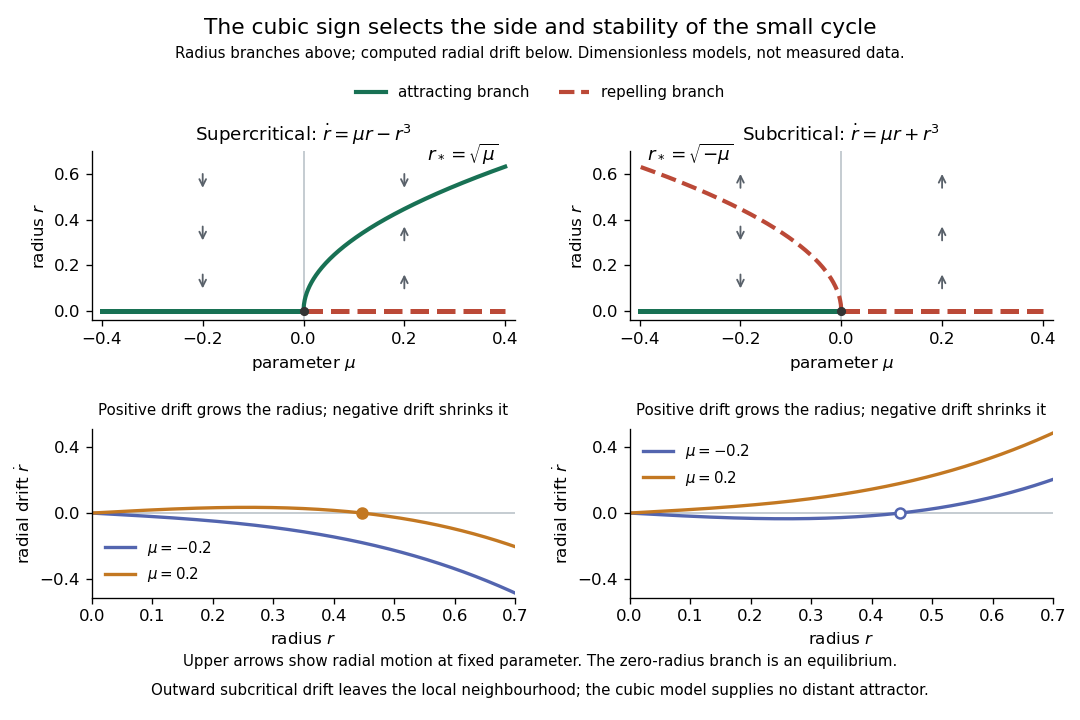
Computed radius branches and radial drift for the two Hopf criticalities
. The exact cubic Hopf normal forms and , with nonzero angular motion understood. The upper bifurcation diagrams distinguish attracting solid branches from repelling dashed branches; is an equilibrium point, while a nonzero constant radius is a periodic orbit. Vertical arrows show radial motion at fixed . Below, the sign of shows why the nonzero roots attract or repel. Stability is within the reduced plane. These are original dimensionless calculations, not measured data; continuation away from zero is a property of the chosen cubic equations, not a global prediction of the local Hopf bifurcation theorem. Details.
Antipode 2026-10-06
The convolution inverse of the identity on a bialgebra: . Existence makes the bialgebra a Hopf algebra; reverses multiplication.
Internal hom for modules over a Hopf algebra 2026-10-06
There are unlisted articles, also show them or only show them.