
Positive distribution Created 2026-09-24 Updated 2026-10-05
A real distribution is positive when for every nonnegative test function . Every positive distribution has order zero and is represented locally by a positive measure.
Taylor series Created 2026-09-24 Updated 2026-10-14
For a function with derivatives of every order at , its Taylor series is the power seriesIts partial sums are Taylor polynomials. At it is called a Maclaurin series. Forming the coefficients, proving that its partial sums form a convergent sequence, and proving that their limit equals are separate tasks. A smooth function provides all the coefficients, but a real analytic function is additionally represented locally by the resulting power series.
For the exponential function, every derivative of at zero equals one, givingHere equality holds for every real : the Taylor remainder is bounded by , which tends to zero for each fixed . At , the degree-five Taylor polynomial is , and the absolute difference from is less than . The factorial denominator eventually overwhelms every fixed power, allowing local derivative information to reconstruct this function throughout the real line.
The geometric series shows why the region of validity matters. For , the Taylor series at zero is , with radius of convergence one. For , its finite Taylor polynomial satisfies the exact identityAt and , the remainder is . At , the same degree-five polynomial has value and remainder , although the Taylor series still converges to there. Convergence of the infinite expression does not guarantee accuracy from a particular small number of terms. For , even the terms fail to tend to zero, so this power series cannot represent the function. The standard expansions and the conditions for convergent series are discussed in OpenStax, working with Taylor series.
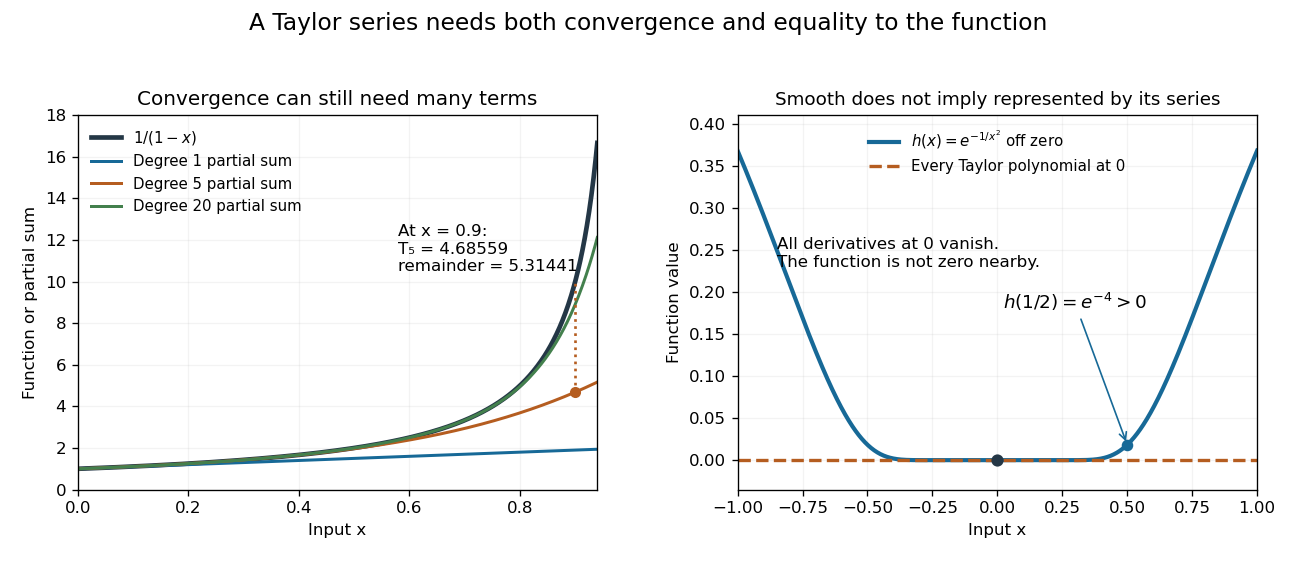
Geometric partial sums converge slowly near their convergence boundary, while a smooth flat function has an identically zero Taylor series
. Details. 
A stronger caution comes from the flat functionIt is a smooth function with for every , so every Taylor polynomial at zero is zero and its Taylor series converges everywhere to zero. Nevertheless . Off zero, repeated differentiation produces a polynomial in times ; the exponential decay makes each required limit at zero vanish. This explains how all the local coefficients can miss a positive function arbitrarily close to the centre. Real analyticity supplies the additional condition that rules out this behavior.
Taylor remainder Created 2026-09-24 Updated 2026-10-14
The Taylor remainder is the difference between a function and a finite Taylor polynomial. Bounds on higher derivatives or their Hölder continuity control this error.
Taylor theorem with Lagrange remainder Created 2026-09-24 Updated 2026-10-14
Multivariate Taylor polynomial Created 2026-09-24 Updated 2026-09-24
Tail event Created 2026-09-24 Updated 2026-10-14
A tail event is an event , where is the tail sigma-algebra of the chosen sequence of random variables. It concerns information available arbitrarily far along the sequence. In the measurable coordinate models described in finite-prefix invariance of tail events, any finite edit preserves whether it occurs.
This is stronger than merely needing a long waiting time. On , with denoting heads, let , taking if there is no head. The eventis not a tail event: changing only from zero to one changes membership. Under fair independent Bernoulli trials its probability is . Even the event , of probability one in this model, is not a tail event as a literal set: the all-zero sequence and the sequence with just one initial head differ in one coordinate. A probability of zero or one does not characterize tail events.
Cosmological Euler equation in synchronous gauge Created 2026-09-24 Updated 2026-10-06
For scalar perturbations of a generic fluid in cosmic time, momentum conservation in synchronous gauge in cosmology gives
Similarity variable Created 2026-09-24 Updated 2026-09-24
A similarity variable is constant along symmetry-group orbits and parametrizes group-invariant solutions.
Projective Lie symmetry of the potential Burgers equation Created 2026-09-24 Updated 2026-09-24
The vector fieldgenerates the local transformationsIts second prolongation sends to times that expression, so it is a Lie point symmetry of the potential Burgers equation.
Group-invariant solution Created 2026-09-24 Updated 2026-09-24
Inclusion map between subset permutation modules Created 2026-09-24 Updated 2026-09-24
Sign of a permutation Created 2026-09-24 Updated 2026-10-14
The sign homomorphism is the determinant of the corresponding permutation matrix. A transposition has sign , so this also proves that the parity of any transposition decomposition is well-defined.
Support of a permutation Created 2026-09-24 Updated 2026-10-03
The support of a permutation is the set of elements it does not fix. A permutation has finite support when this set is finite.
Permutation cycle Created 2026-09-24 Updated 2026-10-03
Sign homomorphism Created 2026-09-24 Updated 2026-10-03
The sign homomorphism sends an even permutation to and an odd permutation to ; its kernel is the alternating group.
A symmetric group is the group of all bijections from a set to itself, with function composition as its operation.
Symbol calculus Created 2026-09-24 Updated 2026-09-24
Even-involution coset fixed-point lemma Created 2026-09-24 Updated 2026-09-24
Suppose a finite group has no index-two subgroup, is a Sylow -subgroup, has index two in , and has order two. The sign of the action on defines a homomorphism and is therefore trivial. Since , a fixed-point-free involution would be an odd number of transpositions. Thus fixes a coset , equivalently .
Sylow counts in a faithful degree-seven action with S4 point stabilizers Created 2026-09-24 Updated 2026-09-24
Suppose a group acts faithfully and transitively on seven points, every point stabilizer is , and every two-point stabilizer is a Klein four-group. Then the group has order andCount pairs consisting of a point and a Sylow subgroup fixing it for ; the two-point stabilizer ensures uniqueness. For , a normal Sylow subgroup would force the group into its order- normalizer in .
Sylow containment from a coset fixed point Created 2026-09-24 Updated 2026-09-24
Sylow subgroups of S3, S4 and A5 Created 2026-09-24 Updated 2026-09-24
The Sylow -subgroups of are its three transposition subgroups, while its unique Sylow -subgroup is . The three Sylow -subgroups of are dihedral groups of order eight and are the normalizers of the three cyclic subgroups generated by inverse pairs of -cycles. The five Sylow -subgroups of are Klein four-groups, one fixing each letter.
There are unlisted articles, also show them or only show them.