
Integral domain Created 2026-09-24 Updated 2026-10-14
An integral domain is a nonzero commutative ring without zero divisors. Equivalently, a product of two nonzero elements is always nonzero. The zero ring is excluded, and fails because . Every field is an integral domain, but the integers show that the converse fails: has no multiplicative inverse in . See MIT's Basic Properties of Rings, definitions 15.9–15.10 and example 15.11.
The practical benefit is multiplicative cancellation. In the integers, has at most one solution and indeed works. Yet has no integer solution. Thus multiplicative cancellation guarantees uniqueness when a solution exists; it does not guarantee division by every nonzero element. Passing to the fraction field supplies the missing solution .
The polynomial ring is also an integral domain. For example, the product of and has leading coefficient and cannot vanish. Generally the leading coefficient of a product is the product of the two leading coefficients; an integral domain prevents that coefficient from vanishing. This connects integer arithmetic to polynomial arithmetic through one reusable principle.
Historically, this connection grew far beyond elementary examples. Keith Conrad identifies the ring of integers of a number field and a ring of polynomial functions on a smooth plane curve as early important examples of Dedekind domains. This shared structure connects number theory with algebraic geometry; see Conrad's Ideal Factorization, section 6.
Ring Created 2026-09-24 Updated 2026-10-14
A ring is a set with two binary operations, addition and multiplication, satisfying three requirements. Under addition, is an abelian group: there is a zero, every element has an inverse element, and grouping or exchanging summands does not change the result. Multiplication is associative and has an identity element , so and . Finally, both versions of the distributive property hold:Here every ring is unital, but the zero ring, with , is allowed. Commutativity of multiplication is an additional condition defining a commutative ring. These conventions agree with [ref].
The integers form a ring with their usual operations. The polynomial ring is another: addition combines coefficients, while multiplication uses the distributive property. For example,The same rules justify symbolic calculations in both rings; this is why one definition can organize apparently different kinds of arithmetic. In every ring, , and . The first identity follows by distributing and subtracting ; the second follows by distributing . Thus familiar sign rules are consequences of the structure.
Order still matters in some rings. In the matrix ring , takeThen matrix multiplication givesNevertheless, matrix multiplication is associative, distributes over addition, and has the identity matrix as its identity element. This is a valid ring. On a column vector, applies first and second: swapping coordinates before discarding the second coordinate differs from doing those actions in reverse. The failure of commutativity records a meaningful difference in function composition.
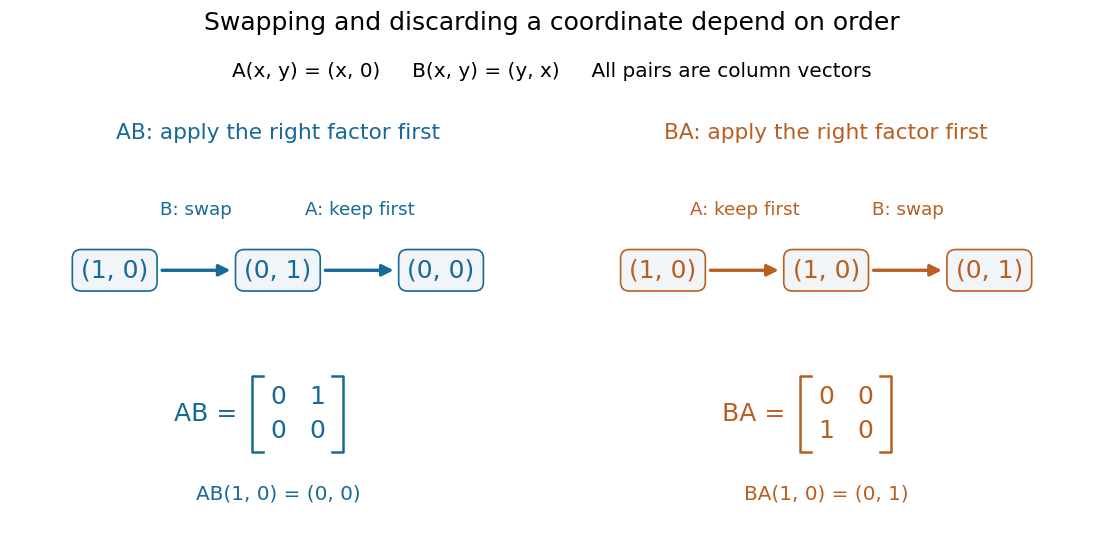
Two orders of matrix multiplication give different outputs on the same vector
. Details. 
Dedekind domain Created 2026-09-24 Updated 2026-09-24
A Dedekind domain is a Noetherian integrally closed domain of Krull dimension one. Equivalently, every localization at a nonzero prime ideal is a discrete valuation ring.
Local ring Created 2026-09-24 Updated 2026-10-14
Maximal ideal Created 2026-09-24 Updated 2026-09-24
Polynomial ring Created 2026-09-24 Updated 2026-09-24
Krull dimension Created 2026-09-24 Updated 2026-09-24
The Krull dimension of a commutative ring is the supremum of the lengths of strict chains of prime ideals.
Integral element Created 2026-09-24 Updated 2026-10-14
An element of an -algebra is integral over when it satisfies a monic polynomial with coefficients in .
Localization of a ring Created 2026-09-24 Updated 2026-10-03
For a multiplicatively closed set , the localization formally makes every element of invertible. Elements are represented by fractions .
Minimum-distance decoding Created 2026-09-24 Updated 2026-09-24
Minimum-distance decoding chooses a codeword closest to the received word; on a binary symmetric channel with , it is maximum-likelihood decoding under Hamming distance.
Maximum-likelihood decoding Created 2026-09-24 Updated 2026-09-24
Maximum-likelihood decoding chooses the codeword under which the received word has greatest conditional probability.
Maximum a posteriori decoding Created 2026-09-24 Updated 2026-10-03
Maximum a posteriori decoding chooses the codeword maximizing prior probability times channel likelihood and minimizes average decision error.
Binary symmetric channel Created 2026-09-24 Updated 2026-10-14
A binary symmetric channel is a discrete memoryless channel that flips each transmitted bit with fixed crossover probability . For one use, write , where is exclusive or and is a Bernoulli random variable with parameter , independent of the input . Thus preserves the bit and flips it. Different uses have independent noise under this model.
With row labels and column labels , its transition matrix isEach row sums to one, and exchanging both binary labels leaves the rule unchanged, explaining symmetric. For , a prescribed three-bit input produces with probability and with probability . The received does not itself announce the changed position: it could also arise from input with no flips.
The binary symmetric channel capacity quantifies how well a block code can overcome this uncertainty, and input distribution optimization for a binary symmetric channel shows why a fair input attains the best information rate. A completely noisy binary symmetric channel has and carries no input information; a known flip on every use, , is instead reversible.
Decipherable code Created 2026-09-24 Updated 2026-10-03
A code is decipherable, or uniquely decodable, when every finite concatenation of codewords has at most one decomposition into source codewords.
Diffie-Hellman key exchange Created 2026-09-24 Updated 2026-09-24
Alice publishes and Bob publishes in a public cyclic group; each can then compute the shared secret . Its security relies on the difficulty of recovering the exponents or otherwise solving the computational Diffie--Hellman problem.
Discrete logarithm problem Created 2026-09-24 Updated 2026-10-03
Given a cyclic group generator and an element , the discrete logarithm problem asks for an exponent such that .
Rabin cryptosystem Created 2026-09-24 Updated 2026-10-14
Rabin encryption sends to modulo a product of two secret primes. Decryption computes the four square roots by the Chinese remainder theorem.
Hamming bound Created 2026-09-24 Updated 2026-09-24
Parity extension Created 2026-09-24 Updated 2026-09-24
Cyclic code Created 2026-09-24 Updated 2026-09-24
There are unlisted articles, also show them or only show them.