A binary symmetric channel independently flips each transmitted bit with crossover probability . Its channel capacity isin bits per use, where is binary entropy and the endpoint convention is . Knowing the input leaves just the uncertainty of the flip, so for every input probability distribution. Since the output is a bit, , and thus . A fair input produces a fair output and reaches the bound. This is the two-symbol case of weakly symmetric channel capacity; Eytan Modiano, MIT 16.36, Channel Capacity and Coding, slides 4–5 gives this calculation.
For crossover probabilities , the resulting channel capacities are approximately , , and bits per use. At , the communication channel is noiseless; at , the output is independent of the input and the capacity is zero. At , every bit is inverted, a known reversible rule, and capacity is one again. More generally , because inverting every received bit exchanges the two crossover probabilities. The existing mutual information figure shows this full symmetric curve.
An uncoded transmission illustrates why the raw bit-error probability is not itself channel capacity. At , transmitting 100 uncoded bits succeeds on all of them with probability . The probability of at least one error is therefore approximately . A suitable block code changes which received words count as recoverable evidence of a message; simply repeating uncoded transmission at rate one does not obtain the reliability promised at rates below .
Let for the input bit of a binary symmetric channel with crossover probability . The law of total probability givesConsequently its mutual information isHere specifies the noise and specifies the input bias; they are different choices. At and , the output has , giving and bits. With the same noise and the fair input , the output becomes fair and bits, attaining binary symmetric channel capacity.
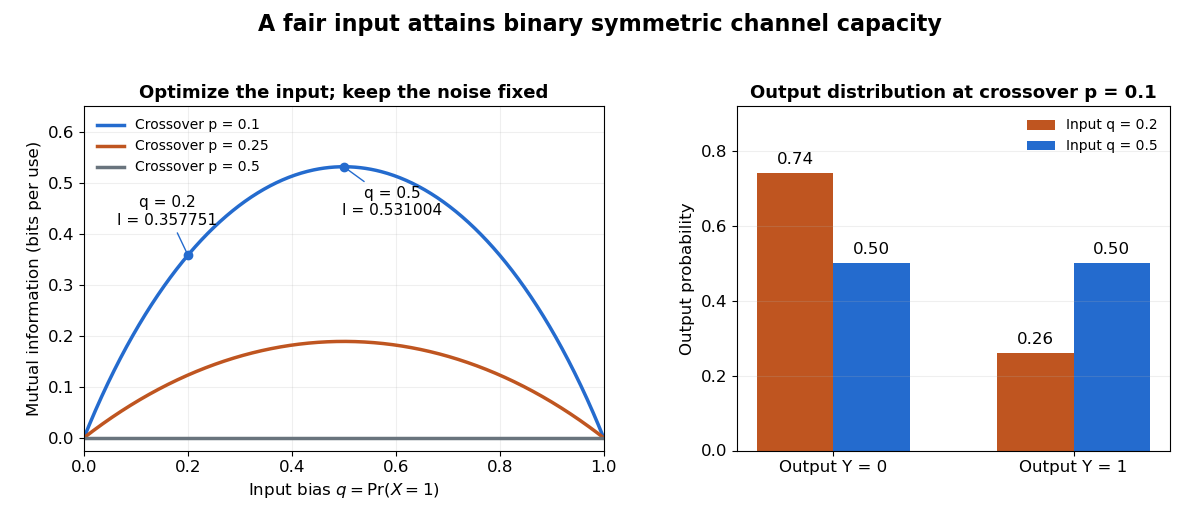
For , binary entropy reaches one only at output mass , and the equation forces . Thus the maximizing input is unique in those cases. For , every input produces the same fair output and zero mutual information, so every input bias is optimal and none transmits information. A fixed input or also carries zero mutual information for every : noise can make its output unpredictable without creating an unknown message to recover.
A binary erasure channel marks its failed transmissions with a special output symbol, whereas a binary symmetric channel changes a bit without announcing whether it changed. At the same nominal failure probability , the two communication channels therefore leave different uncertainty. With a fair input, an unerased output determines the input exactly, while the erasure flag leaves one bit of conditional entropy. Thus and for the binary erasure channel. This is the binary case of capacity of a finite-alphabet erasure channel.
For the binary symmetric channel at , neither possible received symbol rules out either input, and . Its channel capacity is only . A receiver benefits from knowing where information was lost, even when the fraction of affected transmissions is the same.
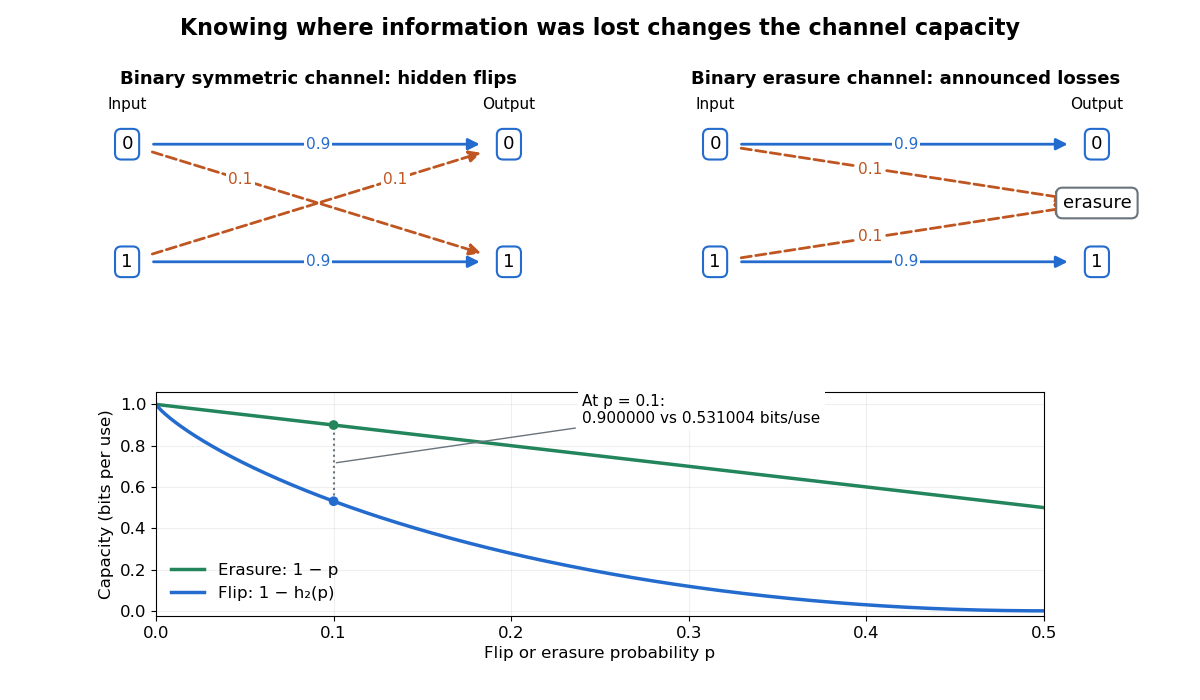


This comparison concerns the specified transition probabilities, rather than a general ordering of every error mechanism. In particular, at , an erasure flag conveys no input information, while deterministic inversion still conveys a full bit. Reporting only an error percentage loses the distinction between hidden corruption, announced loss, and a predictable reversible transformation.
Articles by others on the same topic
There are currently no matching articles.