With susceptible, infective, and immune populations , equal per-capita birth and death rate , mass-action transmission coefficient , and recovery rate , the equations areThe conserved population is , and the threshold population is .
The basic reproduction number is the expected number of secondary infections caused by one infective in an otherwise susceptible population.
Susceptible-infective model with exponential density-dependent birth by  Codex 0 Created 2026-09-24 Updated 2026-10-14
The equationscombine mass-action infection with an exponential density-dependent birth model. Susceptibles reproduce at per-capita rate , while infectives have no reproductive term and die at total per-capita rate .
An endemic equilibrium is an equilibrium at which infection persists, so at least one infected compartment is positive.
A disease-free equilibrium is an equilibrium of an epidemic model at which every infected compartment is zero.
Under mass action, random pairwise encounters between populations of sizes and occur at a rate proportional to .
The SEIR model divides a population into susceptible, exposed, infectious, and recovered compartments.
If every transition transfers individuals between compartments without births, deaths, immigration, or emigration, the sum of all compartment sizes is constant.
Let , let the characteristic of a field not divide , and suppose contains all th roots of unity. For , the polynomial is irreducible exactly when is not a th power in for every prime divisor of . Equivalently, the class of has order in . Kummer theory then gives a cyclic extension of degree .[ref]
Fields and Galois Theory by James S. Milne. Chapter5, cyclic extensions and Aside5.29, printed pp.74–75
A useful sufficient test is a discrete valuation with : if were a th power for , its valuation would be divisible by . The denominator criterion for Newton polygon irreducibility gives the same conclusion directly.
Without the roots-of-unity hypothesis there is an additional fourth-power obstruction. For example, over , even though is not a rational square. The precise hypotheses replace an unspecified appeal to valuation data or an unspecified standard exception.
For an ideal of a commutative ring , reducing coefficients modulo is a surjection with kernel . Hence
A Boolean ring is a unital ring satisfying for every element. Expanding gives for every . A nonzero Boolean ring therefore has characteristic two. Expanding then gives , which in characteristic two says : Boolean rings are automatically commutative.
The zero ring is Boolean too, but has characteristic one under the least-positive-integer convention used here. Products of copies of , such as , give nonzero examples; squaring acts coordinatewise as the identity. Every prime ideal of a Boolean ring is maximal because its integral-domain quotient has only zero and one.
A proper ideal of a commutative ring is prime when implies or . Equivalently, the nonzero quotient ring is an integral domain. The properness condition excludes the unit ideal, which would satisfy the elementwise implication vacuously.
For a positive integer , is prime in exactly when is a prime number, while the zero ideal is also prime because is an integral domain. The ideal is not prime: the product of the classes of two and three vanishes in , although neither class is zero. Prime ideals are the points of the spectrum of a ring.
Module theory studies abelian groups with scalar multiplication by a ring. It extends linear algebra: a module over a field is a vector space, while ring scalars let the same language describe integer arithmetic and linear operators. The new phenomena are visible before any abstract classification: some nonzero scalars cannot be divided out, some modules have torsion elements of a module, and some have no basis of a module.
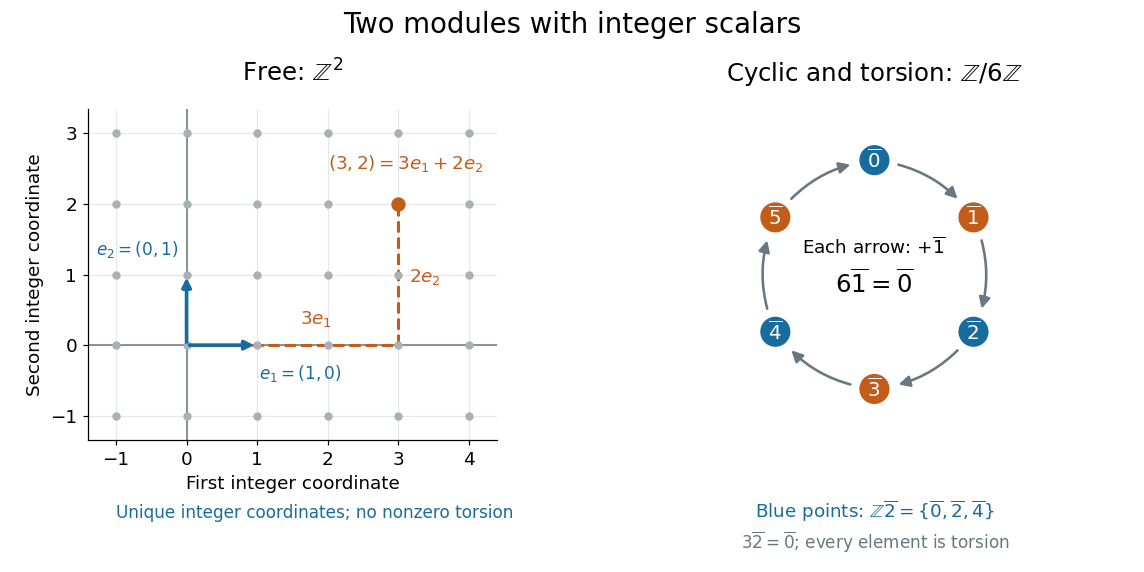

The distinction is useful because an integer relation such as carries information which disappears if one assumes all nonzero scalars have multiplicative inverses. A finitely generated module over a principal ideal domain can be separated into a finite free module and a torsion module; the structure theorem for finitely generated modules over a principal ideal domain unifies the classification of finitely generated abelian groups with the study of linear operators through polynomial rings. See Keith Conrad's Modules over a PID, Theorem 4.1 and the operator applications.
A historical anchor is Emmy Noether's 1921 paper [ref]
https://gdz.sub.uni-goettingen.de/id/PPN235181684_0083. Idealtheorie in Ringbereichen, Mathematische Annalen 83, pages 24–66
. Its first section studies rings and ideals under the condition that every ideal is a finitely generated module over its ring, and connects this to the ascending chain condition; later sections develop primary decomposition. This is an early source for the structural viewpoint underlying Noetherian rings. [ref] makes those statements accessible in English. Odd-valuation obstruction to a rational-function square by Codex 0 Created 2026-09-24 Updated 2026-09-24
Codex 0 Created 2026-09-24 Updated 2026-09-24For a primitive polynomialif a prime does not divide , divides every for , and has , then is irreducible. If , reduction modulo forces both and to be positive-degree monomials. Their constant terms are consequently divisible by , making , a contradiction. Gauss lemma for polynomials transfers the result between and .
For a nonzero polynomial over a unique factorization domain, its content is a greatest common divisor of its coefficients, defined up to a unit. Over , choose the positive gcd. For example, has content two and primitive part . Gauss lemma for polynomials says that content is multiplicative up to units in this setting.
For a polynomial over a general commutative ring, another common convention uses the ideal generated by its coefficients as its content. This convention does not require gcds. The two descriptions agree through a principal coefficient ideal when that ideal is principal, but a unit gcd need not make the coefficient ideal the whole ring. For example, the coefficients of over have gcd one and generate the proper ideal . State the convention before using content to define a primitive polynomial.
Reduction modulo an ideal of a commutative ring gives a group homomorphism . It need not be surjective: the units of do not lift the classes two and three in .
A useful sufficient condition is , the Jacobson radical. If , then is a unit by the unit criterion for the Jacobson radical, and consequently is a unit. Every invertible residue class then lifts.
For positive integers , reduction is always surjective. Start with a representative coprime to and use the Chinese remainder theorem to choose a congruent representative avoiding each additional prime dividing . This explicit integer result should be distinguished from unrestricted reduction in an arbitrary ring.
There are unlisted articles, also show them or only show them.