
For a primitive Dirichlet character modulo , its Gauss sum of a Dirichlet character gives , with . If , take . Then and its lower-right entry is congruent to modulo . Reindexing the sum yields the character . Rational translations preserve vanishing at modular cusps, proving the stated cuspidality as well as the transformation law.
Take the even primitive Dirichlet character whose values at modulo twelve are . Its Gauss sum of a Dirichlet character is . The displayed series has and . Thus is the normalized weight-twelve modular discriminant. It has no interior zeros by the valence formula for the modular group. Its logarithmic derivative equals , so integration gives the Dedekind eta function product. The odd character modulo four similarly produces a series with and leading term ; consequently .
Suppose , is solvable, is invariant under , and is coprime to . If a linear character of restricts to the determinant character , then there is a unique character extension with determinant . This is the solvable-quotient extension result supplied for the exam's application.
Under the invariant, coprime-degree and determinant hypotheses of the coprime-degree determinant extension theorem, without assuming solvable, each cyclic-quotient subgroup has a unique determinant-normalized extension. Use its value at to define . Uniqueness makes conjugacy-invariant. On an elementary subgroup , it agrees with the restriction of the extension to , since is a solvable quotient of . Brauer's characterization of characters therefore makes a generalized character, with .
Let and let be invariant under . If is coprime to , then extends to if and only if its determinant character extends to a linear character of . In particular, if the determinant order is also coprime to the index, there is a unique extension whose determinant order is coprime to the index. When is a p-group and , every invariant irreducible character of degree prime to satisfies this latter determinant condition.
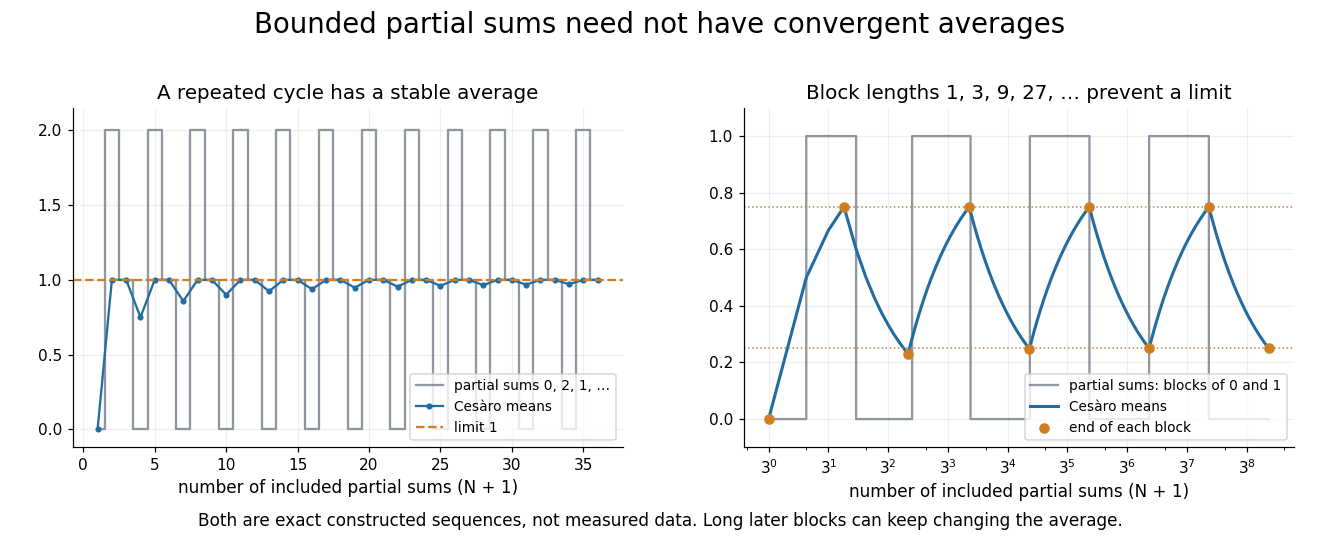
For , direct finite summation gives and . ConsequentlyThe distinct even and odd subsequential limits prevent first-order Cesàro summation. More averaging is a different method; a value assigned by another method is not a first-order Cesàro sum.
Construct partial sums from alternating blocks of zero and one, with lengths . Block , beginning with , has length and value zero when is even, one when is odd. Define a series by and for ; the telescoping series identity recovers these chosen partial sums. They remain in .
At the end of odd block , the Cesàro mean is exactly . At the end of even block , it isThese two subsequences have different subsequential limits, so the series has no first-order Cesàro sum. A later block remains a substantial fraction of everything averaged so far. Boundedness alone therefore does not ensure a stable average.

The finite limit of a sequence of averaged partial sums in the declared Cesàro summation convention, when that limit exists. It can exist when an ordinary sum does not, but every ordinarily convergent series has the same Cesàro sum as its ordinary sum.
For the geometric series with terms , , the partial sums are . Averaging the finite expressions givesIf and , the second term has absolute value at most , and therefore tends to zero. On the unit circle, except at , this yields a first-order Cesàro sum even though the terms do not tend to zero. For , instead and , so there is no finite Cesàro sum.[ref]
The series with terms , indexed from zero, named for Guido Grandi. Its even-indexed partial sums are one and its odd-indexed partial sums are zero, so it has no ordinary sum. First-order Cesàro summation gives . Grouping adjacent pairs would obscure this distinction: the partial sums of the grouped expressions select only one of the original subsequences.
In the average of partial sums , the term occurs exactly times. Reordering this finite sum gives the displayed identity. Early terms have weights closer to one, and the newest term has weight . The triangular weight expresses the cumulative averaging rule; it is not a claim that one may freely rearrange an infinite series.
The centralizer of a subset of a group consists of the elements commuting with every member of . It is the intersection of the element centralizers, hence a subgroup. Directly, identity commutes with every element, products of two elements that each commute with every member of still have that property, and the same is true of inverses. For this is the centre of a group. For an empty subset the commutation condition is vacuous and the centralizer is all of .
A cellular chain that is the boundary of a chain one dimension higher. The chain-complex identity makes every cellular boundary a cellular cycle; their quotient is cellular homology.
Suppose a normal linear model gives an unrestricted mean to each cell and has independent observations per cell, with common error variance . Each fitted cell mean is its sample mean, with variance ; different fitted cell means are independent. Estimate by the pooled within-cell residual sum of squares divided by , where is the number of cells. Thus a cell mean has standard error , a difference of two cell means has standard error , and a two-by-two difference-of-differences has standard error .
// Target: probability-and-statistics.bigb
If every nonempty finite intersection of members of an open cover has vanishing higher sheaf cohomology for , then the cover's Čech cohomology computes . An affine open cover of a separated scheme satisfies this condition for a quasi-coherent sheaf because its finite intersections are affine.
On , let and let be its constant sheaf. For the two closed rational points , take skyscraper sheaves with value , and put . The maps on the two stalks are identities, so this is a sheaf surjection. All three displayed outer sheaves are flasque. The induced global map is the diagonal , so . The one-member affine cover has zero positive Čech cochains. This even gives an -module example: let regular functions act on all copies of by multiplication as rational functions, not by evaluation at the closed point. The kernel is not quasi-coherent.
On the standard two-affine cover of the projective line, with coordinate , a frame for the twisting sheaf on projective space on the second chart equals times the frame on the first. Its Čech cochain complex is , with map . The kernel has basis for . The cokernel has basis for . The two-chart complex also proves vanishing in degrees at least two.
The two affine opens cover the punctured affine plane. Their intersection has ring . The Čech cohomology in degree one is the quotient by . Its basis consists precisely of the Laurent monomials whose two exponents are negative, so this vector space is infinite-dimensional. Global functions, by contrast, form .
For , a twisting sheaf on projective space has when , and top cohomology with basis the Laurent monomials of total degree whose exponents are all negative. All intermediate sheaf cohomology vanishes. Their dimensions are and respectively, with the top group nonzero only for . Decompose the standard Čech cochain complex by exponent vector: no negative exponents gives a simplex with cohomology in degree zero; a nonempty proper negative-support set admits a contracting homotopy inserting a vertex outside that set; all negative exponents give only the top term. For , every twist is trivial on and has .
During radiation domination, and . The adiabatic initial conditions reduce the CDM density equation in a matter-radiation universe to . Its Euler-Cauchy equation powers are two and minus two. The growing solution is the displayed one, in the stated CDM-comoving synchronous gauge.
There are unlisted articles, also show them or only show them.