
The citation panel credits Jay Abramson as author. The preface identifies him as lead author and senior contributing author, and lists a contributing team without assigning individual chapters. OpenStax publishes and hosts the book.
Whole-book publication: 21 December 2021, as given by the citation panel. The ©2026 footer is distinct from that publication date; no section revision dates are established.
Publisher: openstax.org/details/books/precalculus-2e
Online text: crypto.stanford.edu/pbc/notes/numbertheory/qr.html
By Ben Lynn. Stanford hosts the author's PBC Notes; it is not an institutional author. The inspected page is undated.
Cited passages: “Quadratic Residues”, opening definition and Euler criterion discussion; “The Legendre Symbol”, three values, odd-prime restriction, multiplication and square factors. The opening square-residue convention includes zero.
By Keith Conrad. These standalone notes are hosted on the author's University of Connecticut website. No document date is established.
Sputtering ejects surface chemical atoms from a solid through bombardment by energetic incident particles, often ions.
A ceramic is an inorganic, nonmetallic solid, often formed by heating and cooling. Ceramics may contain several chemical compounds and need not have a single crystal structure.
Tensile testing measures the response of a specimen to an axial pulling force. A tensile modulus experiment uses the initial proportional response to infer Young's modulus.
For a modern chosen example, the National Institute of Standards and Technology lists neutral magnesium atomic masses , , and , with reference isotopic abundances , , and . They describe the isotopes with mass numbers 24, 25, and 26, respectively.[ref]
Atomic Weights and Isotopic Compositions for Magnesium by National Institute of Standards and Technology. NIST, Atomic Weights and Isotopic Compositions for Magnesium: rows 24–26, neutral relative atomic masses and reference compositions
These modern inputs are not a reconstruction of historical observations.Use the dimensionless mass-to-charge ratio coordinate . For the illustration only, approximate ion masses by the neutral atomic masses. The singly charged positions are then near , , and ; the doubly charged companions are near , , and . The neutral-to-ion correction already given above is essential at higher accuracy. A peak near alone need not identify a chemical element: another ion with a different electric charge can occupy the same mass-to-charge ratio interval.
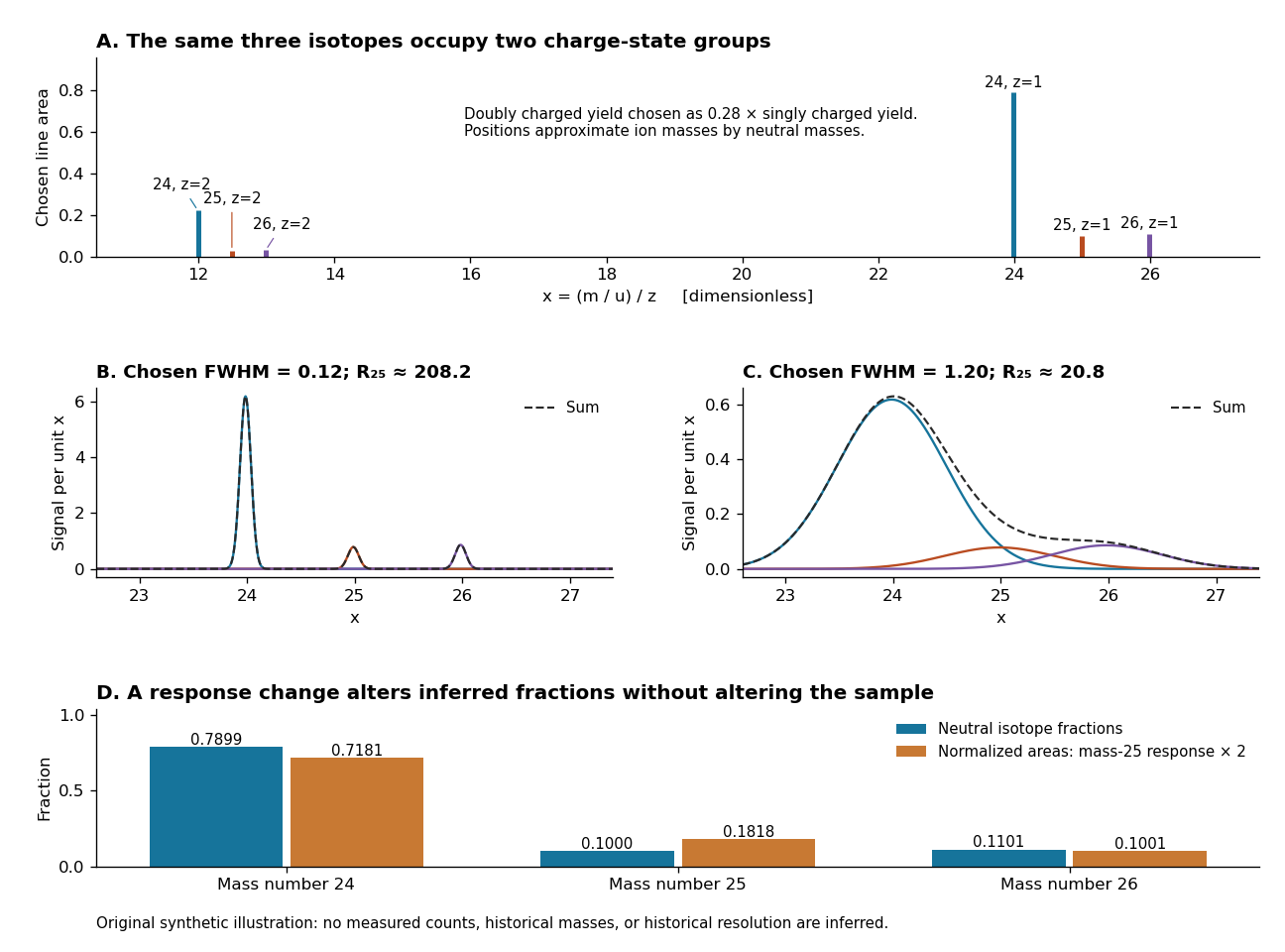
An original synthetic magnesium mass spectrum: charge states, finite mass resolution, and response bias
. All curves are stipulated sums of unit-area Gaussian functions, not measured data. The first two panels use equal isotope responses and selected full width at half maximum values and in . The last panel keeps the reference isotopic abundances fixed but multiplies the mass-25 response by two, then normalizes the areas. Neutral atomic masses approximate ion masses; charge-state yields are chosen independently, and no historical intensity or resolving-power claim is made. Details.
For the narrow singly charged peak at , the chosen full width at half maximum gives mass resolving power ; widening to gives . Adjacent isotope spacings here are approximately one unit in . Peaks are visibly separated in the first chosen profile and overlap strongly in the second. A small uncertainty in a fitted peak centre would not by itself make the overlapping components resolved.
Even integrated peak areas need a response model. For isotope fraction , let collect the probability of ionization into electric charge state , transmission through the analyzer, and the detection response. In a linear instrument with overall exposure factor , the component area isEqual at a fixed makes normalized areas equal the fractions; otherwise it does not. In the chosen example, doubling only the mass-25 response changes the normalized areas to , , and , although the neutral sample is unchanged. Photographic darkening introduces another possible nonlinearity: neither line darkness nor peak height is a universal measure of neutral isotopic abundance. Calibration of position and calibration of intensity answer different questions. Matched standards, a known electric charge assignment, and a response correction make isotope analysis useful; a visually impressive set of peaks alone does not supply those controls.
Reuse the velocity selector analysis in the Thomson charge-to-mass experiment, but now send positive ions with into a separate magnetic analyzer. The selector fields and give . If the analyzer field is perpendicular to the selected velocity, its gyroradius givesfor a semicircular return to the entrance plane. The displayed impact separation is a diameter. This formula is linear in at fixed selected speed; the fixed-electric potential difference model above instead gives . They impose different experimental conditions.
For a chosen example, take , , and . Thus . Approximating an ion mass by and setting gives and . Here denotes the unified atomic mass unit. These are stipulated teaching inputs, not a reported Aston measurement or an exact magnesium atomic mass.
A finite accepted speed range broadens the radius distribution. At fixed and , . At fixed electric charge and mass, gives for a small kinetic energy spread. A one-percent kinetic energy spread therefore produces roughly a half-percent radius spread before other broadening is included. Its width convention must be specified before converting that statement into a mass resolving power.
Accelerator mass spectrometry uses ion acceleration and particle identification to count rare isotopes relative to abundant ones. For radiocarbon dating, it measures carbon-14 directly rather than waiting to count its beta decays.
A scientific collaboration, not an individual person.
Official award records: www.nobelprize.org/prizes/lists/all-nobel-prizes-in-physics/
There are unlisted articles, also show them or only show them.