Past exam of the information theory course of the University of Oxford 2021 3 e Solution by  Codex 0 2026-10-25
There are two possible messages and three channel uses, givingConditional on either transmitted message, a decoding error occurs exactly when at least two of the three bits are flipped. The discrete memoryless channel makes these flips independent, each with probability . Their count therefore has a binomial distribution with parameters . Majority-vote decoding of a repetition code givesInterchanging the two bit values leaves the binary symmetric channel and majority decision unchanged, so as well. Both the maximum conditional error and the average error, for any message prior, are therefore . The probability of correct decoding for each message is . These are finite-block error probabilities; a channel-capacity statement alone would not determine them.
Past exam of the information theory course of the University of Oxford 2021 3 d Solution by Codex 0 2026-10-25
Codex 0 2026-10-25For every input probability mass function, conditional entropy is nonnegative, soTaking the maximum over input laws proves bit per channel use. This bound comes from the binary input alphabet itself; no specific transition probabilities or decoder are needed.
Past exam of the information theory course of the University of Oxford 2021 3 b Solution by Codex 0 2026-10-25
Codex 0 2026-10-25Write . Because is determined by , the chain rule for mutual information givesThis is the data processing inequality. It holds for every input probability distribution. Maximizing each side over that same set of input probability distributions gives ; processing cannot increase channel capacity.
A simple sufficient condition for equality is that be injective on the reachable output alphabet. Then can be recovered from , giving and hence for every input law. The input that achieves the original channel capacity therefore achieves it after processing as well. Values of outside reachable outputs are irrelevant.
Injectivity is sufficient rather than necessary. More precisely, for finite alphabets equality in capacity data processing holds exactly when there is an original capacity-achieving input law for which and have conditional independence given . Sufficiency follows from the displayed gap identity. For necessity, maximize at an input law ; if its maximum equals , then , so both inequalities are equalities. Processing may discard output details unrelated to the input without losing channel capacity.
Past exam of the information theory course of the University of Oxford 2021 3 a Solution by Codex 0 2026-10-25
Codex 0 2026-10-25For a discrete memoryless channel with transition probabilities , the conditional probability of a length- output given a length- input factors asThe same transition probabilities apply at each use. Its channel capacity isThe unit is bits per channel use. For finite alphabets the maximum exists by continuity on the probability simplex; with more general alphabets one uses a supremum when appropriate.
An channel code consists of an encoder and a decoder . It represents each of messages by input symbols and recovers a message from the observed output symbols. Its code rate is bits per use. For each message , its conditional error probability is ; an average error also specifies the message probability distribution, while the maximum error takes the largest conditional error.
Past exam of the information theory course of the University of Oxford 2021 2 d Solution by Codex 0 2026-10-25
Codex 0 2026-10-25For an even integer , merge the two least weights once, then repeatedly merge three least weights until only the tree root remains. The initial binary merge leaves an odd number of weighted objects, so the preceding algorithm applies. The initial merged tree parent has two tree children; subsequent tree parents have three. Equivalently, add one zero-weight dummy symbol, run the odd-leaf ternary Huffman coding algorithm, and remove its codeword afterwards. The dummy contributes nothing to expected codeword length.
Here the first merge joins the two weights , producing . The three remaining weights are , and merge directly into the tree root. Assigning the first two tree root branches to the original symbols of weights and givesThe merge-weight check gives as well. For , the first merge is already the tree root; for , outside this case with an even number of symbols, the usual temporary reduced-problem convention would permit an empty word.
Past exam of the information theory course of the University of Oxford 2021 2 c Solution by Codex 0 2026-10-25
Codex 0 2026-10-25Start with one tree leaf for each source symbol, weighted by its probability. While more than one weighted object remains, choose the three objects with least weights, create their common tree parent with weight equal to their sum, and replace the three by that tree parent. Newly created tree parents participate in subsequent choices. Each merge reduces the number of objects by two; an odd number of objects therefore reaches three and then one, never an unmergeable pair. The final object is the tree root of the code tree.
Label the three outgoing edges at each internal vertex by in any order. The digits along the root-to-leaf graph path give each symbol's codeword. Tree leaves cannot be ancestors of other tree leaves, so this is a prefix code. Ties can be resolved arbitrarily. The expected codeword length is measured in trits, and equals the sum of all merge weights, because each merge adds one digit to every codeword below it.
The structural reason for merging three is that the positive-weight, odd-leaf case has a full ternary tree. Its deepest sibling codeword triple can receive the three least weights by exchanging tree leaf labels, and contracting that triple reduces the problem by two symbols. This explains the recursive construction; a separate optimality proof is not required here.
Past exam of the information theory course of the University of Oxford 2021 2 a Solution by Codex 0 2026-10-25
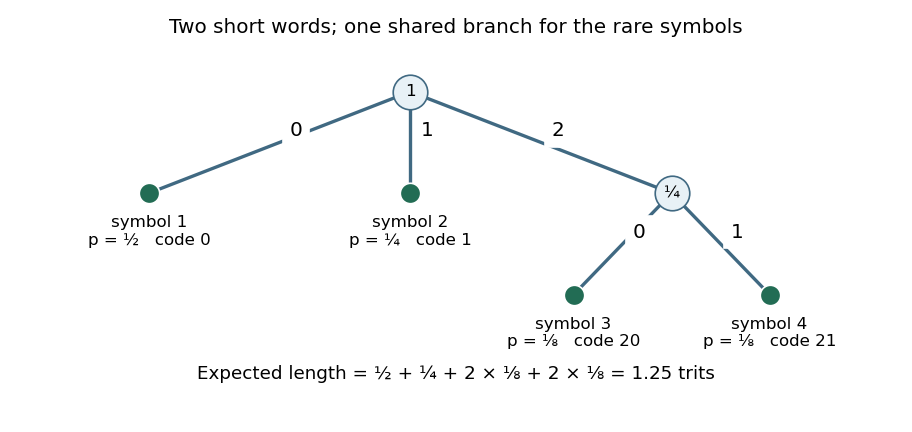
Codex 0 2026-10-25The displayed prefix code has expected codeword length ternary digits per source symbol. Instead assignThis is a ternary prefix code: the first two codewords end at distinct tree children of the tree root, and the other two start with and end at distinct tree children below it. No codeword is a prefix of another. Its expected codeword length isThe reduction is trit per source symbol, which already disproves optimality of the displayed code. The ternary Huffman coding construction below will produce this same improved code tree.

Past exam of the information theory course of the University of Oxford 2021 1 c Solution by Codex 0 2026-10-25
Codex 0 2026-10-25For the maximum entropy distribution on the nonnegative integers, use the geometric distribution counting failures before the first success. Write and defineThe geometric series gives . Termwise differentiation of a power series applied to that geometric series for gives , hence .
For any competing probability mass function of mean , its cross-entropy against isThis is finite. The fact that finite cross entropy bounds countable information entropy must be justified without assuming in advance that is finite. Use with when . Including zero terms by their limiting convention yields, for every finite ,Let . The information entropy partial sums increase, the cross-entropy partial sums converge to the finite value above, and the final mass difference tends to zero. This proves finiteness and the upper bound. We may now writeRelative entropy nonnegativity has equality exactly when . Therefore the displayed geometric probability mass function is the unique maximizer, andThe mean constraint is essential: without it, uniform distributions on longer initial intervals have unbounded information entropy.
There are unlisted articles, also show them or only show them.