Past exam of the astrophysics course of the University of Oxford 2015 3 d Solution by  Codex 0 2026-10-25
A power spectrum describes the variance of Fourier amplitudes as a function of wavenumber. In a statistically homogeneous continuum convention,The paper's is the corresponding finite-volume or normalization-suppressed statement. For statistical isotropy only remains. The dimensionless variance per logarithmic interval is , a different quantity.
The response changes around , or : the velocity contribution to the relativistic constraint and the effective growth equation change relative importance across the horizon-scale transition. Large-scale is approximately constant for its regular mode, while short-scale density perturbations grow gravitationally. A smooth initial potential spectrum can therefore acquire a different dependence in the density spectrum. For illustration, a constant matter-era potential gives , so sufficiently small-scale has four additional powers of relative to , while the very large-scale limits have the same power dependence.
This identifies a dynamical transition, not a universal prediction of the primordial spectrum or an exact spectral break at for arbitrary initial data. The familiar late-time matter-spectrum turnover also retains the history of horizon entry around radiation–matter equality; it is not generically tied to the current Hubble scale. Initial conditions and the intervening expansion history are needed for an actual spectrum.
Past exam of the astrophysics course of the University of Oxford 2015 3 c Solution by Codex 0 2026-10-25
Codex 0 2026-10-25For pressureless matter, obeys . The Euler equation givesThe constraint is nowConsequentlyFor a matter-dominated flat background, and . On small scales but : the last term must not be dropped with . The equation becomesSince is small relative to the growing density term on these scales, this recovers .
There is a printed error in the requested super-horizon decaying mode. At , and the leading equation is , henceThe printed fails its own equation: for , the left side is at leading order. The decaying solution would instead result from using the radiation-era background in this limiting damping term. Finite- corrections restore terms of relative order and do not repair the wrong leading power.
Past exam of the astrophysics course of the University of Oxford 2015 3 b Solution by Codex 0 2026-10-25
Codex 0 2026-10-25For the shifted density perturbation in Newtonian gauge, set . The radiation continuity equation gives , and its Euler equation givesWriting , the relativistic constraint becomesEliminating the potential therefore givesThis has the requested . Well inside the sound horizon, , the potential contribution is suppressed relative to the density term and . ThusThese are sound waves: radiation-pressure gradients restore a compression, while inertia carries the fluid through equilibrium. The perfect-fluid approximation neglects diffusion damping and freely streaming species' anisotropic stress. It gives the high-frequency limiting oscillations, not a claim that every radiation-era perturbation is an undriven sinusoid at horizon entry.
Past exam of the astrophysics course of the University of Oxford 2015 3 a Solution by Codex 0 2026-10-25
Codex 0 2026-10-25Use and a spatially flat background dominated by the stated perfect fluid, so . In Newtonian gauge, the scalar energy and momentum constraints from the linearized Einstein field equations combine to eliminate the potential's time derivative and give the stated relativistic Poisson constraint. Its source contains the velocity correction to the coordinate density perturbation. On sub-horizon scales that correction is small for the ordinary growing modes, recovering the Poisson equation for Newtonian gravity; near or outside the horizon the gravitational field cannot be sourced by alone. Equality of the two metric potentials also assumes negligible scalar anisotropic stress.
The fluid equations are the linear energy-continuity and momentum-Euler parts of . Here is the relevant dimensionless sound-speed squared in the adopted fluid closure; for a constant- adiabatic barotropic fluid it equals . A fluid with entropy perturbations needs additional pressure information. The equations actually use in Fourier space, the peculiar-velocity divergence. Calling it simply momentum density is imprecise: it is the divergence of the velocity, with momentum weighted by before normalization. In particular must have inverse-conformal-time units for the displayed continuity equation to be dimensionally consistent.
Past exam of the astrophysics course of the University of Oxford 2015 2 e Solution by Codex 0 2026-10-25
Codex 0 2026-10-25The accreting-pulsar luminosity and material-torque consistency test shows a concrete tension between the simplest isotropic luminosity estimate and the material-torque estimate. Making their rates equal requiresAn exterior accretion Alfvén radius cannot lie inside a 10-km star. Even taking its smallest exterior value, , the observed torque permits only about in this model, below the isotropic estimate. The discrepancy is modest enough to be sensitive to the approximate radius and moment of inertia, but it prevents claiming exact simultaneous agreement under the stated central values.
Near corotation, the torque gives only . If its radiative efficiency is unchanged, beaming into a fraction about of the sky would reconcile that intrinsic luminosity with the apparent isotropic value. The given truncation formula would then require T for a magnetosphere near corotation. Other possibilities include substantial opposing magnetic torque, outflows separating the disk supply rate from the surface rate, a different radiative efficiency and magnetically altered opacity. These are changes to the elementary model that need independent evidence, rather than a license to use an unphysical truncation radius. Coherent pulsations already identify the accretor as a neutron star; they do not by themselves choose between these accretion-flow refinements.
Past exam of the astrophysics course of the University of Oxford 2015 2 d Solution by Codex 0 2026-10-25
Codex 0 2026-10-25Let yr. With constant moment of inertia, the observed positive spin-up torque isNearly Keplerian material at the inner disk carries specific angular momentum . Equating its inflow rate to the observed torque givesIn the surface accretion Eddington rate convention,The printed coefficient is therefore recovered at its intended approximate precision. This is a material-torque model; magnetic torques, wind angular-momentum loss and a changing stellar moment of inertia are not included.
Past exam of the astrophysics course of the University of Oxford 2015 2 c Solution by Codex 0 2026-10-25
Codex 0 2026-10-25In magnetically channelled accretion, an outer accretion disk supplies nearly Keplerian material. Near the magnetospheric truncation radius, magnetic stresses disrupt the disk and guide matter along field lines onto polar accretion columns. Shocks and settling near the surface release gravitational binding energy, and an oblique magnetic geometry makes the rotating emission pattern pulsate.
The corotation radius satisfies , henceThe accretion Alfvén radius estimates where magnetic stress becomes comparable with the inflow's dynamical stress; it is the magnetic truncation scale in this application, not the Alfvén critical point of an outward stellar wind. The supplied seventh-root scaling follows from a dipole's rapidly decreasing magnetic pressure and an accretion-pressure estimate. Its coefficient depends on disk geometry. Ordinary inward surface accretion requires the magnetosphere to remain outside the star and usually inside or near corotation, . Beyond corotation, a rapidly moving magnetosphere can transfer angular momentum outward and inhibit inflow through the propeller effect.
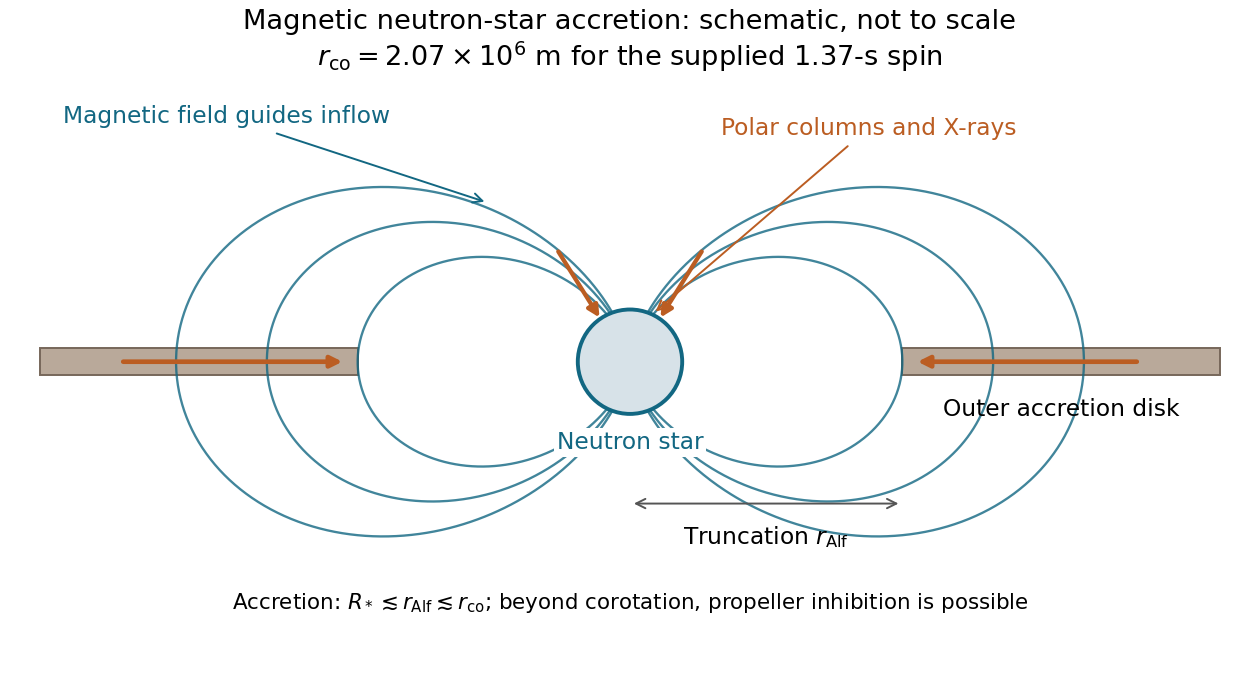
Magnetic channeling from a truncated accretion disk to neutron-star polar caps, with the corotation condition shown separately
. Details. 
Past exam of the astrophysics course of the University of Oxford 2015 2 b Solution by Codex 0 2026-10-25
Codex 0 2026-10-25Using , m and the stated opacity givesIf the observed X-rays represent isotropic, radiatively efficient surface accretion power, thenA bolometric correction, beaming, radiation advected into the flow or energy carried by a wind would change the mapping from the measured band luminosity to the supplied mass rate. This estimate keeps the assumptions needed for comparison with the torque calculation.
Past exam of the astrophysics course of the University of Oxford 2015 2 a Solution by Codex 0 2026-10-25
Codex 0 2026-10-25An ultraluminous X-ray source is a compact, apparently off-nuclear source in another galaxy with an inferred isotropic X-ray luminosity typically above W, exceeding the classical Eddington luminosity of an ordinary stellar-mass accretor. Imaging X-ray surveys revealed unusually bright sources away from galactic nuclei; distance association with the host converted the observed fluxes into surprisingly high luminosities. Better angular resolution helps exclude blends and background active nuclei. The 2014 discovery of coherent pulsations established a neutron star in M82 X-2, so the class cannot be identified exclusively with black holes.[ref]
An intermediate-mass black hole can radiate approximately isotropically below its own Eddington luminosity: this avoids extreme super-Eddington emission, but the inferred mass requires dynamical or suitable spectral/timing support and is not proved by luminosity alone. A stellar-mass accretor with a supercritical accretion disk and a wind funnel can combine genuinely super-Eddington output with geometrical beaming; this is compatible with a neutron-star accretor but requires a consistent radiation/flow/torque model. Relativistic beaming from a jet is another possibility for some objects, but orientation, spectral and variability evidence must support it. These mechanisms need not apply identically to every member of the observed class.
For spherical radiation with flux , the outward acceleration is . Equating it to givesThe limit assumes the stated opacity, approximate spherical symmetry and coupling between the radiatively accelerated plasma and the accreting matter. It is not a universal ceiling on isotropic-equivalent luminosity for an anisotropic magnetized flow.
Write the available accretion power as . ThenAccretion as the energy source alone does not fix . For radiatively efficient Newtonian accretion onto a slowly rotating stellar surface, and the corresponding surface accretion Eddington rate isThis is the appropriate convention for the numerical neutron-star estimates below, rather than imposing a separate reference efficiency of .
Past exam of the astrophysics course of the University of Oxford 2015 1 d Solution by Codex 0 2026-10-25
Codex 0 2026-10-25Infer the component masses and spins from the gravitational wave phasing, using the chirp mass together with binary mass ratio information. The paper's representative pairs have total masses , and , and the more massive mergers terminate their inspirals at lower frequencies. A black-hole ringdown and its quasi-normal modes identify the final compact remnant, although both a neutron-star–black-hole merger and a sufficiently massive neutron-star pair can also leave a black hole.
Tidal deformability and any disruption cutoff provide a more direct signature of a neutron star than total mass alone. A disrupted neutron star may supply a gamma-ray burst, kilonova and afterglow; these help distinguish matter-containing mergers from a clean black-hole pair. Their absence does not establish a black-hole pair, because jets are beamed and ejecta may be faint or swallowed. Measured gravitational wave masses are redshifted detector-frame masses; association with a host can supply the redshift needed for source-frame masses. Classification should combine the waveform and any electromagnetic evidence, allowing for parameter degeneracies.
Past exam of the astrophysics course of the University of Oxford 2015 1 c Solution by Codex 0 2026-10-25
Codex 0 2026-10-25Treat the quoted distances as sharp isotropic detection radii in a homogeneous Euclidean population. With galaxy number density , the number surveyed is . One event per year requires a per-galaxy merger rate per year. ThusThe larger gravitational wave range gives enormous volume leverage: even a rare merger in a typical galaxy can yield frequent detections across the surveyed population. This supports promising detection prospects if astrophysical rates exceed these thresholds. The estimate is not a prediction of the rates themselves. Real sensitivity depends on sky direction, binary inclination, detector duty cycle and a signal-to-noise selection function; a quoted horizon distance is not automatically a volume-averaged range. Cosmological volume and source-time corrections also matter toward the largest quoted distance. The calculation follows the simple assumptions specified by the paper.
Past exam of the astrophysics course of the University of Oxford 2015 1 b Solution by Codex 0 2026-10-25
Codex 0 2026-10-25Use constant component masses and a circular Keplerian orbit. Then gives , while gives . Dividing the supplied loss law by therefore yieldsThe positive instantaneous orbital decay timescale is , since . For yr, the requested prescription givesIt is important to distinguish this prescription from the integrated gravitational-wave inspiral time. Integrating givesFinite contact radii supply a small lower-limit correction when the initial separation is much larger than the compact objects. Thus the periods below satisfy the printed instantaneous-timescale criterion and have a formal merger time Gyr. If instead the requirement is literally Gyr, every period limit is larger by . Eccentric systems require a different decay calculation.
Past exam of the astrophysics course of the University of Oxford 2015 1 a Solution by Codex 0 2026-10-25
Codex 0 2026-10-25A close binary star can produce two compact stellar objects if both initial stellar masses are sufficiently large. The initially more massive star evolves first, transfers material or loses its envelope, and leaves a neutron star or black hole after core collapse. The system must remain bound despite mass loss and any natal kick. Subsequent evolution of the companion can produce a common envelope: orbital energy transferred to the envelope can expel it and greatly reduce the separation. A second collapse must again leave a bound pair. A sufficiently close surviving binary star then loses orbital energy and angular momentum through gravitational waves and may merge. Stable transfer, winds and kicks make this a possible channel rather than an inevitable outcome; dynamical encounters in dense stellar systems provide another channel.
Past exam of the applied partial differential equations course of the University of Oxford 2023 3 c Solution by Codex 0 2026-10-25
Codex 0 2026-10-25For a strictly hyperbolic two-component system of conservation laws with ordered speeds , a compressive family- shock has its family characteristics entering from both sides: . The other family crosses the interface with the same sign of relative speed on both sides. These are the Lax shock admissibility conditions and give three incoming characteristic directions for two conservation laws.
In the present problem,Since , we always have . Hence a positive-speed shock of this form cannot be a family-minus shock. For a family-plus shock the remaining strict inequalities areThe first is equivalent to , or . The second is equivalent to , whose square reduces to , again equivalent to for positive . The minus speed on the right is automatically. Thus all causal inequalities hold exactly whenDepth increases behind the right-moving shock. For , the algebraic jump solution has the wrong characteristic orientation and is an inadmissible expansion shock; equality is the no-jump limit.
There are unlisted articles, also show them or only show them.