Past exam of the advanced quantum field theory for particle physics course of the University of Oxford 2024 1 c Solution by  Codex 0 2026-10-25
An operator equation in a path integral means that insertion of into every time-ordered correlation function vanishes when is separated from the other insertion points. At coincident points, Ward identity contact terms can remain; an operator equation does not assert that these distributions vanish.
Let be a product of local insertions. Make the local phase change of integration variables from part b. The functional measure has unit functional Jacobian: the opposite phases of and cancel in a vector-symmetry-preserving regularization in quantum field theory. There is no vector gauge anomaly. Invariance under a change of integration variables givesIf and , comparison of the coefficients of the arbitrary yields the Ward-Takahashi identityConsequently is an operator equation at separated points. This is stronger than just . For example, has , , so its two Ward identity contact terms are ; dropping them would give a false identity. Equivalently, the Dirac equation and the adjoint Dirac equation give , with the same coincident-point qualification in time-ordered correlation functions.
Past exam of the advanced quantum field theory for particle physics course of the University of Oxford 2024 1 b Solution by Codex 0 2026-10-25
Codex 0 2026-10-25For the local variation , , the terms proportional to cancel and the differentiated phase givesThus, for a compactly supported , integration by parts givesThis Dirac current is the Noether current in the convention . Using the convention with a plus sign reverses the Noether current and the conserved charge together. There is one independent global symmetry in field theory, with four spacetime components of its Noether current. The associated conserved charge is , with vacuum subtraction when required.
Past exam of the advanced quantum field theory for particle physics course of the University of Oxford 2024 1 a Solution by Codex 0 2026-10-25
Codex 0 2026-10-25For a Dirac field, the path integral is a Berezin integral over independent Grassmann fields and :The vacuum boundary conditions and the Feynman i-epsilon prescription are understood; fixes the vacuum normalization. This is the vacuum generating functional without sources, rather than a finite-temperature partition function.
The Dirac adjoint transforms as . For constant , . Both the kinetic term and the Dirac mass term therefore retain their values. This proves the global phase symmetry, whose group is the unitary group .
Past exam of the advanced quantum field theory for particle physics course of the University of Oxford 2021 2 b Solution by Codex 0 2026-10-25
Codex 0 2026-10-25There are exactly four tree-level Feynman diagrams: one four-photon contact graph and one exchange graph for each of the three partitions , and of the external legs. The exchange graphs contain two cubic Feynman vertices. A fermion loop or a closed Faddeev-Popov ghost line has positive loop order, so neither enters here.
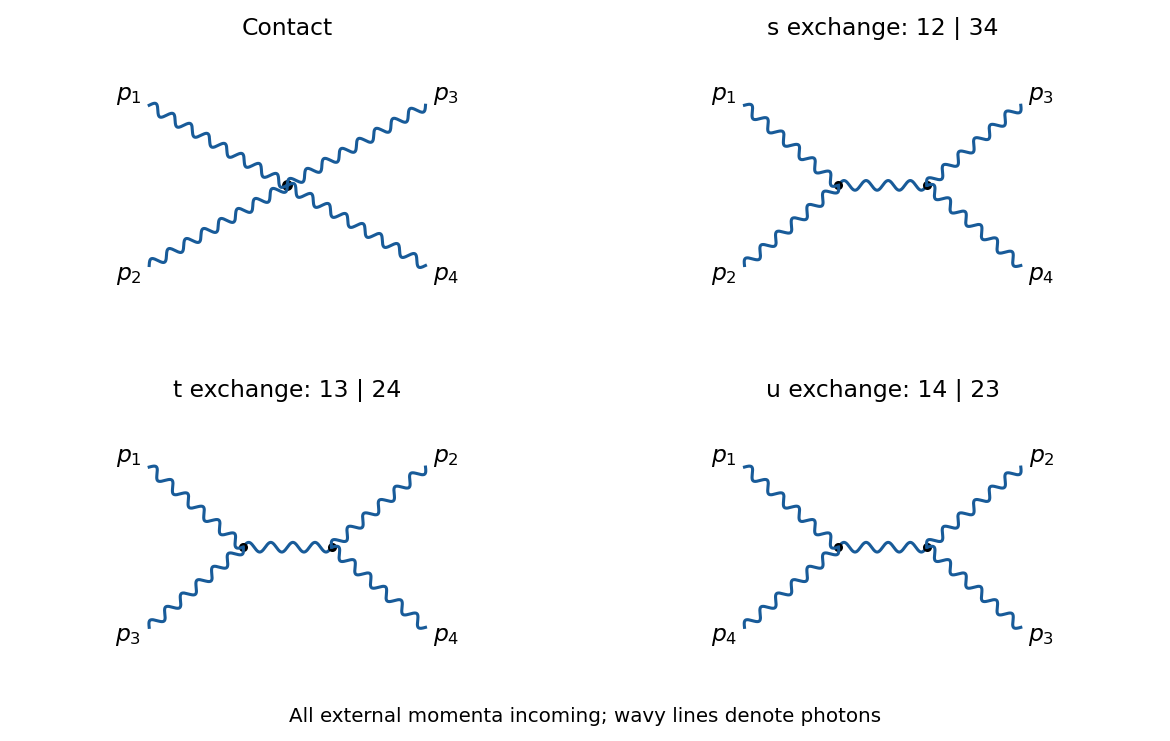
The contact graph and three exchange graphs for physical photon scattering in the nonlinear gauge; all external momenta are incoming
. Details. 
Write and take physical photon polarization vectors with and . At the cubic Feynman vertex attached to legs , the two terms containing or vanish. If flows into the internal line, the remaining factor at that end isAt the other end the internal incoming four-momentum is rather than , giving . Multiplication by the photon propagator givesThe cancellation holds first at generic nonzero channel Mandelstam invariants and then by continuation at degenerate kinematics. Summing the three exchange graphs produces , whereThe quartic Feynman vertex contributes . ThereforeThis is a cancellation for physical on shell photon polarization vectors. The off shell four-photon correlation function need not vanish. Physical light-by-light scattering first occurs through charged-particle loop Feynman diagrams.
Past exam of the advanced quantum field theory for particle physics course of the University of Oxford 2021 1 v Solution by Codex 0 2026-10-25
Codex 0 2026-10-25The scalar QED Ward identity equates the vertex renormalization and wave-function renormalization constants. Consequently, using part (iv),The renormalization constants describe gauge-dependent fields and off shell vertices, so their dependence on is permitted. A physical scattering amplitude includes all Feynman diagrams, the counterterms, and the external-state factors from LSZ reduction. The Ward identities ensure that the dependence on cancels for physical external states. Infrared-sensitive probabilities also require the usual inclusive treatment of unobserved soft photons. Thus no dependence on is implied for consistently calculated physical observables.
Past exam of the advanced quantum field theory for particle physics course of the University of Oxford 2021 1 iv Solution by Codex 0 2026-10-25
Codex 0 2026-10-25The integral printed in the text can be evaluated without reconstructing Figure 1. Put and , and let denote that integral without its factor . The numerator contraction responsible for its covariant gauge dependence isWith the scalar electrodynamics three-point vertex , three such vertices, two scalar propagators and one photon propagator have overall factor . Thus the supplied integrand gives .
First isolate the numerator term . Its contribution isUnder the two denominators exchange and the numerator changes sign. A shift-invariant dimensional regularization therefore gives , including the finite part.
For the remaining numerator , only its term contributes to the ultraviolet pole. Corrections from expanding the denominators, and the numerator , are ultraviolet finite by power counting. Use auxiliary-mass extraction of ultraviolet poles with any rather than literally integrating a massless scaleless integral. Lorentz covariance then givesTODO (source gap): The algebra of the supplied expression is complete, but its graphical identification with Figure 1(b), including the routing at each internal vertex, cannot be visually verified from the unreadable panel.
The complete renormalization constant can nevertheless be obtained independently. Here is a short scalar QED wave-function pole calculation, to avoid assuming either missing panel's value. For an external four-momentum , the exchange contribution to the scalar self-energy has numeratorIts denominator is . The necessary ultraviolet poles, with the measure , are respectivelyThe first two follow by a Feynman parameter and a shift of ; the third is a tadpole integral; the last follows by the same large- extraction used above. The seagull vertex contributes only a photon tadpole integral, which is a scaleless integral, and in any case cannot affect the coefficient of . Multiplication by the exchange graph's factor gives the scalar self-energy insertionThe kinetic counterterm therefore requires . The scalar QED Ward identity sets , soIndeed the full unrenormalized scalar electrodynamics three-point vertex has ultraviolet pole , which is cancelled by . Subtracting the supplied contribution gives the gauge-independent sum stated in part (ii), without assigning either unreadable panel an integrand.
Past exam of the advanced quantum field theory for particle physics course of the University of Oxford 2021 1 iii Solution by Codex 0 2026-10-25
Codex 0 2026-10-25TODO (source gap): Figure 1(c) and its four-momentum labels are unreadable. The assertion about this individual Feynman diagram therefore cannot be checked against its actual integrand. In particular, one must not identify the missing panel with a convenient vanishing seagull vertex graph by inference.
A useful criterion, once the drawing is recovered, is that dimensional regularization annihilates a vector integral of the formby the change of variables . This would prove vanishing for every if all remaining factors were functions of ; a denominator involving must first be checked rather than discarded. Whether this criterion applies to panel (c) is precisely the unavailable information.
Past exam of the advanced quantum field theory for particle physics course of the University of Oxford 2021 1 ii Solution by Codex 0 2026-10-25
Codex 0 2026-10-25TODO (source gap): Figure 1(a), including its internal connections and four-momentum labels, is absent from the recoverable source. The local PDF renderer reports missing image objects, and the matching official PDF's figure could not be retrieved for visual inspection. Therefore the individual Feynman diagram called (a) cannot be assigned an integrand and its separate independence of cannot be verified from the available diagram. A guessed replacement drawing would not resolve this gap.
An independent determination of the complete ultraviolet pole, given in part (iv), remains possible from the scalar QED Ward identity. Together with the textually supplied integral in part (iv), it fixes the sum of the contributions outside that integral to in the stated scalar electrodynamics three-point vertex convention. That sum alone does not identify the contents of panel (a).
Past exam of the advanced quantum field theory for particle physics course of the University of Oxford 2021 1 i Solution by Codex 0 2026-10-25
Codex 0 2026-10-25The superficial degree of divergence of this scalar electrodynamics three-point vertex is one. Its ultraviolet pole is consequently a local expression at most linear in the external four-momenta. The allowed counterterm Lagrangian, with the charge-conjugation and Hermiticity properties of scalar electrodynamics, contains a single one-derivative scalar electrodynamics three-point vertex:Thus the coefficient is independent of the chosen external four-momenta. Setting leaves , so a nonzero generic still determines that coefficient. It does not determine the full finite scattering amplitude at other four-momenta.
Keep and generic off shell while extracting the ultraviolet pole. These choices avoid spurious infrared divergences; setting all scales to zero would instead produce scaleless integrals that can conceal the ultraviolet pole.
There are unlisted articles, also show them or only show them.