Past exam of the advanced quantum field theory for particle physics course of the University of Oxford 2017 1 e Solution by  Codex 0 2026-10-25
First remove the projector denominator explicitly:Let and . The Feynman parameter for a simple and a squared propagator follows by differentiating the elementary two-denominator Feynman formula with respect to givesShift . Then , with . The numerator is unchanged by this parallel shift:Therefore the correctly combined integral isThe printed weight is not compatible with this denominator and prefactor. Exchanging with changes the mass term in as well and cannot supply the missing normalization. A concrete counterexample is with nonzero spacelike external momentum and : after Wick rotation, the remaining integral is nonzero and symmetric under . The source's expression is then exactly one quarter of the correct expression. Thus the claimed equality cannot be imposed when computing the pole.
Past exam of the advanced quantum field theory for particle physics course of the University of Oxford 2017 1 d Solution by Codex 0 2026-10-25
Codex 0 2026-10-25Apply the dimensionally regulated tadpole integral before removing the infrared regulator:At fixed regulator away from gamma-function poles, the power of has positive real part. ConsequentlyBoth the correctly weighted tadpole and the source's doubled version vanish. This is the near-four-dimensional limit appropriate to the question; the order of limits is important. Equivalently the exactly massless tadpole is a scaleless integral and is zero in dimensional regularization. The statement is not valid for every arbitrary fixed dimension: for example, gives a nonzero prefactor and growth as . One must keep the regulator in its stated near-four-dimensional domain.
Past exam of the advanced quantum field theory for particle physics course of the University of Oxford 2017 1 c Solution by Codex 0 2026-10-25
Codex 0 2026-10-25Route the photon momentum as and the internal scalar momentum as . The transverse projector obeys , so the two cubic vertices giveMultiplying the two vertices and propagators therefore givesFor the seagull, . Including the photon-loop symmetry factor gives insteadThe printed seagull coefficient is twice this result. The vertex's factor two differentiates the two photon fields; closing them into one line requires the compensating symmetry factor. Direct expansion of the action gives the same check: the interaction density has one photon contraction, yielding coefficient , not . The identical-photon origin of the vertex factor is also explicit in the standard scalar-electrodynamics rules.[ref]
Quantum Field Theory by David Tong. §6.5.1, charged scalars: the seagull vertex factor two comes from the two identical photon fields
This discrepancy does not affect the massless-photon limit in part d or the ultraviolet pole in part f. Past exam of the advanced quantum field theory for particle physics course of the University of Oxford 2017 1 b Solution by Codex 0 2026-10-25
Codex 0 2026-10-25The one-particle-irreducible scalar two-point function has three one-loop topologies: a scalar-photon exchange loop built from two cubic vertices; a photon tadpole at one seagull vertex; and a scalar tadpole at one quartic vertex. The last is absent when . Reducible chains of self-energy insertions belong to the Dyson expansion and are not additional one-loop self-energy graphs. The scalar-QED photon-tadpole symmetry factor is because its two identical photon legs are joined; the oriented complex-scalar tadpole has no such identical-real-line factor.
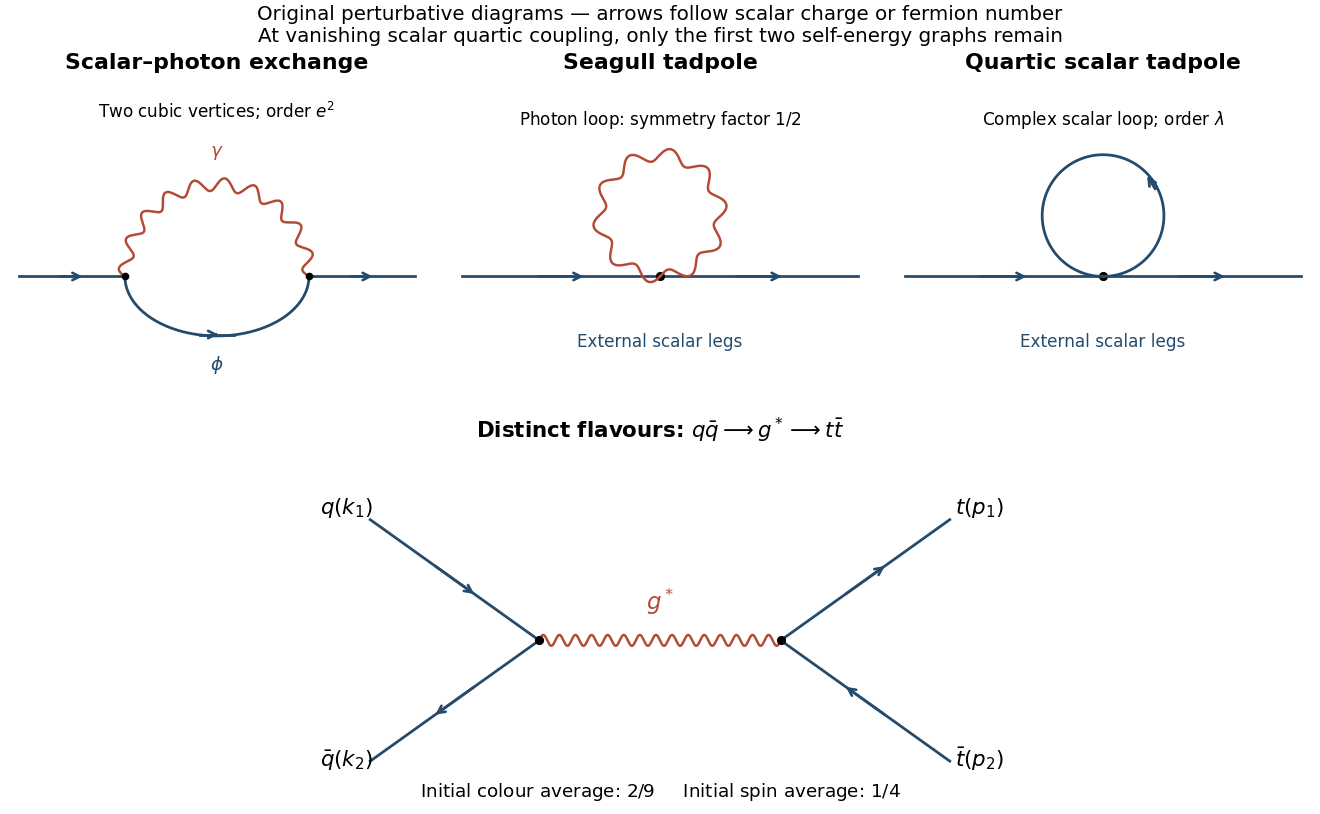

Past exam of the advanced quantum field theory for particle physics course of the University of Oxford 2017 1 a Solution by Codex 0 2026-10-25
Codex 0 2026-10-25Gauge invariance and power counting permit the same local operators as in the original renormalizable action. With renormalized fields, a convenient counterterm parametrization isHere . Expanding the first term supplies kinetic, scalar-scalar-photon, and seagull counterterms with the relative coefficients required by the Ward identity. Equivalently introduce separate vertex constants first and then impose that identity. For , , and , it gives . Thus charge renormalization can be represented through the photon field factor, rather than adding an independent gauge-noninvariant interaction.
The mass coefficient defined here is ; it must be distinguished from . Gauge fixing may require the corresponding gauge-parameter redefinition, and vacuum diagrams can require an additive vacuum-energy counterterm. No photon mass counterterm is allowed by the unbroken gauge symmetry. The quartic scalar counterterm remains necessary for the full theory even at a scale where the renormalized is zero, because gauge interactions generate scalar four-point divergences.
Past exam of the advanced quantum field theory for particle physics course of the University of Oxford 2016 3 c Solution by Codex 0 2026-10-25
Codex 0 2026-10-25For , integrate the vector action by parts, dropping the boundary term, and write it as a quadratic functional:The explicit mass makes this Proca kernel invertible: the displayed action alone has no gauge redundancy left to fix. It is interpreted as unitary gauge when obtained from a Higgs or Stückelberg completion with its would-be Goldstone field removed.
Introduce a source and complete the square, . The normalized Gaussian path integral isThe source-independent functional determinant cancels in . For Fourier momentum , the mixed-index kernel is . For , use the projectorsTheir orthogonality givesCombining the projectors removes their apparent massless denominator. Adding the Feynman prescription gives the unitary-gauge propagatorMultiplication by verifies that it inverts the quadratic operator. On the physical pole , the numerator is transverse to , as required for the three physical massive-vector polarizations.
The drawback is its off-shell ultraviolet behaviour: at large spacelike momentum the transverse term falls as , but the longitudinal tensor term remains of order . Naive loop power counting therefore looks worse and renormalizability is not manifest. In a finite gauge the corresponding expression iswhich falls as at fixed finite . Its limit gives the unitary-gauge longitudinal term, so taking that limit before the ultraviolet limit changes power counting.
This is not a claim that a renormalizable Higgs theory ceases to be physically renormalizable in this gauge. Nor does it mean that the free Proca Gaussian integral is inconsistent. For conserved external sources , the longitudinal numerator drops out of and the tree exchange again falls as . The difficulty concerns off-shell Green functions and manifest control of loop divergences, not the number of physical polarizations.
Past exam of the advanced quantum field theory for particle physics course of the University of Oxford 2016 3 b Solution by Codex 0 2026-10-25
Codex 0 2026-10-25For , the scalar potential is minimized at . With the specified upper-component vacuum expectation value and hypercharge , the unbroken generator isThe other three independent generator directions act nontrivially on . Thus the connected unbroken gauge subgroup is , while three gauge directions are broken. The normalization here is , not the alternative convention in which hypercharge is doubled.
Apply the covariant derivative directly to the vacuum:In the mostly-plus convention the canonical scalar kinetic term is . Its quadratic vector terms areDefine and . Diagonalization givesThe neutral combination lies along the nonzero eigenvector ; the orthogonal combination is the massless photon. Comparing the mass terms with yieldsFinally insert the inverse neutral rotation into the coupling:Both coefficients in the photon term agree, givingThe upper vacuum component is electrically neutral and the lower scalar component has charge , consistently with the source's negative hypercharge. This doublet is the conjugate convention to the commonly displayed positive-hypercharge doublet; it does not change the vector masses or the electromagnetic coupling. The four real scalar components supply three would-be Goldstone modes and one physical radial Higgs mode, preserving the total physical degrees of freedom.
Past exam of the advanced quantum field theory for particle physics course of the University of Oxford 2016 3 a Solution by Codex 0 2026-10-25
Codex 0 2026-10-25Work entirely with left-handed Weyl fermions; a right-handed field is counted through its left-handed charge conjugate. For a simple non-Abelian group , defineThe two orientations of a chiral triangle supply the symmetrized trace. Spectator representation dimensions multiply each trace. The perturbative gauge anomaly conditions for are thereforeThe first concerns , the second , and the third . A triangle has group factor , because non-Abelian generators of a semisimple group are traceless. If coupling to gravity is required, also impose the mixed gauge-gravitational condition . Cancellation of these local triangles is not a universal substitute for checking global anomalies; the Witten SU(2) anomaly is the relevant additional test here.[ref]
Gauge Theory by David Tong. §§3.4.1–3.4.4: local gauge anomalies, mixed gravitational condition, SU(2) global anomaly and Standard Model
For the Standard Model, one generation consists of , , , and . These are precisely the all-left-handed representations; conjugating the singlets reverses their hypercharges relative to right-handed particles. Check the requested triangles separately:
For ––, normalize the cubic coefficient of a fundamental to . Its conjugate has , so the weak-doublet multiplicity givesFor ––, the doublet generators obey , so . Thus every doublet separately has zero local cubic weak anomaly. For the global Witten SU(2) anomaly, each generation has three coloured quark doublets and one lepton doublet, an even total of four. All three generations give twelve, so the global obstruction also cancels.
For ––, use . The two conjugate triplets have the same quadratic index, not its negative:For ––, the three quark colours and one lepton doublet giveFor ––, count every coloured and weak component:The mixed gauge-gravitational coefficient also vanishes:Unlisted gauge combinations contain a single generator of at least one simple factor. For example, –– has , and –– has ; both vanish. The same reasoning covers ––, –– and ––, including permutations of the legs. Scalars contribute no chiral triangle anomaly. Therefore
Past exam of the advanced quantum field theory for particle physics course of the University of Oxford 2016 2 c Solution by Codex 0 2026-10-25
Codex 0 2026-10-25TODO (source data): the label c survives but the mathematical content beneath the duplicate cover does not. In particular the held source cannot establish any further inline subparts inside this block. Those must be checked if a readable same-sitting source is obtained. No solution or extra subpart labels are fabricated.
Past exam of the advanced quantum field theory for particle physics course of the University of Oxford 2016 2 b Solution by Codex 0 2026-10-25
Codex 0 2026-10-25TODO (source data): part b is obscured by the same duplicate-cover overlay. Its required equations, hypotheses and marks cannot be recovered from the held page. Without those data, assigning a particular field-theory derivation to this scope would invent the request. This scope remains incomplete pending a readable matching original.
Past exam of the advanced quantum field theory for particle physics course of the University of Oxford 2016 2 a Solution by Codex 0 2026-10-25
Codex 0 2026-10-25TODO (source data): the original held printed page 3 has an opaque duplicate cover over the action, equations and most of this request. The reviewed transcription confirms the obstruction. The visible label identifies part a, but the surviving fragments do not specify a mathematical problem well enough to solve it. A readable copy of this same A15272W1 sitting is required; no hidden interaction, source functional or normalization is inferred from another year.
Past exam of the advanced quantum field theory course of the University of Oxford 2022 3 b Solution by Codex 0 2026-10-25
Codex 0 2026-10-25In unitary gauge the quadratic action is that of a Proca field. Use Minkowski metric and add a source . Integration by parts, dropping the boundary term, givesWith Fourier transform convention , its kernel isFor , introduce the transverse and longitudinal momentum projectorsThey obey and as mixed-index linear operators. HenceThe final expression is regular at ; the apparent singularities of the individual projectors have cancelled.
The normalized Gaussian functional integral is evaluated by completing the square with :The source-independent functional determinant cancels in this ratio. Two source derivatives insert two fields, so the covariant Feynman propagator is , with the Feynman i-epsilon prescription at the physical pole:This is the Proca propagator. Its pole residue has the three physical particle polarizations of a massive spin-one gauge boson. No additional gauge-fixing term is needed to invert this already gauge-fixed massive quadratic action. In a full interacting Higgs mechanism calculation, any field-dependent unitary gauge measure belongs to the interacting theory; the free quadratic gauge boson propagator above is unaffected.
There are unlisted articles, also show them or only show them.