Past exam of the advanced quantum theory: path integrals and many-particle physics course of the University of Oxford 2024 1 d Solution by  Codex 0 2026-10-25
Insert the complete orthonormal basis of energy eigenstates on either side of the Boltzmann factor. The spectral theorem givesAt low temperature, the gap suppresses excited energy eigenstates. The harmonic oscillator eigenfunction of the ground state isThereforeThe common zero-point energy factor cancels. Dividing the kernel by its trace would give the position probability density of the canonical ensemble; at zero temperature this tends to , whose variance is . Thus zero temperature projects onto the ground state and retains its quantum spread, rather than concentrating at the minimum of the classical potential energy.
There is also a check on the first correction. With , the first excited harmonic oscillator eigenfunction satisfies and . Hence the spectral theorem gives , in agreement with part (c).
Past exam of the advanced quantum theory: path integrals and many-particle physics course of the University of Oxford 2024 1 c Solution by Codex 0 2026-10-25
Codex 0 2026-10-25Because at , the factor cancels from the ratio. Write and . The exact answer isAt high temperature, . Expanding the hyperbolic tangent givesThe displayed leading expression is the ratio of classical Boltzmann factors for potential energy and . Indeed the classical canonical ensemble givesThe momentum Gaussian integral is independent of and cancels in the ratio. This is the classical phase-space limit of the thermal kernel. Here , with the Boltzmann constant; the associated classical position variance is . At fixed , ultimately tends to one as temperature tends to infinity, while its width grows.
At low temperature, . Now , so at fixed Unlike the classical high-temperature expression, this limiting width remains nonzero at zero temperature, reflecting the ground state of the quantum harmonic oscillator.
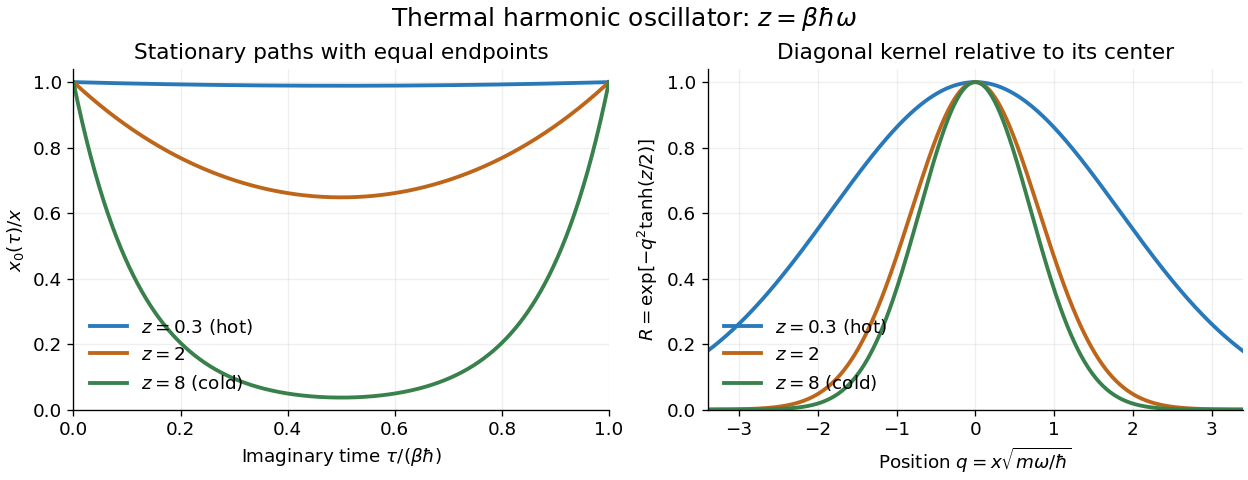
Imaginary-time stationary paths and the crossover of the diagonal thermal kernel
. Original plots of the equal-endpoint Euclidean oscillator path and the diagonal thermal kernel of a quantum harmonic oscillator, divided by its value at zero. Increasing lowers the temperature: the path spends more of its interior near zero, and the ratio approaches the finite-width ground state profile. Details. Past exam of the advanced quantum theory: path integrals and many-particle physics course of the University of Oxford 2024 1 b Solution by Codex 0 2026-10-25
Codex 0 2026-10-25After the shift , the endpoint values of are both zero. Expanding the Euclidean action givesBy integration by parts, the cross term isThe first term vanishes by the homogeneous Dirichlet boundary conditions, and the second by the Euler-Lagrange equation. The translation has unit Jacobian determinant in the time-sliced configuration-space path integral, so . Consequently classical-path factorization of a quadratic path integral is exact here:All dependence on the common endpoint lies inThe endpoint domain and the integrand defining are the same for every . This is a zero-endpoint Gaussian path integral; the canonical partition function instead integrates the entire diagonal kernel over . The final sentence of the printed part omits from its exponential: the physical Boltzmann factor has the dimensionless exponent .
An optional normalization check uses the Dirichlet oscillator fluctuation determinant. Its eigenvalues are , . Relative to the free-particle Gaussian path integral, the hyperbolic-sine infinite product givesThus . Integrating the resulting diagonal thermal kernel of a quantum harmonic oscillator by a Gaussian integral yields , including the zero-point energy.
Past exam of the advanced quantum theory: path integrals and many-particle physics course of the University of Oxford 2024 1 a Solution by Codex 0 2026-10-25
Codex 0 2026-10-25Put , the interval of imaginary time, and assume . For a variation with , the first variation of the Euclidean action isThe boundary term vanishes. The fundamental lemma of the calculus of variations therefore gives the Euler-Lagrange equationIts sign differs from the real-time harmonic oscillator equation because the Euclidean action contains positive kinetic energy and positive potential energy. The general solution is . Applying the two endpoint conditions gives and . Equivalently, the equal-endpoint Euclidean oscillator path isThis form displays reflection about the midpoint and satisfies both endpoints immediately. On this path,Thus the Euclidean action reduces to a boundary term. Since and ,The positive quadratic form is the second variation, so this stationary path is the unique minimum, rather than merely an arbitrary stationary point.
Past exam of the advanced quantum theory: path integrals and many-particle physics course of the University of Oxford 2023 2 c Solution by Codex 0 2026-10-25
Codex 0 2026-10-25Use . The given state is a two-species uniform boson number state: only the mode of each species is occupied. Applying an annihilation operator to an unoccupied mode gives zero, while has eigenvalue . ThusThe two species have independent fixed occupation numbers, so mixed expectation values factorize. The inverse discrete Fourier transforms yieldIn the momentum-space Hamiltonian operator, only contributes: each annihilation operator must remove an occupied boson, and each creation operator must restore it to the same mode. HenceThere is no replacement of by in this energy: in the real-space calculation the relevant neighboring-site commutator is zero. Both expressions assume distinct neighbouring sites, as in ii.
To match the prescribed spin length in the mean, impose . At fixed integer , the energy is minimized by maximizing . Consequently the best choices within this relaxed family areWhen is even, and . When is odd, either assignment of gives . Without fixing , this auxiliary boson Hamiltonian operator has no lower bound: taking sends its expectation value to .
Next, . Each term changes the two species' occupation numbers, producing a state orthogonal to . ThereforeFor distinct sites modulo , expand the product of the two spin operators. The terms and again have zero expectation value. The remaining terms giveHere and the Kronecker delta vanishes at distinct sites. ConsequentlyThe same holds for the components. At the balanced choice and as , each transverse two-point correlation function tends to independently of separation, whereas the one-point transverse magnetization is zero. This is transverse spin order in a number eigenstate: the state has a definite total and retains the global U(1) symmetry of rotations about , yet has the transverse correlations of an ordered state with no selected common azimuth. The sum of the and correlations tends to , describing ferromagnetic long-range order within this approximation. The thermodynamic limit is understood with both the separation and growing, without identifying the two sites periodically.
Fixed-spin qualification. The proposed state is not actually in the physical fixed- Hilbert space for . It satisfies the local spin constraint in the Schwinger boson representation only in expectation value. For example, with ,The nonzero component has local total occupation numbers and hence local spins , instead of . More generally the local total number operator has varianceEach species contributes a binomial distribution at a given site, with success probability , and the two contributions are independent. In the physical subspace that variance must be zero. The proposed state even hasby the Casimir operator identity from a. Thus the calculated energy is a relaxed mean-field theory estimate, not a Rayleigh-Ritz variational principle bound for the stated fixed- quantum XY chain. Projecting onto at every site would give a physical trial state and generally change its expectation values; in the two-site example the projected state has energy , whereas the unprojected value is . The calculated long-range order characterizes the supplied approximation and does not establish long-range order in the exact one-dimensional ground state.
Past exam of the advanced quantum theory: path integrals and many-particle physics course of the University of Oxford 2023 2 a Solution by Codex 0 2026-10-25
Codex 0 2026-10-25Use throughout. Let , and . Operators belonging to different boson species commute. The proposed Schwinger boson representation givesConsequently the first of the spin commutation relations isThe number operator commutators , and their counterparts giveThus all the spin commutation relations hold. Also : each fixed- sector is invariant. To identify its spin, calculate the Casimir operator:The irreducible spin representation with prescribed therefore requires , and its normalized Fock basis correspondence isConversely, and . The nonnegative integer occupation numbers give precisely , and there are such states. As a check, the spin raising operator acts aswhich is the usual spin ladder operator coefficient .
For a lattice of fixed spins, the local spin constraint in the Schwinger boson representation is essential:The full two-species bosonic Fock space also contains other local irreducible spin representations; fixing only the total boson number does not remove them.
Past exam of the advanced quantum theory: path integrals and many-particle physics course of the University of Oxford 2023 1 c Solution by Codex 0 2026-10-25
Codex 0 2026-10-25Put . Factoring out the ground state Boltzmann factor from the exact canonical partition function givesAt fixed finite , the binomial theorem givesTaking the logarithm yields the finite-ring low-temperature expansion of the Helmholtz free energy,The constant term is the ground state energy. The term is the contribution of the ground state degeneracy factor. The first thermal correction follows directly by retaining the first excited state manifold:Each pair of domain walls costs , explaining the absence of an term. For , every configuration has an even number of domain walls, so the displayed remainder improves to .
This is an expansion for fixed , not a uniform thermodynamic limit. In particular, the small correction requires , with higher terms also controlled as at fixed . Taking first instead selects and givesIts leading correction is of order . The finite-ring pair constraint and the extensive population of domain walls in an arbitrarily long chain explain the different ordering of these two limits.
Past exam of the advanced quantum theory: path integrals and many-particle physics course of the University of Oxford 2023 1 b Solution by Codex 0 2026-10-25
Codex 0 2026-10-25The Boltzmann factor factorizes over bonds. Define the spin-chain transfer matrix byHere is the Kronecker delta. Summing the product of these matrix elements over all configurations, and closing the final bond by periodic boundary conditions, gives the canonical partition functionHence, writing for the identity matrix and for the all-ones matrix,Every element of is a sum of ones, while every diagonal element of is one. ThusMore explicitly, for , . If , then . These complementary eigenspaces have dimensions and . Equivalently, is the orthogonal projector onto the linear span of . The eigenvalues and their eigenvalue multiplicities are thereforeSince the two matrices share these eigenvectors, the exact finite-ring canonical partition function isBoth terms matter in the finite-ring low-temperature limit: discarding the second would lose the correct ground state degeneracy factor and introduce a spurious single-wall contribution.
Past exam of the advanced quantum theory: path integrals and many-particle physics course of the University of Oxford 2018 2 d Solution by Codex 0 2026-10-25
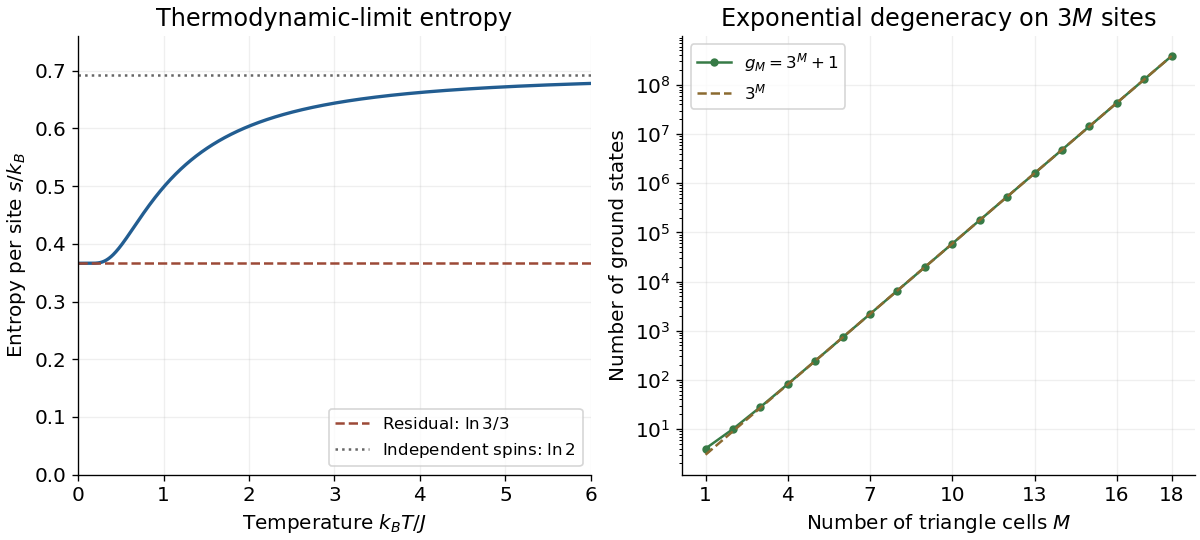
Codex 0 2026-10-25For low temperature, factor out the largest Boltzmann factor from the dominant eigenvalue:Thus the Helmholtz free energy per site has the expansionDifferentiate at fixed , remembering that . The entropy per site isThe nonzero residual entropy comes from an exponentially large ground-state degeneracy, generated by geometrical frustration. A triangle with antiferromagnetic energy has minimum energy : if , the apex must have the opposite sign; if , either apex sign is permitted. The two all-equal configurations instead have energy . Thus exactly one of a minimum-energy triangle's bonds is frustrated. The bridge can simultaneously minimize its energy at by requiring , where is the next cell's first base spin.
For fixed and , the number of allowed apex choices is therefore two when and one when . The zero-temperature counting transfer matrix on successive first base spins isThe eigenvalues of are and . Dividing by the sites and taking the thermodynamic limit gives , independently confirming the derivative calculation. This does not assert a unique ordered ground state: the extensive choice of frustrated bonds is precisely what leaves entropy at zero temperature. At high temperature, all Ising spins become independent and per site.


Past exam of the advanced quantum theory: path integrals and many-particle physics course of the University of Oxford 2018 2 c Solution by Codex 0 2026-10-25
Codex 0 2026-10-25Let , so that the total number of Ising spins is . Write and group each triangle's two base spins and its apex into one cell. The Ising chain with alternating triangular decorations has a triangle bond followed by an undecorated connecting bond. Summing an apex Ising spin first gives a decorated-bond Boltzmann weightThe undecorated bridge has Boltzmann weight . In the basis ,Each cell contributes , so periodic boundary conditions giveThe two matrices have common normalized eigenvectors and , expressing spin inversion symmetry. Their respective eigenvalues areConsequently the cell transfer matrix has eigenvaluesand the finite-size partition function isFor , and , so only survives in the thermodynamic limit. Divide the Helmholtz free energy by , the number of sites rather than the number of cells or base spins:As a counting check, gives , , hence , exactly the number of independent Ising spin configurations. This model has separated decorated bonds and should not be confused with the corner-sharing sawtooth Ising chain, which has a different site count.
Past exam of the advanced quantum theory: path integrals and many-particle physics course of the University of Oxford 2018 2 b Solution by Codex 0 2026-10-25
Codex 0 2026-10-25For an open chain there are bonds, with both endpoint Ising spins independently summed. Retain the same spin-chain transfer matrix, but replace the trace by endpoint vectors. With ,This follows directly by expanding the product of Boltzmann factors. If are orthonormal eigenvectors of the symmetric matrix , the equivalent spectral decomposition isFixed endpoint Ising spins replace the corresponding by a basis vector; extra endpoint energies replace its entries by the corresponding Boltzmann factors. The leading bulk Helmholtz free energy per spin agrees with the periodic result, because the boundary changes only subextensive terms. In particular, gives , as required for one free Ising spin.
Past exam of the advanced quantum theory: path integrals and many-particle physics course of the University of Oxford 2018 2 a Solution by Codex 0 2026-10-25
Codex 0 2026-10-25Let and use the two spin values as row and column labels. Define the spin-chain transfer matrixIt is a real symmetric matrix because ; every entry is strictly positive for finite bond energies at . The Boltzmann factor of a spin configuration factorizes into the product . Summing the intermediate spin labels is exactly matrix multiplication, and the final closure imposes periodic boundary conditions. ThusWriting , its eigenvalues areA positive-entry matrix need not have two positive eigenvalues; can be negative. The Perron–Frobenius theorem ensures here. Therefore the Helmholtz free energy is , and its value per spin in the thermodynamic limit is .
Past exam of the advanced quantum theory: path integrals and many-particle physics course of the University of Oxford 2018 1 d Solution by Codex 0 2026-10-25
Codex 0 2026-10-25Since every quasiparticle energy is positive, the ground state is the vacuum of all the annihilation operators, including . Its zero-momentum mode is therefore empty. For each positive momentum, the inverse Bogoliubov transformation givesBoth annihilate the normalized pair state . For example, applying produces the two cancelling terms . ThusThe factors have even fermion parity and commute for disjoint momentum pairs. Each normalized factor is a superposition of zero and two fermions, whose pair-occupation probability is . ThereforeThere is no zero-mode contribution. For fixed , the sum converges since .
A normalized simple excited state is for . Its excitation energy is , and its total momentum is : both terms in add momentum . Acting on the pair givesThe affected pair now contains exactly one fermion instead of mean number ; all other pairs are unchanged. ConsequentlyThis is the fermion number of a Bogoliubov excitation. Its change in mean fermion number lies between zero and one for , with the value one at . The Bogoliubov quasiparticle coherently mixes adding a fermion and removing the opposite-momentum fermion; it is not an eigen-excitation of the original fermion number operator. Indeed,so fermion number is not conserved when , while fermion parity is conserved. The generally noninteger change is an expectation value in a coherent paired background, rather than a fractional eigenvalue of the fermion number operator. In the weak-pairing limit at fixed , it tends to one, as expected for an ordinary added fermion.
Past exam of the advanced quantum theory: path integrals and many-particle physics course of the University of Oxford 2018 1 c Solution by Codex 0 2026-10-25
Codex 0 2026-10-25Group the nonzero modes into independent pairs . For one pair set , and introduce the Nambu spinor . Normal ordering using givesThis exactly contains both kinetic terms and the pairing terms once; there is no additional factor of one half because only is summed.
Insert , where and is the Bogoliubov transformation matrix. Direct matrix multiplication yieldsChoose the diagonalizing branchThen the off-diagonal terms vanish and the upper diagonal entry is . Extend the angle to negative momenta as in part b; the sine relation just written applies to the positive representative of each pair. The BCS coherence factors can be chosen asHere denotes , and denotes ; these expressions are nonsingular because and . The minus sign of for positive is fixed by the pairing phase in this Hamiltonian.
A second use of the canonical anticommutation relations givesThe zero-momentum term was never paired and is simply . HencewithThe constant is the ground-state energy. At fixed , its ultraviolet tail converges: in one dimension. Replacing by would incorrectly pair a spinless mode with itself.
Past exam of the advanced quantum theory: path integrals and many-particle physics course of the University of Oxford 2018 1 b Solution by Codex 0 2026-10-25
Codex 0 2026-10-25For real angles write and . For one independent pair , the transformation and its conjugate readUsing the canonical anticommutation relations for the modes givesThe remaining anticommutators vanish for independent momentum pairs. The displayed two-by-two matrix is unitary and its inverse is obtained by changing to .
When the same formula is indexed over both signs of momentum, its first row at must agree with the conjugate of its second row at . Thus a consistent global convention requiresThis is the odd-momentum fermionic Bogoliubov angle convention. If one checks only the first-row formulas, their cross anticommutator is ; its vanishing gives the condition modulo , with possible signs absorbable in the modes. Requiring both rows to describe the same operators fixes the convention above. Merely checking a separate unitary matrix at each momentum misses this redundancy: choosing in both first rows would give .
At , the annihilation operator and its conjugate belong to one mode. The full displayed formula is consistent only with ; choose and . This mode is not a two-mode pair.
Past exam of the advanced quantum theory: path integrals and many-particle physics course of the University of Oxford 2018 1 a Solution by Codex 0 2026-10-25
Codex 0 2026-10-25With no pairing, the Hamiltonian is diagonal in the fermionic occupation numbers. The Pauli exclusion principle allows each momentum mode to be either empty or occupied once. Without a fixed fermion number constraint, occupying a mode lowers the energy precisely when its single-particle energy is negative. Therefore, with the Fock vacuum, a ground state isChoose a fixed ordering of the fermionic creation operators; changing it alters only the overall phase. Any zero-energy modes may be occupied or empty without changing the ground-state energy.
To identify the occupied modes, complete the square:Here is the dispersion parameter, not inverse temperature. If , every mode has positive energy and the unique ground state is the Fock vacuum, with . If , there are still no negative-energy modes, but have zero energy if they lie on the allowed momentum grid. Each such mode doubles the ground-state degeneracy.
For , defineBoth are positive, and the occupied Fermi sea consists of the two intervals . With , the requested finite-size ground-state energy is explicitlyThe factor two counts opposite momenta. Endpoints are excluded from this sum because they have zero energy; when an endpoint is allowed, its optional occupation adds ground-state degeneracy. A narrow negative-energy interval can contain no allowed finite-size momenta, in which case the sum is empty. The zero-momentum mode is always empty since .
There are unlisted articles, also show them or only show them.