Past exam of the advanced quantum theory: path integrals and many-particle physics course of the University of Oxford 2025 2 d Solution by  Codex 0 2026-10-25
The canonical anticommutation relations make , so the proposed exponential function terminates exactly:Use the inverse Bogoliubov transformation , , and the actions and . The two vacuum state conditions becomeBoth therefore require . Normalizing this quantum state gives . Choosing positive , which fixes an irrelevant overall global phase, yields because . Thus the two-mode fermionic paired vacuum isThe other sign for describes the same physical quantum state. The positive relative coefficient is fixed by the paper's pairing order and the convention .
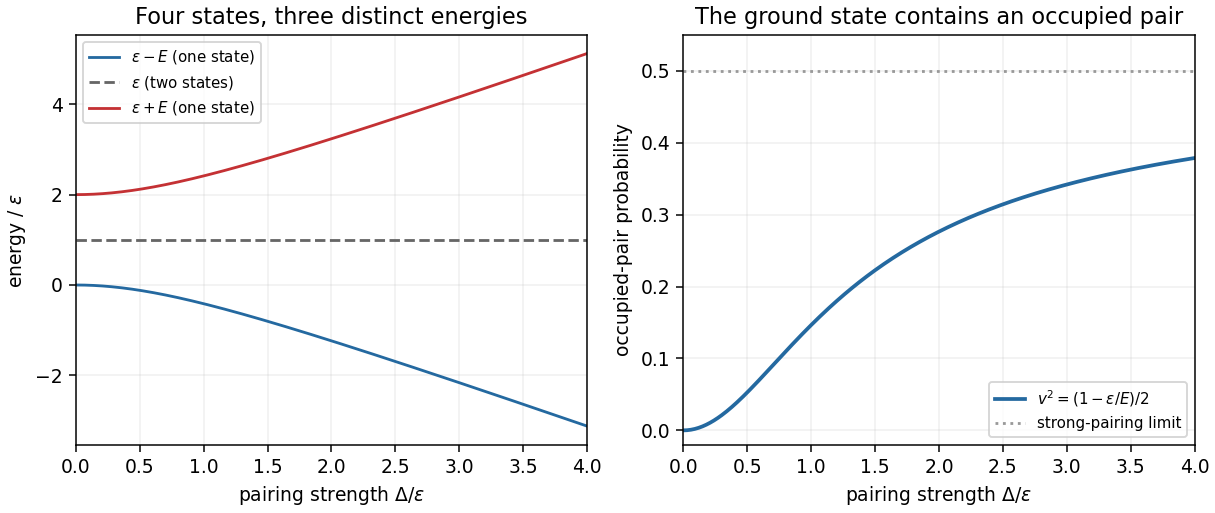
As a direct eigenvector check, and implyIt is therefore the unique ground state, as also follows from positive quasiparticle excitation energy . It has definite even fermion parity but is not an eigenstate of the original total number operator: the empty-pair and occupied-pair probabilities are and . In particular . The pair amplitude is , consistently with .
For the limiting check at fixed positive , , , so . For at fixed positive , , , giving equal amplitudes for the empty and occupied pair. These checks also fix which branch of the Bogoliubov transformation produces the ground state.
Past exam of the advanced quantum theory: path integrals and many-particle physics course of the University of Oxford 2025 2 c Solution by Codex 0 2026-10-25
Codex 0 2026-10-25Let , and . Substitution of the Bogoliubov transformation, with normal ordering using and , givesFor example, the term in contributes ; these constants must be retained to obtain the ground-state energy. The two-orbital fermionic pairing Hamiltonian is consequentlyTo eliminate the pairing term, choose a canonical rotation of two fermionic modes satisfyingWith , , take , so . Setting givesThis positive choice fixes a convenient convention for the vacuum state in part (d). It yieldsBoth number operators independently have eigenvalues . Hence the energy eigenvalues and state degeneracies areThere is one fermionic Bogoliubov quasiparticle of energy per occupied transformed orbital. The two Nambu spinor matrix eigenvalues should not be mistaken for two independently occupiable levels of opposite energy; the normal ordering constant and the two positive quasiparticle excitation costs give the four physical energy eigenvalues above.
An independent diagonalization of a matrix checks both the pairing sign and the additive constant. In the ordered orthonormal basis , the even-fermion parity block isbecause and . Its characteristic polynomial is , giving . The odd-fermion parity Fock states are unaffected by pairing and both have energy .
Equivalently, with the Nambu spinor ,Replacing by gives , reproducing the result by normal ordering.

Past exam of the advanced quantum theory: path integrals and many-particle physics course of the University of Oxford 2025 2 b Solution by Codex 0 2026-10-25
Codex 0 2026-10-25Writing the Bogoliubov transformation componentwise, together with its Hermitian adjoint, givesThe full canonical anticommutation relations for implyEqual-type anticommutators vanish because and :For the mixed anticommutators, the only potentially nonzero terms cancel:while follows from . Taking the Hermitian adjoint supplies the remaining relations. Thus the necessary and sufficient condition isEquivalently, the matrix is an orthogonal matrix, , giving a canonical rotation of two fermionic modes. Its inverse is therefore
Past exam of the advanced quantum theory: path integrals and many-particle physics course of the University of Oxford 2025 2 a Solution by Codex 0 2026-10-25
Codex 0 2026-10-25Use the standard canonical anticommutation relations for the two distinct fermionic orbitals. In particular , in addition to the relations explicitly listed in the paper; these mixed relations are part of the usual two-orbital fermionic Fock space interpretation. Normalize the original vacuum state by and fix the orderingThe canonical anticommutation relations give and . Consequently the number operator is an orthogonal projector:The same holds for . Hence each eigenvalue obeys and is either or , expressing the Pauli exclusion principle. Also , so the two number operators have a simultaneous orthonormal basis of Fock states:Each number operator has eigenvalues , each with state degeneracy two. For , the zero eigenspace is spanned by and the unit eigenspace by ; for , these are respectively and . Any normalized linear combination within one such eigenspace is also an eigenstate of that number operator.
Past exam of the advanced quantum theory: path integrals and many-particle physics course of the University of Oxford 2025 1 d Solution by Codex 0 2026-10-25
Codex 0 2026-10-25Keep fixed and put , so as temperature tends to zero. For even , the finite-ring antiferromagnetic Ising correlation becomesBoth alternating ground states have , so their equal-weight canonical ensemble has the same two-point correlation function despite its zero one-point correlation function.
For odd , the signs instead giveDirect substitution gives an indeterminate ratio. Expanding at fixed with ,Consequently the zero-temperature correlation of an odd antiferromagnetic Ising ring isThe odd-ring factor has a direct probability interpretation. At zero temperature, the canonical ensemble gives equal weight to its ground states. The single frustrated bond in an antiferromagnetic Ising ring is uniformly located, with probability of lying on the chosen -bond path. If it is absent from that path, ; if it is present, this product is . Averaging gives .
Thus the decay with separation here comes from averaging a movable, compulsory frustrated bond in an antiferromagnetic Ising ring, even after additional thermally excited frustrated bonds in an antiferromagnetic Ising ring disappear. In particular for odd , and reproduces the ground-state energy. The formula also respects , although its factor changes sign halfway around the ring.
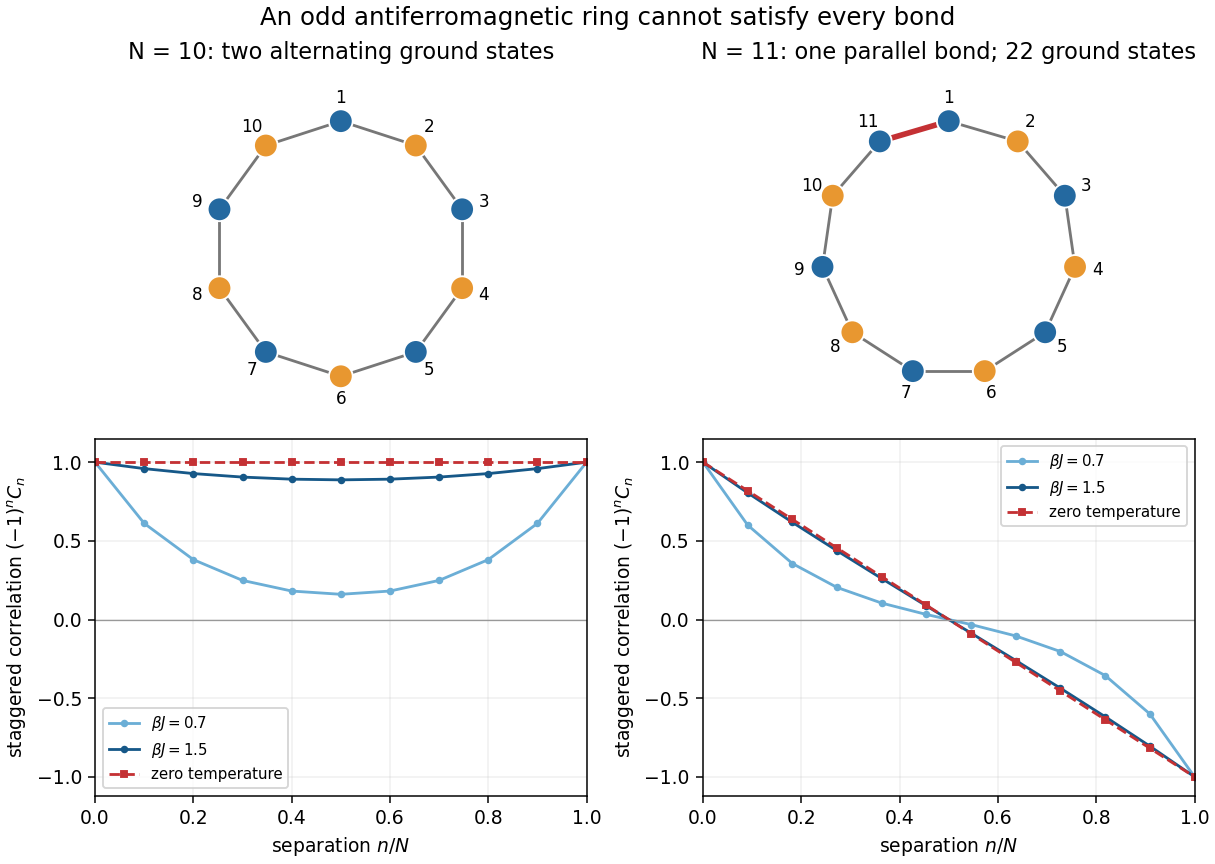

The order and scale of limits matter. Taking the thermodynamic limit first at positive temperature gives the exponential function in part (c). Cooling an odd finite ring first leaves the linear factor . Both orders subsequently give at fixed , but this agreement is not uniform in separation: when stays nonzero, the odd-ring linear factor survives in the zero-temperature expression.
Past exam of the advanced quantum theory: path integrals and many-particle physics course of the University of Oxford 2025 1 c Solution by Codex 0 2026-10-25
Codex 0 2026-10-25Take the thermodynamic limit at fixed separation and fixed finite . Since , the terms and in the finite-ring antiferromagnetic Ising correlation vanish, through either even or odd . ThereforeMatching the decaying exponential function gives the correlation length, in units of the site spacing:If the physical spacing is , the physical correlation length is . The alternating sign records the preferred opposite orientation of neighboring Ising spins; the finite correlation length shows that this preference does not maintain long-range Néel order at positive temperature.
For large , , so : the correlation length becomes large on cooling, but diverges only at zero temperature. At infinite temperature, and ; the separate equal-site two-point correlation function remains .
Past exam of the advanced quantum theory: path integrals and many-particle physics course of the University of Oxford 2025 1 b Solution by Codex 0 2026-10-25
Codex 0 2026-10-25Write , where is the inverse temperature, is temperature and is the Boltzmann constant. In the canonical ensemble, each spin configuration has probability . The nearest-neighbor Boltzmann factors multiply, so the spin-chain transfer matrix, in the order , isMultiplying its entries around the ring and summing over every Ising spin yields the partition function:The trace implements the periodic boundary conditions; replacing it by an endpoint sum would describe a different partition function. The normalized eigenvectors and corresponding eigenvalues areThe negative eigenvalue is essential for the antiferromagnetic Ising model. Introduce their ratioThe exact finite- partition function and Helmholtz free energy areFor finite , , so for both even and odd . The last term retains the finite-ring effect of geometric frustration.
To insert an Ising spin into this trace, use the diagonal matrix . In the eigenbasis of , it exchanges and , and hence has vanishing diagonal entries. The one-point correlation function is thereforeThe same conclusion follows directly from spin inversion symmetry: reversing every Ising spin preserves the energy and the Boltzmann factor while reversing .
For the two-point correlation function, the two insertions divide the ring into paths of and bonds. ThusIn particular, the exact finite-ring antiferromagnetic Ising correlation isBecause the one-point correlation functions vanish, this is also the connected correlation function. It gives and , as required by and exchanging the two paths around the ring. At , distinct Ising spins are independent and for ; is understood separately if a power occurs in the displayed expression.
Past exam of the advanced quantum theory: path integrals and many-particle physics course of the University of Oxford 2024 2 e Solution by Codex 0 2026-10-25
Codex 0 2026-10-25Put for and , using . Since the zero mode has zero kinetic energy, the exact kinetic energy in this trial state isTogether with part (d), the fixed-mean-number Bogoliubov variational energy isFor repulsive contact interaction, , each . Using the double-angle hyperbolic-function identities,soThe stationary point therefore satisfiesThis is a minimum, not just a vanishing derivative. Define the positive Bogoliubov quasiparticle dispersionAt the displayed solution , and . HenceThe hyperbolic cosine has its unique minimum at zero, proving global minimization of each retained term. Treating equal-magnitude wavevectors together simply multiplies the same function by their multiplicity. At a fixed ultraviolet cutoff, the resulting energy change from isIndeed . More directly, for small positive ,The pair vacuum expectation value lowers the interaction energy at first order in , whereas the nonzero occupation number and its kinetic energy cost start at second order. The two-mode squeezed vacuum admixes opposite-momentum pairs into the condensate, introducing spatial correlations that reduce the chance of two bosons coinciding. These correlations lower repulsive contact interaction enough to outweigh the added kinetic energy. A small quantum depletion of a Bose condensate can therefore lower the energy below the uncorrelated condensate value.
Two qualifications delimit this result. First, the paper does not state the sign of . More generally a finite stable minimum exists only when for every retained nonzero mode; repulsion ensures this. For example, with in some mode, tends to as , so an unconditional minimum claim for arbitrary is false. Also the formula minimizes the truncated Bogoliubov theory energy, not the exact quartic Hamiltonian including its discarded terms, and it must remain in the regime of small quantum depletion of a Bose condensate.
Second, a three-dimensional unregulated contact interaction cannot give a finite absolute beyond-leading-order ground-state energy by this bare sum. For large , , whose three-dimensional sum has an ultraviolet divergence. A finite ultraviolet cutoff, or renormalization of a three-dimensional dilute-gas contact coupling matched to a physical scattering length, is needed. This does not alter the modewise minimization or the finite-cutoff lowering mechanism just derived.
Past exam of the advanced quantum theory: path integrals and many-particle physics course of the University of Oxford 2024 2 d Solution by Codex 0 2026-10-25
Codex 0 2026-10-25The coherent state in the zero mode has mean occupation number . The other occupation numbers follow from part (c), giving exactlyImpose the fixed mean particle number by choosingHere is the quantum depletion of a Bose condensate. The approximation requires , so remains positive and macroscopically large. The specified coherent state and multimode squeezed vacuum are not exact eigenstates of the total number operator; in this variational construction is their prescribed mean particle number.
Write . Substituting into the retained part of the interaction energy before truncating givesThe last two terms quadratic in have no explicit large- factor when the Bogoliubov transformation parameters are held fixed, and are discarded along with the nonzero-mode quartic contribution already omitted in part (c). This is the same truncation that underlies the number-conserving Bogoliubov quadratic Hamiltonian. Thus, defining the physical number density correctly as ,Replacing by at the outset would give the wrong coefficient : expanding the leading condensate interaction energy supplies the necessary subtraction.
The printed definition is an error. In three dimensions the contact interaction coupling has units of energy times volume, so does not even have units of energy. There is a direct counterexample with no depletion: when , the specified coherent state has exactly . In fixed length and energy units, , and give , whereas the printed with gives . The requested formula and the minimization in part (e) hold with .
Past exam of the advanced quantum theory: path integrals and many-particle physics course of the University of Oxford 2024 2 c Solution by Codex 0 2026-10-25
Codex 0 2026-10-25Normalize the specified state by and write . Its zero mode is a coherent state, so any normally ordered product of zero-mode creation operators and annihilation operators can be evaluated using and . In particular , rather than , which would apply to a zero-mode number state.
Sort the momentum-space contact-interaction Hamiltonian by its number of zero-mode factors. Four such factors give . Three zero-mode factors and one nonzero momentum violate momentum conservation, so no such term survives. With two zero-mode factors there are three possibilities:
- Two zero-mode creation operators leave the opposite-momentum pair .
- Two zero-mode annihilation operators leave .
- One zero-mode factor on each side leaves . Choosing which of the two creation operators and which of the two annihilation operators are zero gives four placements.
The sums over include both members of each opposite-momentum pair, consistently with the overall factor . Terms with one zero-mode factor contain three nonzero-mode factors; their expected values vanish in the centered multimode squeezed vacuum. Indeed each is linear in , and an odd product has zero vacuum expectation value. Terms with no zero-mode factors are independent of at fixed . ThereforeTo evaluate these vacuum expectation values, use the inverse Bogoliubov transformation and its Hermitian adjoint:Since , the only nonzero two-factor vacuum expectation value is . The bosonic squeezed-vacuum contractions are consequentlyIn particular the three requested quantities are , and , respectively. The minus sign in the pair vacuum expectation values comes from the inverse Bogoliubov transformation and is essential to lowering the interaction energy. Substitution yields
Past exam of the advanced quantum theory: path integrals and many-particle physics course of the University of Oxford 2024 2 b Solution by Codex 0 2026-10-25
Codex 0 2026-10-25Taking the Hermitian adjoint gives . For nonzero wavevectors, the canonical commutation relations implyWhen the Kronecker delta is nonzero, , so the hyperbolic Pythagorean identity givesFor the two annihilation operators, the only potentially nonzero terms areHere implies equal magnitudes and hence equal , because depends only on . ThusThe corresponding commutators of two creation operators vanish by the Hermitian adjoint. This verifies that the Bogoliubov transformation preserves the full bosonic canonical commutation relations.
Past exam of the advanced quantum theory: path integrals and many-particle physics course of the University of Oxford 2024 2 a Solution by Codex 0 2026-10-25
Codex 0 2026-10-25Let be the box volume. The number operator is the sum of the occupation numbers of all momentum eigenstates, including the zero mode:In the Fourier series for the contact interaction, the two creation operators supply phase and the two annihilation operators supply . Fourier orthogonality with periodic boundary conditions givesThe four normalization factors together contribute , leaving the momentum-space contact-interaction HamiltonianThe Kronecker delta enforces momentum conservation. An equivalent expression that resolves the momentum transfer isBoth are already in normal ordering; no extra commutator constant is introduced.
There are unlisted articles, also show them or only show them.