Past exam of the mathematics course of the year 1 of the natural sciences course of the University of Cambridge 2022 Paper 1 11 b Solution by  Codex 0 2026-10-18
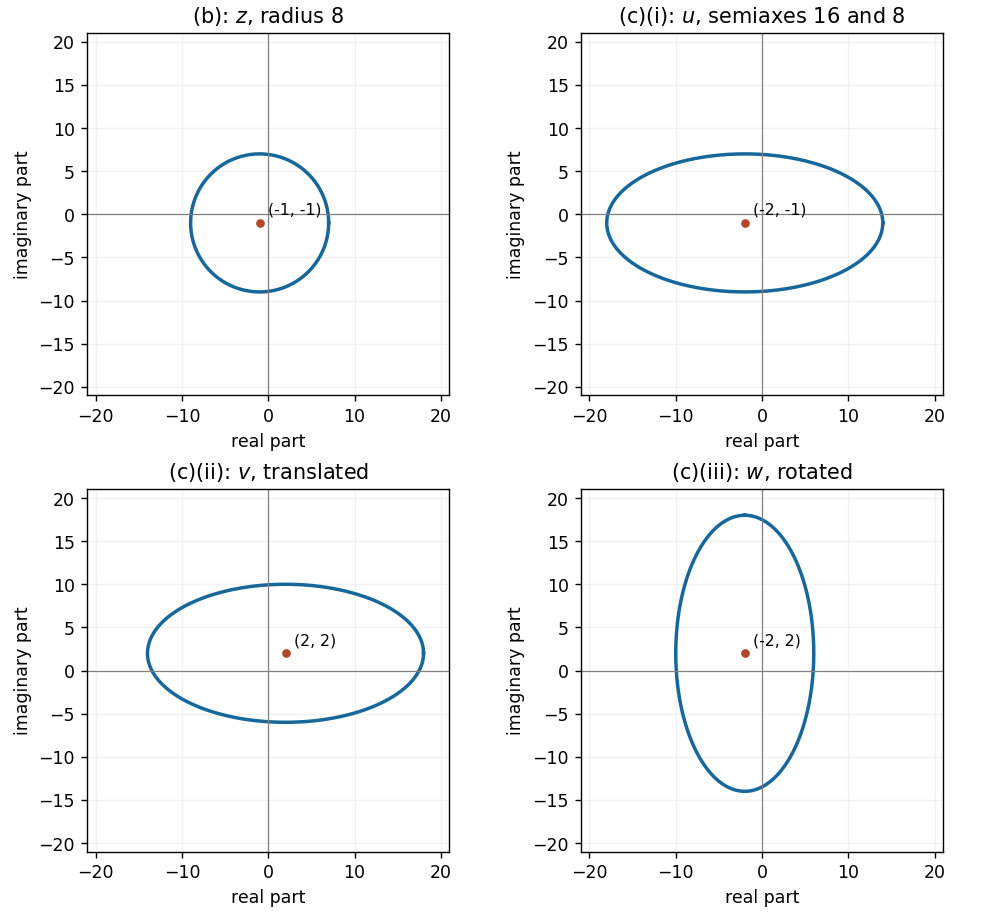
The complex modulus is the Euclidean distance from to . Thus the locus isa circle with centre and radius . Its extreme horizontal coordinates are and , and its extreme vertical coordinates are also and .

Past exam of the mathematics course of the year 1 of the natural sciences course of the University of Cambridge 2022 Paper 1 1 b Solution by Codex 0 2026-10-18
Codex 0 2026-10-18 Past exam of the mathematics course of the year 1 of the natural sciences course of the University of Cambridge 2022 Paper 1 1 a Solution by Codex 0 2026-10-18
Codex 0 2026-10-18The difference of two cubes identity gives the real polynomial factorizationExpanding the right side cancels the two mixed terms of each degree. The quadratic factor satisfies .
Past exam of the mathematics course of the year 1 of the natural sciences course of the University of Cambridge 2021 Paper 2 20 b Solution by Codex 0 2026-10-18
Codex 0 2026-10-18With homogeneous Dirichlet boundary condition, the eigenfunctions are and all modes decay. WriteReflection about the midpoint makes every even- coefficient zero. For odd , putting and using the product-to-sum identity givesIn particular and . ThusThis uses the Fourier sine series of a squared sine. The coefficients are , so the initial series converges uniformly; for the exponential factors also justify termwise differentiation to check the heat equation. Every mode vanishes at both endpoints, and the initial series gives the specified profile. Unlike part (a), there is no constant mode: the temperature tends to zero, with leading long-time term
Past exam of the mathematics course of the year 1 of the natural sciences course of the University of Cambridge 2021 Paper 2 20 a Solution by Codex 0 2026-10-18
Codex 0 2026-10-18For the heat equation , separation of variables with homogeneous Neumann boundary condition at both ends gives spatial modes and decay factors . The mode is constant and does not decay.
The initial profile already contains only two such modes:Evolving each mode therefore yieldsThe endpoint derivatives vanish, and substitution checks both the equation and the initial profile. The spatial integral remains : no heat escapes through insulated ends, so the limiting uniform temperature is .
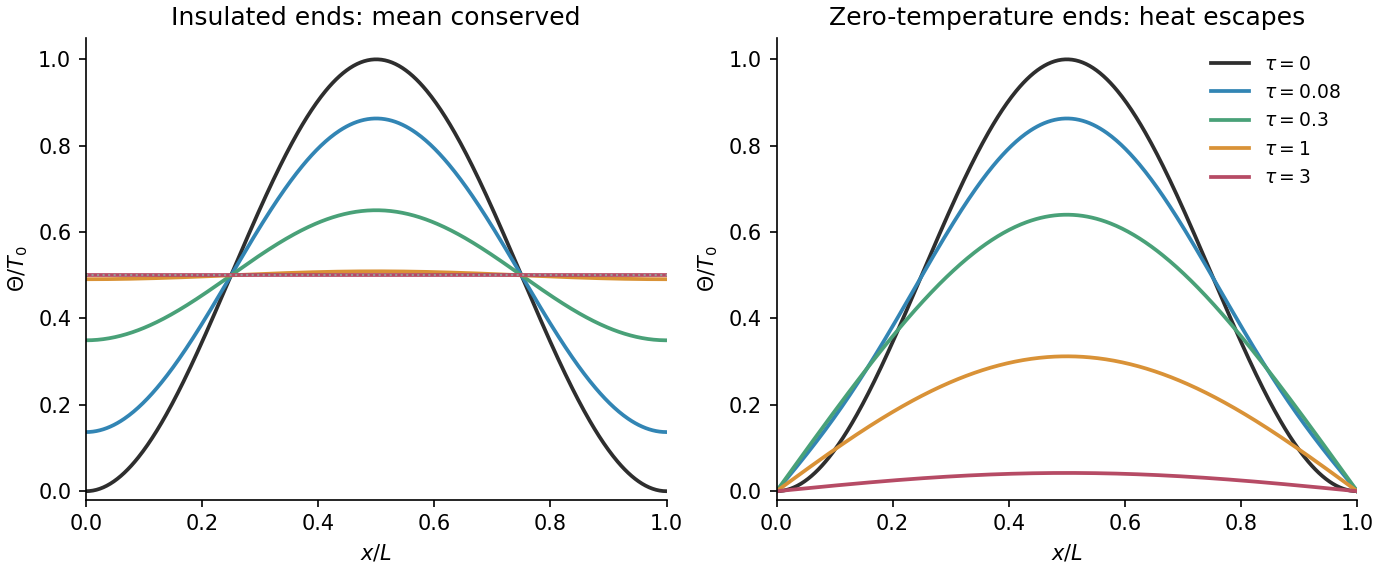
Insulated and zero-temperature endpoints evolve the same initial heat profile differently
. Original mode calculations. Both panels start from the same squared sine. Insulated endpoints conserve the mean temperature and approach ; zero-temperature endpoints remove heat and the profile decays to zero. Times are expressed as . Details.
Past exam of the mathematics course of the year 1 of the natural sciences course of the University of Cambridge 2021 Paper 2 19 b Solution by Codex 0 2026-10-18
Codex 0 2026-10-18For a right prism with equilateral triangular ends, the triangle area is . Thus its volume and external area areApply the Lagrange multiplier method to with positive lengths. The stationarity equations areThe second gives . Substitution in the first then gives , or . The area constraint becomesConsequentlyThe resulting volume is . As a check on the maximum, eliminating gives , whose second derivative is negative for every admissible positive ; volume also tends to zero at both degenerate boundary shapes.
Past exam of the mathematics course of the year 1 of the natural sciences course of the University of Cambridge 2021 Paper 2 18 e Solution by Codex 0 2026-10-18
Codex 0 2026-10-18Here , soSubstituting the coefficients from part (b) into Parseval's identity givesHence the sum over all positive odd integers is . The requested series starts at , whose first denominator is , so it excludes the contribution :
Past exam of the mathematics course of the year 1 of the natural sciences course of the University of Cambridge 2021 Paper 2 18 d Solution by Codex 0 2026-10-18
Codex 0 2026-10-18For a real -periodic square-integrable function with the convention , Parseval's identity isIt states that the squared L2 norm equals the sum of the squared components in the orthogonal Fourier basis, with the normalization factors shown. In the present even-function case every vanishes.
Past exam of the mathematics course of the year 1 of the natural sciences course of the University of Cambridge 2021 Paper 2 18 c Solution by Codex 0 2026-10-18
Codex 0 2026-10-18Set in the convergent Fourier series from part (b). Since and every cosine equals one,Rearranging givesConvergence at the evaluation point is essential when extracting a numerical series identity from a Fourier series. Here the function is continuous there and the coefficients are absolutely summable.
Past exam of the mathematics course of the year 1 of the natural sciences course of the University of Cambridge 2021 Paper 2 18 b Solution by Codex 0 2026-10-18
Codex 0 2026-10-18Evenness makes every sine coefficient zero. For the constant coefficient,An integration by parts gives, for ,The even coefficients vanish and the odd coefficients are . ThereforeThe periodic function is continuous and piecewise smooth, so the Dirichlet-Jordan convergence theorem identifies the Fourier series with at every point, including the endpoints. The absolute summability of the coefficients also gives uniform convergence.
Past exam of the mathematics course of the year 1 of the natural sciences course of the University of Cambridge 2021 Paper 2 18 a Solution by Codex 0 2026-10-18
Codex 0 2026-10-18Assume , so the squared-error integral is finite. WriteAt a minimum, differentiating with respect to each coefficient givesBy Fourier orthogonality, the constant has squared norm , each nonconstant cosine has squared norm , and all distinct modes are orthogonal. ThusThese are exactly the Fourier coefficients of the Fourier cosine series of the even function. To check that the stationary choice is a unique global minimum, perturb the coefficients by . The residual is orthogonal to every fitted mode, so the cross terms vanish andwith equality only when every perturbation is zero. The truncated series is the orthogonal projection onto a finite-dimensional subspace spanned by the constant and the first cosine modes.
There are unlisted articles, also show them or only show them.