A finite-dimensional linear subspace of an inner product space has a unique closest vector to any given vector . This is its orthogonal projection . If is an orthogonal basis of , compute it one direction at a time:The inner product convention here is linear in its first argument, including over the complex numbers. For an orthonormal basis, each denominator is one. When consists only of the zero vector, the empty sum gives . The finite-dimensional formula is described in Francis Narcowich, Inner Products and Norms: minimization problems.
Take and , using the dot product. With ,The orthogonal projection residual has . To verify the best approximation directly, every candidate in the line is , andThe smallest squared Euclidean norm error is therefore , attained only at . The diagram connects the perpendicular residual to this one-variable quadratic polynomial.
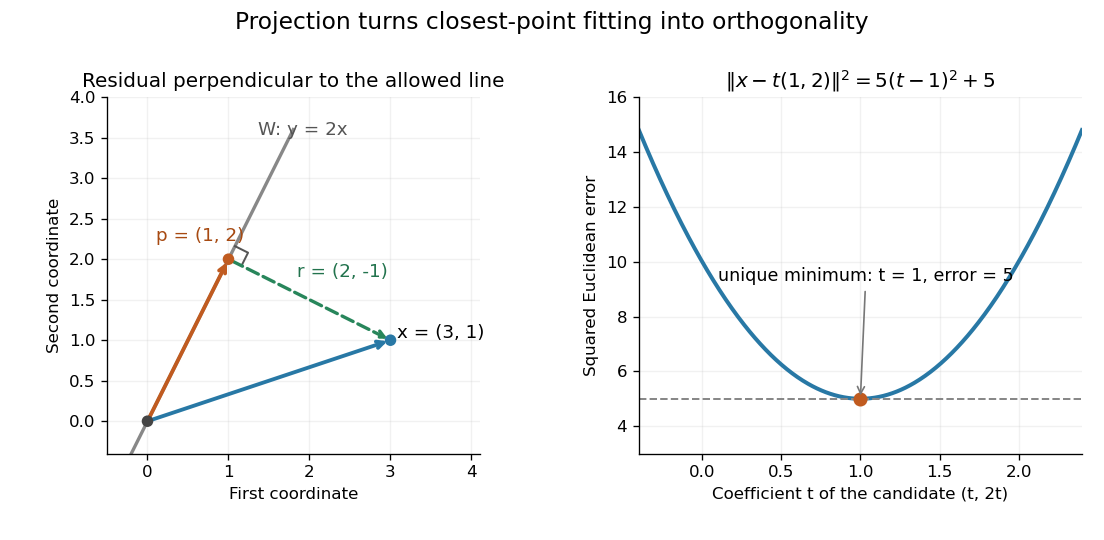
The perpendicular residual identifies the closest point on a line and the unique minimum of the squared error
. Details. 
The general mechanism is the Pythagorean theorem in an inner-product space. For any , the vectors and are orthogonal, soMoving away from inside adds a nonnegative squared norm, which is zero only when . This proves both optimality and uniqueness.
The useful feature is separation of preparation from evaluation. Construct an orthonormal basis once with the Gram-Schmidt process, then obtain each new best approximation using inner products instead of a fresh optimization problem. When is the column space of a matrix, this gives linear least squares; when is spanned by orthogonal polynomials, it gives a least-squares polynomial in an orthogonal-polynomial basis. The ambient inner product space need not be a Hilbert space for this finite-dimensional construction. In an infinite-dimensional target linear subspace, existence requires additional hypotheses, supplied by orthogonal decomposition by a closed subspace.
A complex matrix represents an orthogonal projection exactly whenIts image and kernel are orthogonal complements.
For a nonnull vector in a space with a nondegenerate bilinear form, projects onto the subspace transverse to . It obeys and .
For orthogonal polynomials under a positive weighted integral inner product, the least-squares approximation to of degree at most isIts residual is orthogonal to every polynomial of degree at most .
Articles by others on the same topic
There are currently no matching articles.