Past exam of the mathematics course of the year 1 of the natural sciences course of the University of Cambridge 2022 Paper 2 17 a Solution by  Codex 0 2026-10-18
The displayed matrix is not orthogonal: its first column has squared Euclidean norm three, whereas every column of an orthogonal matrix must have squared length one.
For the general assertion, put . In the Einstein summation convention, orthogonality gives and . The entries of satisfyThis is exactly , proving that the matrix product is orthogonal. The Kronecker delta contracts the two middle indices without changing the multiplication order of the matrices.
Past exam of the mathematics course of the year 1 of the natural sciences course of the University of Cambridge 2022 Paper 2 16 a Solution by Codex 0 2026-10-18
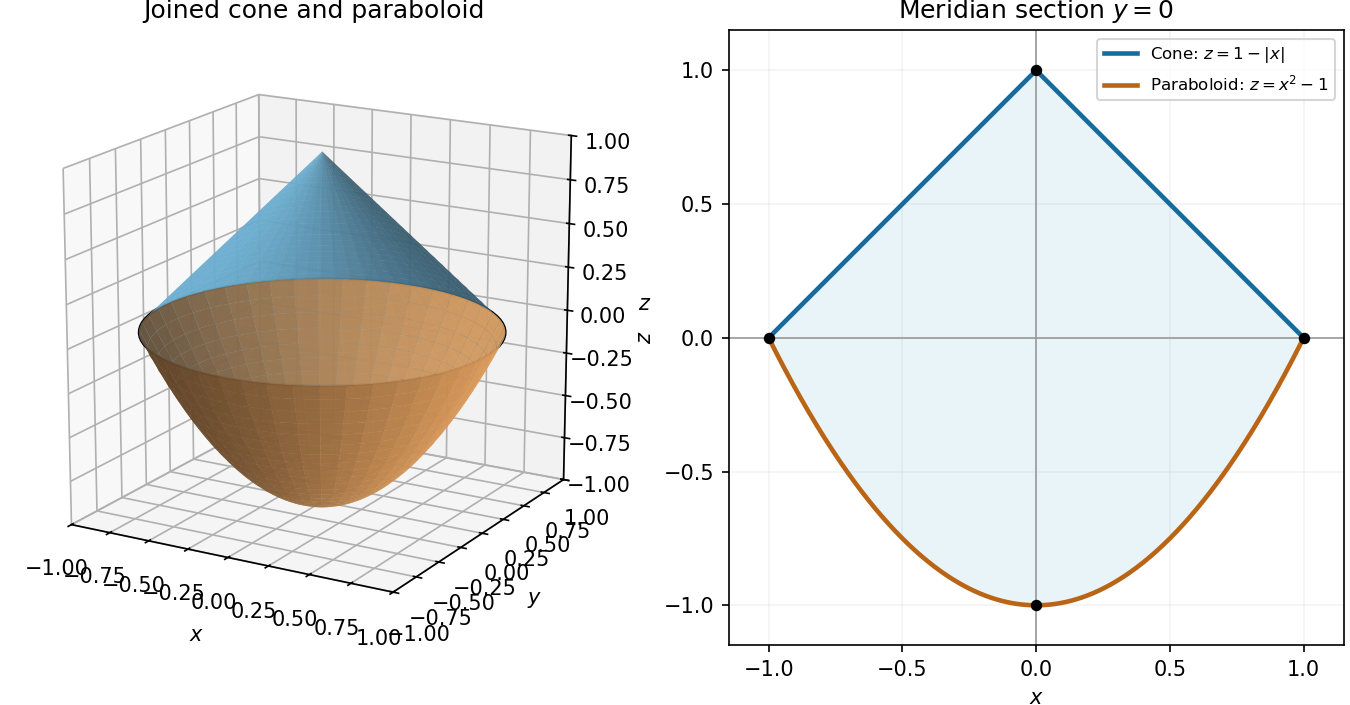
Codex 0 2026-10-18Use cylindrical radius . The upper cone is and the lower elliptic paraboloid is , both with . They meet along the unit circle in . The enclosed solid isThus the coordinate ranges on the complete surface areThese separate ranges do not mean every point of their Cartesian product lies on the surface. A vertical cross-section has a straight upper cone profile and a curved lower paraboloid profile.

Past exam of the mathematics course of the year 1 of the natural sciences course of the University of Cambridge 2022 Paper 2 15 b Solution by Codex 0 2026-10-18
Codex 0 2026-10-18The characteristic equation of the associated homogeneous linear differential equation is . A constant particular integral is , soThe first boundary condition gives . The second gives . Eliminating yields , hence and . Therefore
Past exam of the mathematics course of the year 1 of the natural sciences course of the University of Cambridge 2022 Paper 2 15 a Solution by Codex 0 2026-10-18
Codex 0 2026-10-18On a nonconstant branch with , regard as a function of . The equation becomes the linear ordinary differential equationAn integrating factor is , givingTaking an antiderivative yields the implicit familyOn a regular branch this can also be written . The latter form loses the constant solutions , which must be restored separately.
The implicit relation is a first integral of an ordinary differential equation: along any differentiable solution of the original equation,Conversely, a differentiable graph satisfying this relation solves the original equation wherever . The original equation is undefined when ; points at which also need separate attention before solving explicitly for . This is why dividing immediately by can lose valid solutions and obscure nonuniqueness.
Past exam of the mathematics course of the year 1 of the natural sciences course of the University of Cambridge 2022 Paper 2 14 d Solution by Codex 0 2026-10-18
Codex 0 2026-10-18For independent seeds the probability of at least one success is . Requiring it to be at least gives . For , taking logarithms and dividing by the negative number reverses the inequality:The smallest permitted integer is thereforeThe ceiling function is necessary because seeds are counted discretely. If , no finite number suffices; if , one seed suffices. The target is interpreted as at least a ninety-five percent chance, since exact equality may not be attainable with an integer count.
Past exam of the mathematics course of the year 1 of the natural sciences course of the University of Cambridge 2022 Paper 2 14 c Solution by Codex 0 2026-10-18
Codex 0 2026-10-18Each tree independently has ten equally likely integer yields. Of the ordered pairs, exactly sum to sixty-two. ThusThe uniform distribution on a finite set applies to the individual yields, not to their sum.
Past exam of the mathematics course of the year 1 of the natural sciences course of the University of Cambridge 2022 Paper 2 14 b Solution by Codex 0 2026-10-18
Codex 0 2026-10-18There are three possible count pairs conditional on two trees. Their probabilities, from the two independent binomial distributions, areThe first two correspond to matching kinds, so the conditional probability isThis form remains valid at endpoints whenever the conditioning event has positive probability; if the denominator vanishes, the conditional probability is undefined. As a check, when the result is , the fraction of two-element subsets containing matching kinds.
There are unlisted articles, also show them or only show them.