Past exam of the mathematics course of the year 1 of the natural sciences course of the University of Cambridge 2022 Paper 2 13 b Solution by  Codex 0 2026-10-18
The curl of is . Thus for it cannot be a gradient field, while for it is zero and all its vector-field potentials are constants. This zero-vector case is allowed by the question.
For the radial vector field , write . Choose a radial primitiveFor , the chain rule givesHence all vector-field potentials on a connected domain where the field is defined areThe assumed existence of the needed derivatives and integrals justifies this construction. If the domain includes the origin and the field is regular there, choose and extend the primitive there. Any two vector-field potentials differ by a constant on each connected component.
Past exam of the mathematics course of the year 1 of the natural sciences course of the University of Cambridge 2022 Paper 2 12 e Solution by Codex 0 2026-10-18
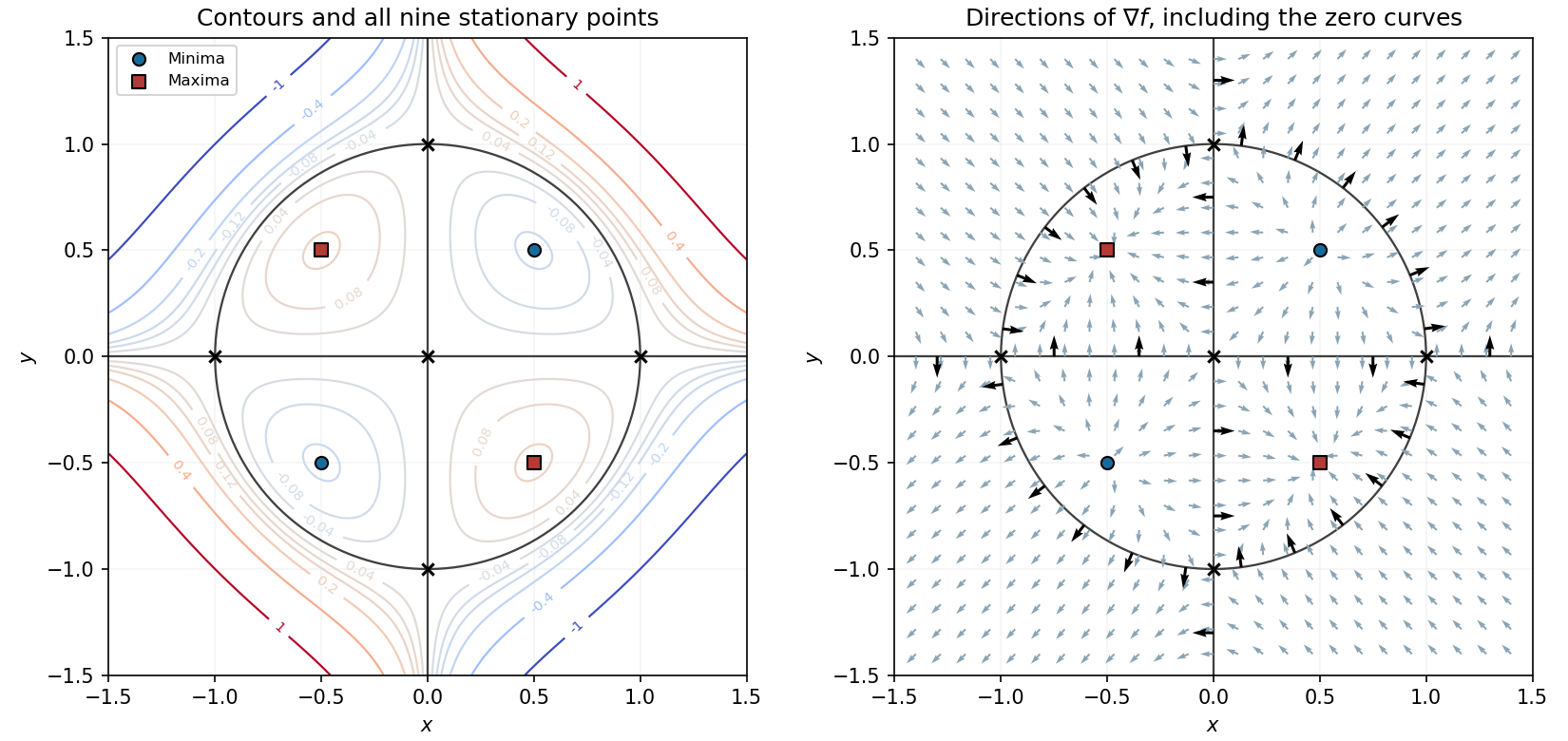
Codex 0 2026-10-18Near each local minimum, the gradient points outward; near each local maximum, it points inward. The five remaining points have saddle directions, determined by their indefinite Hessian matrices.
On the -axis the exact gradient is , and on the -axis it is . Thus arrows are perpendicular to the axes and reverse direction at the origin and the unit-axis stationary points.
On the unit circle, substitute into the gradient to obtainIt is radial outward in quadrants I and III, radial inward in quadrants II and IV, and zero at the four axis intersections. These arrows, together with the nearby saddle and extremum patterns, are shown in the right panel of the contour figure. The gradient is normal to every regular level curve and points toward increasing values of .
Past exam of the mathematics course of the year 1 of the natural sciences course of the University of Cambridge 2022 Paper 2 12 d Solution by Codex 0 2026-10-18
Codex 0 2026-10-18The zero level set is especially simple:The two axes and the unit circle divide the plane into regions where the signs alternate. Inside the circle, has the opposite sign to ; outside it has the same sign. Closed level curves surround the two interior local minima and two interior local maxima; the zero curves cross at the five saddle points of a scalar function. Farther out, the nonzero level curves are open within the displayed square.

Past exam of the mathematics course of the year 1 of the natural sciences course of the University of Cambridge 2022 Paper 2 12 c Solution by Codex 0 2026-10-18
Codex 0 2026-10-18For a stationary point, the two factors from part (a) must vanish. If , the second equation gives ; if , the first gives . Thus the axis points are .
If both coordinates are nonzero, solve and , giving . These four points complete the list of nine stationary points.
For classification, the Hessian matrix isAt its eigenvalues are , and at the four unit-axis points they are . These five points are saddle points of a scalar function, all with value zero.
At and the eigenvalues are one and two, so both are strict local minima of value . At and they are minus one and minus two, so both are strict local maxima of value . This follows from the second-derivative test. These extrema are local: the polynomial is unbounded above and below on the full plane.
Past exam of the mathematics course of the year 1 of the natural sciences course of the University of Cambridge 2022 Paper 2 12 b Solution by Codex 0 2026-10-18
Codex 0 2026-10-18 Past exam of the mathematics course of the year 1 of the natural sciences course of the University of Cambridge 2022 Paper 2 12 a Solution by Codex 0 2026-10-18
Codex 0 2026-10-18 Past exam of the mathematics course of the year 1 of the natural sciences course of the University of Cambridge 2022 Paper 2 11 a Solution by Codex 0 2026-10-18
Codex 0 2026-10-18Three vectors form a basis of three-dimensional space exactly when their scalar triple product is nonzero:It is the determinant of the matrix with these columns, so this condition is equivalent to linear independence and spanning the whole space.
Take the dot product of the expansion of with . The terms containing and vanish, leaving . Cycling the same argument yieldsThe three cross-product numerators use the reciprocal basis.
Past exam of the mathematics course of the year 1 of the natural sciences course of the University of Cambridge 2022 Paper 2 1 b Solution by Codex 0 2026-10-18
Codex 0 2026-10-18First . Taking the remaining cross product givesThe order of the two cross products matters because the operation is not associative.
Past exam of the mathematics course of the year 1 of the natural sciences course of the University of Cambridge 2022 Paper 2 1 a Solution by Codex 0 2026-10-18
Codex 0 2026-10-18Expanding the cross product componentwise givesIts dot product with each original vector is zero, as required.
Past exam of the mathematics course of the year 1 of the natural sciences course of the University of Cambridge 2022 Paper 1 5 b Solution by Codex 0 2026-10-18
Codex 0 2026-10-18Put . The geometric series has first term and common ratio , with absolute value less than one. Therefore its sum is
Past exam of the mathematics course of the year 1 of the natural sciences course of the University of Cambridge 2022 Paper 1 5 a Solution by Codex 0 2026-10-18
Codex 0 2026-10-18 Past exam of the mathematics course of the year 1 of the natural sciences course of the University of Cambridge 2022 Paper 1 20 b Solution by Codex 0 2026-10-18
Codex 0 2026-10-18First suppose . Differentiation under the integral sign, justified on compact positive parameter intervals by an integrable bound, givesThe first integral is . For , use the partial fraction decompositionThe standard inverse tangent antiderivatives then giveThe same value holds at by continuity, or by direct integration. Hence the proposed first-order linear differential equation is valid on the positive parameter range:Divide by to recognise a quotient rule derivative:To fix , the value alone is insufficient, since every displayed solution tends to zero there. Instead considerThis limit follows from the dominated convergence theorem: for and , the logarithm's absolute value is bounded by ; for , it is at most . After division by , these are integrable. The limiting improper integral is absolutely convergent, and the substitution rule changes it into its own negative. Its value is therefore zero, giving . ThusThe question calls a real parameter, but this last formula and the proposed differential equation do not hold on the entire real axis. The defining integral is odd in , because its logarithm depends on . Applying the positive-parameter result to therefore gives the correct extensionwith . In particular, for , the right-hand side of the differential equation must be ; for every the unified expression is . The logarithmic quadratic parameter integral therefore provides the requested identity on its valid range and the corrected answer elsewhere.
Past exam of the mathematics course of the year 1 of the natural sciences course of the University of Cambridge 2022 Paper 1 20 a Solution by Codex 0 2026-10-18
Codex 0 2026-10-18Under the usual regularity assumptions, the Leibniz integral rule isThere is a genuine domain problem in the following integral as printed in the PDF. PutThe point is a simple pole, withFor every , the lower endpoint is less than and the upper endpoint is greater than . The interval therefore crosses the pole. Since near , the two one-sided improper integrals diverge logarithmically, with opposite signs. Their divergences do not define an ordinary integral. Consequently the ordinary limit in the question is undefined as written: its underlying integral has no finite value for any .
A separately specified Cauchy principal value does exist for . Under that interpretation, differentiating a principal-value integral across a fixed simple pole givesThe first term isand the second tends to zero because is bounded near . Thus the principal-value version has limit . The two conclusions are distinct: this regularised answer requires the additional principal-value convention, which the printed question does not state.
There are unlisted articles, also show them or only show them.