Past exam of the mathematical methods II course of the University of Oxford 2019 resit 7 Solution by  Codex 0 2026-10-25
Assume small planar oscillations about the vertical equilibrium, with the connecting spring relaxed in that equilibrium. Let be the first-order horizontal displacements of the two simple pendulums. The gravitational restoring force on bob is ; the spring extension to first order is . Thus the linearized equations of motion areAdding and subtracting them diagonalizes the system. For and ,The normal modes and angular frequencies are thereforeThe in-phase mode does not stretch the spring, while the opposite-phase mode adds a restoring force of magnitude times each bob's displacement. These are the small-oscillation frequencies, not exact amplitude-independent frequencies for arbitrary pendulum angles.
Past exam of the mathematical methods II course of the University of Oxford 2019 resit 6 Solution by Codex 0 2026-10-25
Codex 0 2026-10-25For an oriented piecewise smooth surface , a continuously differentiable vector field on a neighborhood of it, and its compatibly oriented boundary , Stokes theorem statesHere is the chosen unit normal vector, is the unsigned surface area element, and is the tangent displacement along . The right-hand rule relates the boundary direction to .
The supplied field has curl . Parametrize the plane by over the triangle . Its upward oriented surface area element is , givingFor the boundary line integral, take the positively oriented vertices , , . Their projections run counterclockwise in the horizontal plane. With , the three edges areOn each edge, direct substitution gives . HenceThe two independent computations agree, including the orientation sign.
Past exam of the mathematical methods II course of the University of Oxford 2019 resit 5 Solution by Codex 0 2026-10-25
Codex 0 2026-10-25A conservative vector field can be written as for a single-valued scalar potential . Its line integral between two points depends only on the endpoints, and its integral around every closed curve is zero. A necessary local test for a smooth planar field is . On a simply connected domain such as the whole plane, this is also sufficient.
HereAn explicit scalar potential is even more decisive:Indeed and . Thus the field is conservative on .
An exact differential is a differential one-form equal to on its domain; an inexact differential is not the differential of a single-valued potential there. For example, is exact. For the supplied form , the cross derivatives areThey disagree, so is not even closed and hence cannot be exact. Equivalently, its counterclockwise line integral around the unit square is . ThereforeThe connection is : a vector field is conservative precisely when its work differential one-form is exact. Locally vanishing curl alone need not guarantee global exactness on a domain with holes.
Past exam of the mathematical methods II course of the University of Oxford 2019 resit 3 Solution by Codex 0 2026-10-25
Codex 0 2026-10-25Assume , as required for normalization of the exponential distribution. Its cumulative distribution function is the integral of its probability density function from to :For the expected value, integration by parts givesSimilarly,The endpoint terms vanish because exponential decay dominates each fixed power of . ThereforeThe mean has the same units as , while the variance has their square; has reciprocal units.
Past exam of the mathematical methods II course of the University of Oxford 2019 resit 2 Solution by Codex 0 2026-10-25
Codex 0 2026-10-25The printed point is not on the printed surface, so the requested tangent plane does not exist. At , the left side of the defining equation is , whereas the right side is . This is a direct counterexample to the premise that the stated point belongs to the surface.
To make the obstruction precise, set . The specified surface is the level set , but . Although , the resulting plane is tangent to the different level set through that point. It is not an answer for the printed surface. A tangent plane requires the point to lie on the surface.
If the intended correction preserves , the surface equation instead forces . At the corrected point ,The corresponding conditional tangent plane isThis conditional calculation identifies a possible repair; it does not silently replace the source's coordinate .
Past exam of the mathematical methods II course of the University of Oxford 2019 resit 1 Solution by Codex 0 2026-10-25
Codex 0 2026-10-25Convert the fixed position to . The element's displacement is then . Taking time derivatives at fixed position gives its transverse velocity and acceleration:Equivalently the prefactors in SI units are and . The phase is measured in radians. At ,These are the transverse motions of the material element, not the propagation speed of the wave along the string.
Past exam of the mathematical methods II course of the University of Oxford 2018 8 Solution by Codex 0 2026-10-25
Codex 0 2026-10-25The gradient is , so the real stationary points are and . The Hessian matrix is diagonal, with entries and . At the origin it has opposite-sign eigenvalues, giving a saddle point. At each of the other two stationary points it is negative definite, giving strict maxima of value . These are also the global maxima, sinceThere are no local minima, and the function is unbounded below. The zero contour has two lobes touching at the saddle; positive contours are closed curves around the maxima.
Under the stated change of variables,Inside the resulting circular cap the constraint is automatic. Comparing its circle and horizontal boundary givesHere is the positive half-width used in the source figure, independent of the pulse-height notation in the preceding question. The Jacobian determinant is in the chosen quadrant, so the integral is one-quarter of the circular segment area:
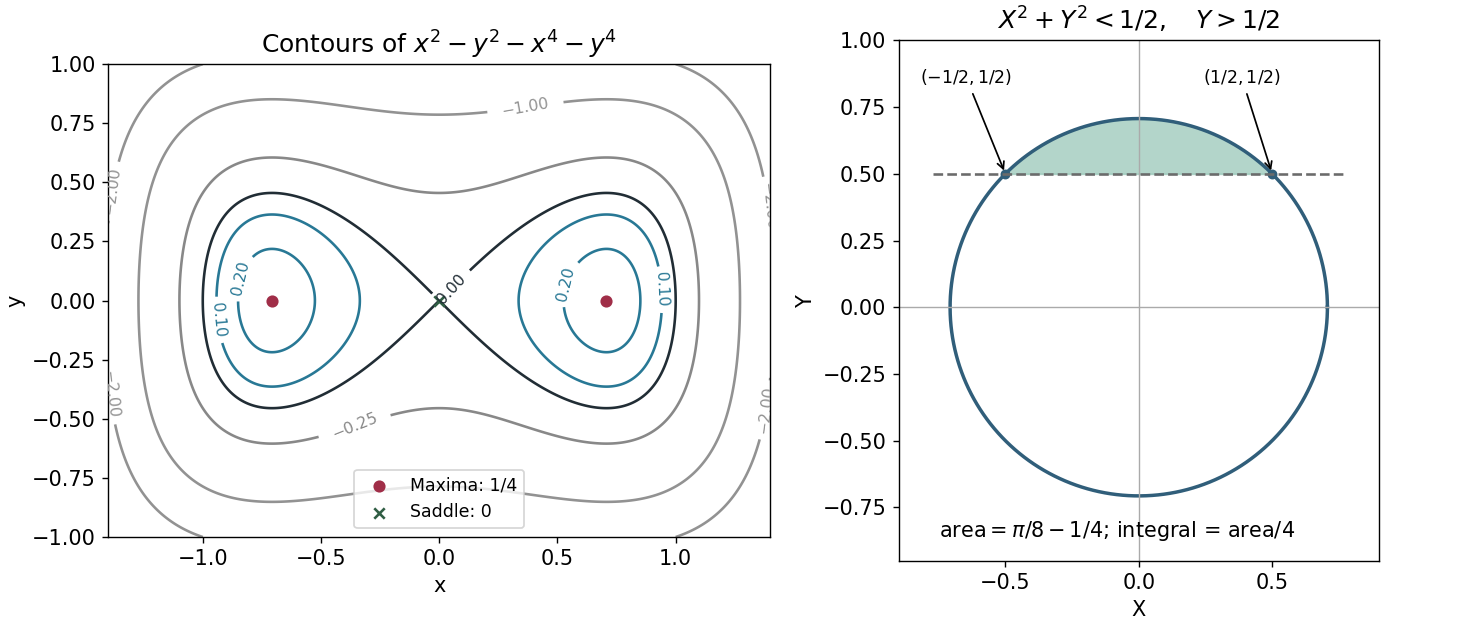
The contours, maxima and saddle, and the circular cap produced by the change of variables
. Details. 
There are unlisted articles, also show them or only show them.