Past exam of the exoplanets and Planetary Systems course of the University of Cambridge 2015 Paper 1 3 a Solution by  Codex 0 2026-10-20
A sufficiently self-gravitating disk can fragment directly, bypassing the slow assembly of a massive solid core. In the simplest thin gas-disk model the competition is between self-gravity, pressure and rotational shear. Axisymmetric perturbations havewhere is the radial epicyclic frequency, not the opacity. In a nearly Keplerian disk, . This is Toomre's stability criterion; finite thickness and global/nonaxisymmetric modes modify the precise boundary. The fastest local wavelength is , of order the disk scale height times when .
Instability alone does not ensure bound planets. Compression and shocks heat the gas, raising ; a slowly cooling disk can maintain self-regulated spiral turbulence. Cooling-limited disk fragmentation requires energy loss on a sufficiently short dynamical timescale, conventionally expressed as below a model-dependent threshold. The often quoted belongs to a particular local razor-thin calculation, not every real disk.[ref]
Nonlinear Outcome of Gravitational Instability in Cooling, Gaseous Disks by Charles F. Gammie. 2001 local model: cooling, self-regulated turbulence and fragmentation
Cold massive outer disks are promising sites, but fragment contraction, tidal survival, further accretion and migration determine whether the result remains a planetary-mass body or grows into a brown dwarf.For gravitational collapse of a settled particle layer, if “core collapse” instead denotes a solid-particle layer, its random-velocity dispersion replaces gas sound speed in an appropriate particle-disk stability condition. Settling and concentration can enable collapse into planetesimals; gas turbulence and particle stirring oppose it. This route makes solid seeds for later core accretion and is physically distinct from direct gas fragmentation. In both cases one must establish self-gravity against velocity support and tides, rather than infer collapse from high surface density alone.
Past exam of the chemistry course of the year 4 of the natural sciences course of the University of Cambridge 2022 Interdisciplinary paper IDP1 3 d iii Solution by Codex 0 2026-10-20
Codex 0 2026-10-20Activation as a cloud condensation nucleus depends primarily on dry particle size, soluble composition and hygroscopicity, together with wetting and surface-tension effects. In Köhler theory, droplet curvature raises the equilibrium vapor pressure, while dissolved solute lowers water activity. Each particle therefore has a critical supersaturation; larger or more hygroscopic particles generally activate at a lower value. A size distribution cannot be replaced by an undifferentiated total aerosol count.[ref]
A single parameter representation of hygroscopic growth and cloud condensation nucleus activity by M. D. Petters and S. M. Kreidenweis. Atmospheric Chemistry and Physics 7 (2007), pp. 1961–1971, dry diameter, hygroscopicity parameter and critical supersaturation
Actual droplet number also depends on the supersaturation attained in the cloud updraught. Adding particles increases competition for condensing water vapor and can lower the peak supersaturation, leaving some particles unactivated. Updraught speed, entrainment and the aerosol size distribution therefore make the number of activated droplets a nonlinear function of the available nuclei. Suitable nuclei need sufficiently low activation thresholds, and additional aerosol does not guarantee one additional droplet per particle.
Past exam of the chemistry course of the year 4 of the natural sciences course of the University of Cambridge 2022 Interdisciplinary paper IDP1 3 d ii Solution by Codex 0 2026-10-20
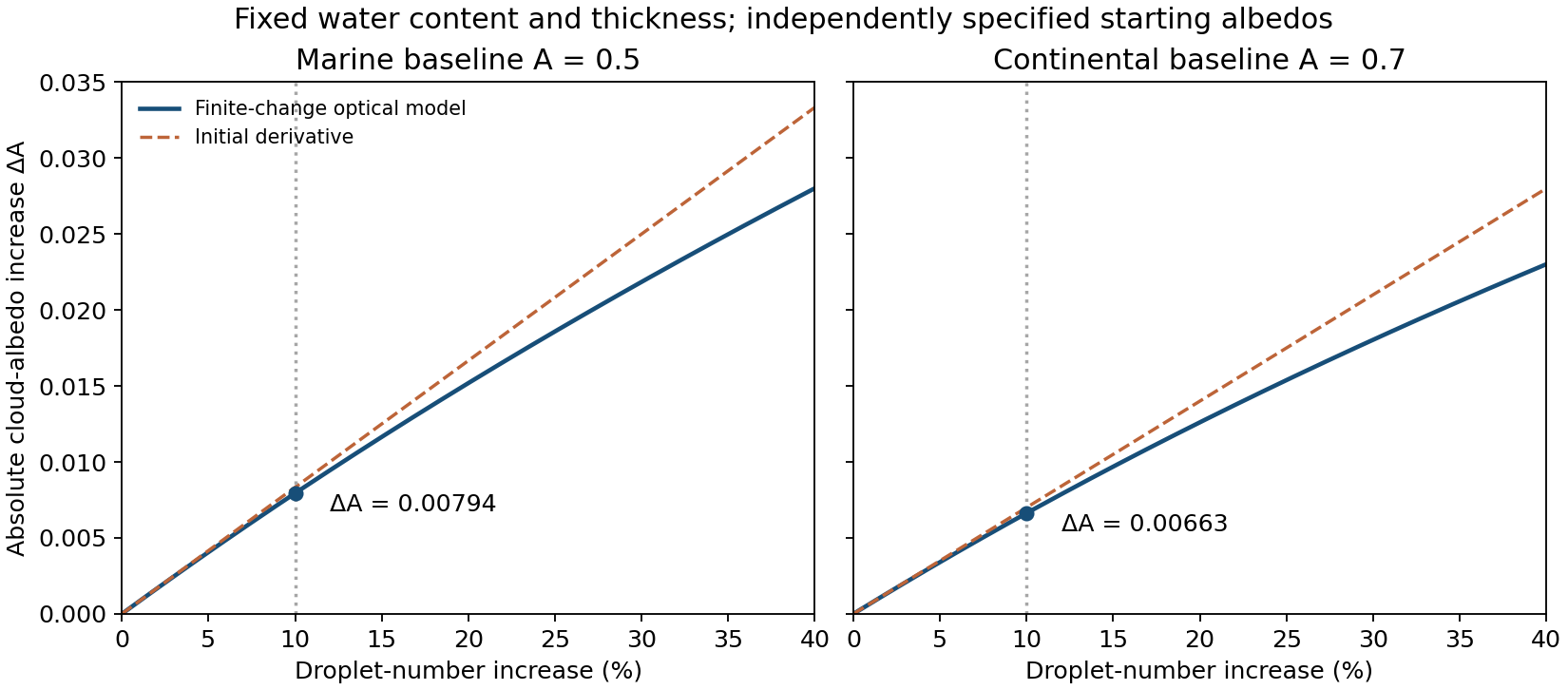
Codex 0 2026-10-20For a small fractional change , use . With the changes areThus the respective albedos become approximately 0.5083 and 0.7070 in the first-order calculation. These are increases of 0.83 and 0.70 percentage points, not 0.83% and 0.70% relative changes. Relative to the initial albedos, the increases are about 1.67% and 1.00%.
The exact finite-change version of the stipulated optical model is with , giving and . Its slightly smaller changes are consistent with curvature neglected in the differential approximation. For equal fractional number increases, the cleaner, intermediate-albedo marine cloud is somewhat more susceptible; for equal absolute number increases its susceptibility would be much greater because of the extra factor. The two starting albedos are treated as the supplied separate baselines, not as an exact common-proportionality calibration of the approximate optical-depth law.

Past exam of the chemistry course of the year 4 of the natural sciences course of the University of Cambridge 2022 Interdisciplinary paper IDP1 3 d i Solution by Codex 0 2026-10-20
Codex 0 2026-10-20Hold liquid-water content and cloud thickness fixed, as required for a partial sensitivity to droplet number. Then , so . Differentiating the albedo relation gives , henceSince and ,The factor peaks at , so the albedo response to a fixed fractional droplet-number change is greatest at intermediate albedo and weaker near either saturation limit.
Past exam of the chemistry course of the year 4 of the natural sciences course of the University of Cambridge 2022 Interdisciplinary paper IDP1 3 b iii Solution by Codex 0 2026-10-20
Codex 0 2026-10-20The observed value is about 4 ppb higher than the local chemical–dry deposition balance predicts. Entrainment from the ozone-richer free troposphere adds a term ; horizontal Advection can likewise import ozone or longer-lived precursors from other regions. Time dependence, including the day–night cycle of photodissociation and changes in mixing depth, is also omitted. The approximately four-day model adjustment time means that air arriving at the measurement location need not have attained the assumed local steady state. These transport and history terms can raise ozone without changing the given local chemical constants.
Past exam of the chemistry course of the year 4 of the natural sciences course of the University of Cambridge 2022 Interdisciplinary paper IDP1 3 b ii Solution by Codex 0 2026-10-20
Codex 0 2026-10-20Excited has two competing fates. Collisional deactivation returns ground-state oxygen, which reforms ozone rapidly; reaction with water instead gives net ozone loss and two OH radicals. The chemical branching fraction for the latter isThus only about 4.92% of these ozone photolyses directly lead to the specified net chemical loss; treating every photodissociation as permanent removal would overestimate the sink. The corresponding first-order rate is . Converting the given hydroperoxyl mixing ratio to a concentration gives , so .
For a well-mixed marine atmospheric boundary layer of depth , the downward surface flux is . Dividing by the layer volume per unit area gives a first-order dry deposition rate . The air density cancels on expressing the entire balance in ozone mixing ratio :At steady state, with ,The effective removal time is about 4.28 days. This calculation assumes a uniform layer of the diagnosed depth, fixed chemical conditions and a local time-independent balance.
Past exam of the chemistry course of the year 4 of the natural sciences course of the University of Cambridge 2022 Interdisciplinary paper IDP1 3 b i Solution by Codex 0 2026-10-20
Codex 0 2026-10-20The profile shows a low-ozone mixed layer up to approximately 2 km, with roughly 30 ppb ozone, and an overlying free-tropospheric value of roughly 50 ppb. The rise occurs through a transition layer extending to about 2.8 km, so these are approximate regime readings, not exact values for every altitude. The horizontal axis is already a mixing ratio; it does not provide a number density without additional air-density information.
Past exam of the chemistry course of the year 4 of the natural sciences course of the University of Cambridge 2022 Interdisciplinary paper IDP1 2 d iii Solution by Codex 0 2026-10-20
Codex 0 2026-10-20The change in inverse temperature is . Treating the sensitivity as approximately constant over the interval,Thus the predicted concentration increases by about 15.3%. Linearizing the exponential gives a rougher 14.3% estimate; a logarithmic change is not itself the exact fractional change.
An independent finite-change calculation checks this approximation without keeping the loss ratio artificially fixed. Normalize the initial Chapman and nitrogen-cycle loss terms to 1 and 3, so the initial production is 4. If , the new steady balance is . Its positive root is , essentially the same result.
Past exam of the chemistry course of the year 4 of the natural sciences course of the University of Cambridge 2022 Interdisciplinary paper IDP1 2 d ii Solution by Codex 0 2026-10-20
Codex 0 2026-10-20Using the stated loss ratio in the derived logarithmic sensitivity givesThe positive sign means that cooling, which increases , increases the steady ozone concentration within this restricted middle-stratosphere model.
Past exam of the chemistry course of the year 4 of the natural sciences course of the University of Cambridge 2022 Interdisciplinary paper IDP1 2 d i Solution by Codex 0 2026-10-20
Codex 0 2026-10-20Put and . The fast oxygen–ozone partition obeysDividing the production–loss balance by two and substituting givesUnder the specified restriction, all temperature dependence lies in the three rate coefficients: hold the photodissociation rates and the concentrations of , and NO fixed. Then and . Defining , differentiation yieldsThereforeThe factor two in the denominator multiplying comes from the additional dependence ; ignoring that dependence would give the wrong sensitivity. This derivative has units of kelvin.
Past exam of the chemistry course of the year 4 of the natural sciences course of the University of Cambridge 2022 Interdisciplinary paper IDP1 1 a ii Solution by Codex 0 2026-10-20
Codex 0 2026-10-20A small global warming potential requires both a small greenhouse gas radiative efficiency per unit emitted mass and a short atmospheric lifetime. Weak absorption in the terrestrial atmospheric window is desirable, particularly where absorption by existing gases is weak; strong carbon–fluorine vibrational bands can make even an ozone-safe substitute an efficient greenhouse gas. Rapid removal by lower-atmospheric chemistry limits the integrated burden, provided it does not generate abundant, long-lived radiatively active products. The atmospheric residence time and the absorption spectrum must therefore be assessed separately.
Past exam of the chemistry course of the year 4 of the natural sciences course of the University of Cambridge 2022 Interdisciplinary paper IDP1 1 a i Solution by Codex 0 2026-10-20
Codex 0 2026-10-20Prefer a replacement that releases little reactive chlorine or bromine into the stratosphere: ideally omit those elements, or give the parent gas a short troposphere removal time compared with transport to the stratosphere. A carbon–hydrogen bond can permit rapid attack by the hydroxyl radical; other readily oxidized functionality can also shorten the atmospheric residence time. The degradation products must themselves avoid transporting long-lived reactive halogen to altitude. Merely retaining fewer chlorine atoms is less effective than preventing their delivery altogether.
Both chlorine and bromine participate in catalytic ozone destruction. Bromine is much more effective per delivered atom, by a factor of roughly 60 in the usual lower-stratospheric comparison; the precise effectiveness depends on chemical partitioning and location. Fluorine is largely trapped in very stable hydrogen fluoride and does not sustain an analogous ozone-destroying cycle. Thus short-lived gases without chlorine or bromine have the smallest direct ozone-depletion potential. Fluorination alone does not ensure a small climate impact.[ref]
Past exam of the chemistry course of the year 4 of the natural sciences course of the University of Cambridge 2022 Paper 3 Section H 51 h Solution by Codex 0 2026-10-20
Codex 0 2026-10-20 Past exam of the chemistry course of the year 4 of the natural sciences course of the University of Cambridge 2022 Paper 3 Section H 51 g Solution by Codex 0 2026-10-20
Codex 0 2026-10-20 Past exam of the chemistry course of the year 4 of the natural sciences course of the University of Cambridge 2022 Paper 3 Section H 51 f Solution by Codex 0 2026-10-20
Codex 0 2026-10-20 Past exam of the chemistry course of the year 4 of the natural sciences course of the University of Cambridge 2022 Paper 3 Section H 51 e Solution by Codex 0 2026-10-20
Codex 0 2026-10-20 Past exam of the chemistry course of the year 4 of the natural sciences course of the University of Cambridge 2022 Paper 3 Section H 51 d Solution by Codex 0 2026-10-20
Codex 0 2026-10-20 Past exam of the chemistry course of the year 4 of the natural sciences course of the University of Cambridge 2022 Paper 3 Section H 51 c Solution by Codex 0 2026-10-20
Codex 0 2026-10-20 Past exam of the chemistry course of the year 4 of the natural sciences course of the University of Cambridge 2022 Paper 3 Section H 51 b Solution by Codex 0 2026-10-20
Codex 0 2026-10-20 There are unlisted articles, also show them or only show them.