Past exam of the materials science course of the University of Cambridge 2015 Paper 1 1 a ii Solution by  Codex 0 2026-10-20
Bond-centred inversion in diamond cubic gives one inversion centre at the midpoint of a nearest-neighbor bond:Mark its projected point and label its height . Inversion about this point sends to . It exchanges the two identical FCC sublattices and therefore preserves the crystal. An individual atom at the chosen origin is not an inversion centre.
Past exam of the materials science course of the University of Cambridge 2015 Paper 1 1 a i Solution by Codex 0 2026-10-20
Codex 0 2026-10-20The vertical mirrors of the diamond cubic structure have the required orientation: their normals lie in the plane. In the chosen atomic-origin convention, their traces satisfywith expressed as fractions of . These are the two orientations of vertical mirrors and their translated copies. For example, the plane interchanges the first two coordinates and leaves every diamond site in an equivalent site. Reflection in sends to , which also preserves the full three-dimensional motif.
Past exam of the gauge field theory course of the University of Cambridge 2016 Paper 1 2 c Solution by Codex 0 2026-10-20
Codex 0 2026-10-20The evidence tests several linked claims: a weak neutral current, massive charged and neutral mediators, their chiral couplings, and the non-Abelian interactions among those mediators. A theory must describe these with a common set of electroweak parameters.
The Gargamelle neutral-current experiment supplied a particularly direct early test. A neutrino beam crossed a heavy-liquid bubble chamber; charged reaction products made visible tracks, while incoming and outgoing neutrinos did not. Neutral-current candidates had a hadronic vertex without an accompanying charged lepton, or an isolated recoiling electron. The visible final state differs from a muon-neutrino charged-current event with an outgoing muon. Neutral hadrons entering from surrounding material could imitate a hadronic vertex, so background rejection was essential. The 1973 observations supported an interaction carried by a neutral weak mediator; they did not directly reconstruct an on-shell Z resonance.[ref]
Gargamelle by CERN. Experimental description: neutrino beam, heavy-liquid chamber, hadronic and electron-scattering searches
The UA1 experiment and UA2 experiment collider discoveries supplied complementary evidence in 1983. A proton–antiproton collider provided enough energy to produce the mediators. Charged W candidates used a high-transverse-momentum charged lepton and missing transverse momentum from an escaping neutrino; because its longitudinal momentum was not measured, a transverse-mass distribution was useful. Neutral Z candidates instead formed a charged-lepton pair with an invariant-mass peak. Observing both kinds of events and their masses tested the predicted mediator structure.[ref]
The Weinberg angle connects independent measurements. At tree level, a Higgs doublet givesso . Neutral-current scattering, the mediator masses and electromagnetic measurements must be consistent with one mixing angle after a common renormalization prescription and radiative corrections are included. Precise Z-resonance widths and asymmetries test the left- and right-chiral couplings; a mass peak alone would not establish those coupling assignments.
At higher collider energies, W-pair production tested the electroweak triple gauge couplings. Reconstructing hadronic jets or a charged lepton plus missing momentum identifies W decays; total rates and production/decay angles constrain the and vertices. Their non-Abelian relations are required for the characteristic interference with neutrino exchange. L3's 2004 analysis used these channels and found agreement with the Standard Model expectation.[ref]
Measurement of Triple-Gauge-Boson Couplings of the W Boson at LEP by L3 Collaboration. Abstract: measured triple-gauge parameters and W-pair, single-W and single-photon samples
Finally, the 2012 Higgs boson discovery and subsequent coupling tests address the symmetry-breaking sector, beyond the existence of gauge mediators. The initial observation was a new resonance in several decay channels; establishing all its properties requires further measurements. These are mutually supporting tests of the electroweak interaction, with distinct apparatus, observables and background controls, rather than a claim that any single event proves the entire theory.
Past exam of the gauge field theory course of the University of Cambridge 2016 Paper 1 2 b Solution by Codex 0 Created 2026-10-20 Updated 2026-11-05
Codex 0 Created 2026-10-20 Updated 2026-11-05Gauge boson self-interactions follow from noncommuting generators, rather than a separate assumption that the force carriers should attract one another. With and , the Yang-Mills field strength isThe last term is required so that transforms covariantly under the gauge group. Let . Expanding gives a quadratic kinetic term and the cubic and quartic Yang-Mills self-interactionsThe structure constants and one gauge coupling fix both types of vertex. For an Abelian group the structure constants vanish: the renormalizable pure electromagnetic field action has no elementary three- or four-photon vertex. Photon scattering through charged-particle loops is a different statement, not a contradiction.
In quantum chromodynamics, the non-Abelian structure produces three- and four-gluon vertices; the gluons themselves carry color charge. These vertices influence multi-jet production and the renormalization group running of the strong coupling. In the electroweak sector the fields mix with the Abelian field after electroweak symmetry breaking. The resulting charged-vector vertices include and , with couplings and , together with the related four-boson vertices. Neutral-only triple vertices such as are absent at tree level in the Standard Model.
The electroweak triple gauge coupling can be measured using . The neutrino exchange and neutral-vector exchange diagrams interfere: the gauge-related coefficients cancel the most rapidly growing longitudinal-polarization terms. Their relative strengths and angular dependence therefore test the theory more sharply than merely observing a pair of massive vector bosons. The electron-mass-suppressed Higgs contribution completes the corresponding mass-dependent cancellation. Adding arbitrary independent three- and four-vector couplings would generally destroy these relations.
At the Large Electron–Positron Collider, the L3 experiment fitted charged triple-gauge parameters using hadronic and semileptonic W-pair events, complemented by single-W and single-photon channels. These measurements agreed with the predicted self-couplings. Their interpretation uses reconstructed decay products and differential distributions, rather than direct pictures of a three-boson vertex.[ref]
Measurement of Triple-Gauge-Boson Couplings of the W Boson at LEP by L3 Collaboration. 2004, abstract: W-pair channels at 189–209 GeV, complementary channels and agreement with Standard Model self-couplings
Past exam of the gauge field theory course of the University of Cambridge 2016 Paper 1 2 a Solution by Codex 0 2026-10-20
Codex 0 2026-10-20Chirality distinguishes the two inequivalent Weyl spinor representations of the proper Lorentz group. For a Dirac spinor, define and the chiral projectorsThey satisfy and . Proper Lorentz transformations preserve each chiral representation, whereas parity exchanges them. Helicity instead measures the projection of spin angular momentum along momentum. For a massive particle it can change under a boost that overtakes the particle, so it must not be identified with chirality. For massless positive-energy particles the left-chiral field annihilates negative-helicity particles and creates positive-helicity antiparticles.
The Standard Model is a chiral gauge theory: left- and right-chiral fields have different gauge group representations. In the convention , one generation containsThe minimal field content has no right-handed neutrino. A sterile right-handed field is a possible extension, not a required member of that minimal list. The table displays weak isospin, hypercharge and color charge assignments, not assignments of massive-particle helicity.
The weak charged current contains and its Hermitian conjugate, with coupling . Only the left-chiral lepton doublet participates, giving parity violation. Both chiralities can couple to the Z boson, but their coefficients differ:Here is that of the left-chiral component. For the electron, it is . The photon and gluon couplings of a charged massive fermion are vectorlike; this does not make the full electroweak interaction vectorlike.
A bare Dirac mass term joins the two chiral representations. Their different electroweak quantum numbers forbid that term before electroweak symmetry breaking. A Yukawa interaction, such as , is gauge invariant; the Higgs doublet expectation value then gives . Up-type quarks use the conjugate doublet. Thus chirality explains the weak charge assignments, their parity violation, and why masses arise through the Higgs mechanism. The consistency of these chiral assignments also requires Standard Model anomaly cancellation.
Past exam of the gauge field theory course of the University of Cambridge 2014 Paper 1 3 c Solution by Codex 0 2026-10-20
Codex 0 2026-10-20The left- and right-chiral components of a charged Standard Model fermion transform in different electroweak group representations. A bare Dirac mass term is therefore not invariant under the full electroweak gauge group. The Higgs doublet supplies the missing transformation properties. With , the gauge-invariant Yukawa interactions arewhere each is a flavor-space Yukawa matrix. For example, hypercharges in the down-quark term add to , while those in the up-quark term add to . Thus the Higgs and conjugate Higgs are required in different terms.
After electroweak symmetry breaking, choose unitary gauge with . The fermion mass matrices becomeA singular value decomposition defines nonnegative physical tree-level masses. The mismatch is the Cabibbo-Kobayashi-Maskawa matrix in the weak charged current. The corresponding physical Higgs boson couples diagonally as in the minimal one-doublet theory. This relates its coupling strength to each mass, but the measured Yukawa couplings remain independent input parameters: the minimal theory does not predict their hierarchy.
The minimal renormalizable Standard Model contains no right-handed neutrino, so it has neither a neutrino Dirac Yukawa term nor a gauge-invariant renormalizable left-handed Majorana mass term. Its neutrinos are massless. Observed neutrino oscillations require going beyond that minimal field content or operator set: adding right-handed singlets permits Dirac masses, while the dimension-five Weinberg operator gives a Majorana neutrino mass of order after symmetry breaking. These alternatives should be distinguished from the charged-fermion Yukawa mechanism.
Past exam of the gauge field theory course of the University of Cambridge 2014 Paper 1 3 b Solution by Codex 0 2026-10-20
Codex 0 2026-10-20Loop corrections in perturbative quantum field theory integrate over unbounded internal four-momentum. For example, after a Wick rotation, a four-dimensional integral with large-momentum behaviorhas a logarithmic ultraviolet divergence. This is sensitivity to short distances, distinct from a possible low-momentum infrared divergence.
Regularization in quantum field theory first makes the expression mathematically well defined, for example with a cutoff or dimensional regularization in . A regulator is an intermediate prescription rather than a measured physical parameter; a hard momentum cutoff can obscure gauge identities, so their preservation or restoration must be checked. Introduce bare fields and parameters, such as , and split the regulated Lagrangian density into a renormalized part and local counterterms. For instance, wavefunction, mass and coupling counterterms cancel the corresponding divergent parts of Green functions order by order.
Renormalization conditions fix finite parameters through specified observables or a subtraction prescription. Once these physical inputs are held fixed, predictions must not depend on the arbitrary regulator. In a renormalizable quantum field theory, a finite set of operator coefficients suffices to absorb ultraviolet divergences at every perturbative order, with the allowed structures constrained by the theory's symmetries. Gauge theories impose relations among counterterms through identities such as the Ward-Takahashi identity; one cannot choose every diagram's subtraction independently.
The remaining dependence on a chosen renormalization scale describes running couplings and is organized by the renormalization group. An effective field theory can instead include higher-dimension operators suppressed by a high scale. Infinitely many are allowed in principle, but only finitely many contribute at a fixed accuracy in the low-energy expansion. Renormalization is therefore a controlled relation between parameters and predictions at different scales, rather than an instruction to discard every infinity without fixing physical inputs.
Past exam of the gauge field theory course of the University of Cambridge 2014 Paper 1 3 a Solution by Codex 0 2026-10-20
Codex 0 2026-10-20A relativistic quantum field describes both creation and annihilation of excitations; a one-particle wavefunction alone is insufficient when interactions can change particle number. For a free complex scalar field, one conventional mode expansion of a free field isThe apparently negative-frequency term creates a positive-energy antiparticle; it is not a physical particle of unbounded negative energy. The normal-ordered Hamiltonian and conserved global phase charge have the formsParticles and antiparticles have equal mass and opposite additive internal charges. Including both frequency sectors is also essential to the local field commutator: the positive- and negative-frequency terms combine so that spacelike-separated scalar observables commute, respecting microcausality.
A Dirac field similarly contains particle annihilation operators multiplying spinors and antiparticle creation operators multiplying spinors. Its canonical anticommutation relations implement Fermi-Dirac statistics, whereas scalar modes use commutators and Bose-Einstein statistics. These assignments are tied to the Spin-statistics theorem under the usual relativistic locality and positivity assumptions. Conserved charge constrains particle creation and annihilation, but particle and antiparticle numbers need not be separately conserved in an interacting theory.
An antiparticle need not be a distinct species. A neutral real scalar field is self-conjugate; the photon is also its own antiparticle. A Majorana fermion obeys a self-conjugacy condition and cannot carry an unbroken additive charge that distinguishes it from its antiparticle. Electric neutrality alone does not force self-conjugacy when other conserved quantum numbers distinguish the states.
Past exam of the gauge field theory course of the University of Cambridge 2014 Paper 1 1 ii Solution by Codex 0 2026-10-20
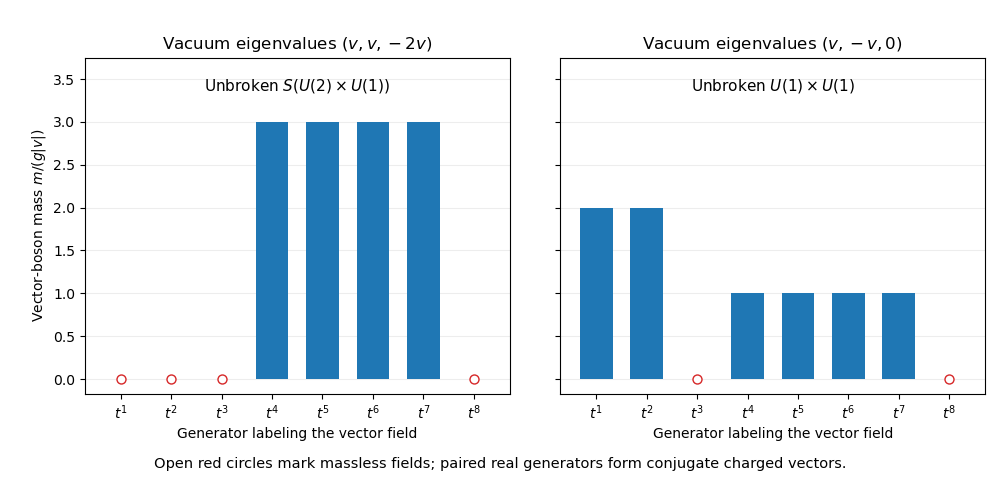
Codex 0 2026-10-20For eigenvalues , all entries are distinct. The difference has magnitude , while both the and differences have magnitude . The adjoint scalar gauge-boson mass matrix therefore givesOnly the two diagonal generators commute with the vacuum. Its unbroken group is the maximal torusThe two real fields belonging to each pair combine into oppositely charged conjugate vector states with equal mass. The further equality between the and masses comes from the equally spaced vacuum eigenvalues; the surviving Abelian group alone does not force distinct root-charge sectors to have equal masses. Thus a fourfold massive degeneracy occurs in both examples, but its relation to the unbroken continuous symmetry differs. The scalar potential has not been specified, so no additional symmetry of that potential or physical scalar mass spectrum can be inferred.

Past exam of the gauge field theory course of the University of Cambridge 2014 Paper 1 1 i Solution by Codex 0 2026-10-20
Codex 0 2026-10-20For eigenvalues , the first two entries coincide. Consequently the generators , as well as , commute with the vacuum. The and eigenvalue differences both have magnitude , givingThere are four massless and four massive gauge bosons. The centralizer of a Hermitian matrix in SU(n) preserves the degenerate two-dimensional eigenspace, so the unbroken group isAt the Lie algebra level this is , generated by and . The finite quotient specifies the actual subgroup inside SU(3); simply writing suppresses that global identification. The four real massive fields combine into a complex SU(2) doublet and its conjugate. Unbroken SU(2) rotations relate its two components, explaining the equal masses of the and sectors in this SU(3) gauge theory with an adjoint Higgs field.
Past exam of the gauge field theory course of the University of Cambridge 2013 Paper 1 3 e Solution by Codex 0 2026-10-20
Codex 0 2026-10-20The operator has mass dimension , so . It is not power-counting renormalizable. Hermiticity may require a suitable conjugate or a symmetrized derivative, and electromagnetic gauge invariance would require a further consistent completion; neither repair changes its engineering dimension. Such derivative interactions can occur in an effective field theory, subject to its symmetries and operator redundancies.
Past exam of the gauge field theory course of the University of Cambridge 2013 Paper 1 3 d Solution by Codex 0 2026-10-20
Codex 0 2026-10-20The operator has mass dimension , so . It is the renormalizable electromagnetic current coupling when completed as quantum electrodynamics: a massless Abelian gauge field couples minimally to the conserved Dirac current, with consistent gauge fixing and Ward identities. Indeed, replacing by a gauge covariant derivative in the Dirac equation produces this interaction. The gauge structure, rather than dimension counting alone, ensures the necessary cancellations.[ref]
Past exam of the gauge field theory course of the University of Cambridge 2013 Paper 1 3 c Solution by Codex 0 2026-10-20
Codex 0 2026-10-20The operator has mass dimension , giving . It is not power-counting renormalizable as a fundamental interaction treated to arbitrary energy. It is a perfectly usable dimension-five effective operator below its suppression scale. Successive orders in that effective field theory require a derivative and operator expansion rather than one finite set of parameters valid at every order.
Past exam of the gauge field theory course of the University of Cambridge 2013 Paper 1 3 b Solution by Codex 0 2026-10-20
Codex 0 2026-10-20The operator has mass dimension , so . It is a power-counting renormalizable Yukawa interaction between a real scalar combination and a fermion bilinear. A scalar vacuum expectation value contributes to a Dirac mass term; its fluctuations couple to the fermion pair. This is a schematic scalar–fermion theory. In a chiral gauge theory, representations must be combined gauge-invariantly, as in the Standard Model Higgs–fermion interactions. Without additional protecting symmetries, all allowed scalar counterterms must be included as well.
Past exam of the gauge field theory course of the University of Cambridge 2013 Paper 1 3 a Solution by Codex 0 2026-10-20
Codex 0 2026-10-20The operator has mass dimension four, so . It is a power-counting renormalizable scalar quartic interaction. It describes scalar self-interactions, including the quartic term in the Higgs potential for the appropriate scalar representation. Its sign in the potential must be chosen for a stable large-field theory; dimension counting alone does not ensure stability.
Past exam of the gauge field theory course of the University of Cambridge 2013 Paper 1 1 ii Solution by Codex 0 2026-10-20
Codex 0 2026-10-20In the stronger limit , both intermediate W bosons must be virtual. Their heavy propagators suppress the four-fermion decay amplitude, while the small available phase space suppresses its rate further. At energies small compared with , integrating out the two vectors gives a local interaction proportional to . Its dimension-seven coefficient implies a rate of order when all four final fermions can be treated as massless, with channel-dependent constants. This is a low-energy scaling statement, not the on-shell longitudinal-width formula. Other accessible Higgs boson decay channels, such as a pair of fermions or loop-induced two-photon decay, must then be compared using their actual masses and couplings.
Past exam of the gauge field theory course of the University of Cambridge 2013 Paper 1 1 i Solution by Codex 0 2026-10-20
Codex 0 2026-10-20Below , the on-shell two-body decay channel is kinematically closed. An imaginary in the preceding formula is therefore a sign that this formula no longer applies. Slightly below threshold, the physical process can instead contain an on-shell W boson and an off-shell one, , followed by decay of the remaining W boson. Its rate requires the virtual-vector propagator, its allowed fermionic decay channels and the corresponding multiparticle Lorentz-invariant phase space. The nonzero decay width of the W boson smooths the idealized threshold. A polarization-resolved rate for two on-shell longitudinal vectors must not be analytically continued and treated as that multiparticle rate.
Past exam of the gauge field theory course of the University of Cambridge 2012 Paper 1 3 c Solution by Codex 0 2026-10-20
Codex 0 2026-10-20The SU(5) grand unified theory embeds the strong and electroweak groups in a single simple gauge group. Its 24 gauge generators contain the eight gluons, three weak generators and one hypercharge generator, plus twelve additional generators connecting color and weak directions. A common gauge coupling applies at the unification scale with the properly normalized hypercharge generator; low-energy couplings differ through their renormalization group evolution.
Using left-chiral fields throughout, one Standard Model generation fits intoThe dimensions are and , so no right-handed neutrino is required in these multiplets. A singlet neutrino can be added. A suitable adjoint scalar vacuum breaks SU(5) to the Standard Model subgroup; a fundamental scalar contains an electroweak doublet and a colored triplet. The extra heavy vector bosons can mediate transitions between quarks and leptons, hence proton decay in the minimal model. This is a proposed unification, not an experimentally established identification of new particles.
The hierarchy problem concerns keeping an elementary weak-scale scalar light in the presence of much heavier physical scales. A heavy state coupled to it generically induces a threshold correction of order , with a product of couplings. Without protection, a weak-scale result then needs cancellation against a much larger parameter. In SU(5), this is sharpened by doublet-triplet splitting: the electroweak doublet must stay light while its colored partner must be sufficiently heavy to avoid rapid proton decay. Choosing a small tree-level doublet mass is not by itself a mechanism protecting it from subsequent heavy-particle corrections. Supersymmetry and other proposals change this protection problem, but the minimal SU(5) embedding alone does not solve it.
Past exam of the gauge field theory course of the University of Cambridge 2012 Paper 1 3 b Solution by Codex 0 2026-10-20
Codex 0 2026-10-20In units , a dimensionless action fixes . Canonical kinetic terms then give , and . If an interaction operator has dimension , its coefficient has mass dimension . Thus scalar quartic, Yukawa and gauge couplings are dimensionless; a scalar cubic coupling has dimension one, a four-fermion coupling has dimension minus two, and the Weinberg coefficient has dimension minus one. These are engineering dimensions; anomalous scaling is an additional quantum effect.
For a connected graph with independent loop momenta, boson lines, fermion lines and derivatives at vertex , ordinary covariant-gauge ultraviolet counting gives the superficial degree of divergenceThe second form follows from and counting field ends at vertices. It presumes the canonical large-momentum propagators; unitary-gauge vector propagators can obscure the cancellations of a renormalizable gauge theory. A nonnegative signals a possible overall ultraviolet divergence, not proof of one. Symmetries can cancel it, while a graph with can still contain divergent subgraphs.
With only operators of dimension at most four, increasing the vertex count does not require counterterms of unbounded dimension. Subject to the necessary symmetry identities and absence of gauge anomalies, scalar quartic theory, Yukawa theories and the Standard Model are perturbatively renormalizable when all required interactions are included. In particular, coupling a scalar to other fields can require a scalar quartic counterterm even if its coefficient was initially set to zero. The Higgs mechanism does not destroy renormalizability of the underlying anomaly-free gauge theory.
By contrast, repeated insertions of the dimension-six Fermi interaction or a dimension-five operator allow increasingly high-dimensional counterterms. Such terms are useful in an effective field theory with a stated expansion in energy over a high scale; nonrenormalizable does not mean unpredictive at a fixed order. A scalar interaction and perturbative Einstein gravity in four dimensions provide other examples. Renormalizability also does not assert small coupling at every scale or a complete ultraviolet theory.
Past exam of the gauge field theory course of the University of Cambridge 2012 Paper 1 3 a Solution by Codex 0 2026-10-20
Codex 0 2026-10-20A bare Dirac mass couples left and right chirality, so the distinct electroweak representations prevent writing it as a gauge-invariant term before symmetry breaking. Instead the Yukawa interactions areWeak indices are contracted to singlets. Substituting the vacuum value gives mass matrices and a physical Higgs coupling plus its conjugate. Biunitary diagonalization defines mass eigenstates; a mismatch between the up- and down-quark left rotations appears in the CKM matrix. Gauge-boson masses arise from the Higgs kinetic term, whereas these fermion masses arise from the Yukawa term.
With only the minimal field content there is no right-handed neutrino, so no renormalizable neutrino Yukawa term. Adding a gauge-singlet permits both a Dirac scale and a Majorana scale . For one family the symmetric mass matrix in a left-chiral basis isIts signed eigenvalues are . Rephasing gives positive physical masses, and for the seesaw mechanism yieldsFor and , the light scale is about . Integrating out the heavy state generates the dimension-five Weinberg operator, whose Higgs vacuum insertion gives the same suppression. Alternatively a Dirac neutrino can have a very small Yukawa coupling with lepton number conserved. A tiny observed neutrino mass does not by itself distinguish these mechanisms.
There are unlisted articles, also show them or only show them.