Past exam of the chemistry A course of the University of Cambridge 2024 Paper 2 A6 c i Solution by  Codex 0 2026-10-20
Use the supplied separable molecular model,with electronic factors unity. The integer masses are , and . The rotational symmetry numbers are respectively : rotating either hydrogen or methanal by about its appropriate symmetry axis exchanges identical hydrogens, whereas CO has distinct ends.
With the given conversion , a spectroscopic constant corresponds to a temperature . At K the partition-function factors areFor instance,The vibrational partition functions here include their zero-point Boltzmann factors. The given reference-energy change must therefore be used consistently with that convention; adding a second vibrational zero-point energy correction would double count it. Because the numerical energy change is per mole, its exponential uses , not :Consequently,This tiny dimensionless value refers to the extremely dilute one-molecule-per-cubic-metre standard state. It is not a concentration-independent statement about the fraction of carbon monoxide converted in a particular cloud. The calculation follows the supplied classical rotational and harmonic vibrational formulas, without adding separate nuclear-spin factors.
Past exam of the chemistry A course of the University of Cambridge 2024 Paper 2 A10 b ii Solution by Codex 0 2026-10-20
Codex 0 2026-10-20For the valence band, , so the electron curvature is negative. A missing electron is a positive-mass electron hole:The quadratic expansion has , so each diagonal electron inverse mass is . Reversing the sign to describe the missing electron gives the positive hole mass above. As in the conduction calculation, convert beta from eV to joules and use m; the result applies near the band edge.
Past exam of the chemistry A course of the University of Cambridge 2024 Paper 2 A10 b i Solution by Codex 0 2026-10-20
Codex 0 2026-10-20Near the zone centre, . The tight-binding model becomesOnly appears at quadratic order, so the band effective mass tensor is isotropic. Higher-order lattice terms need not be isotropic.
For the conduction band, , so the curvature is positive andHere m and both beta parameters must be converted from eV to joules. The band edges at the zone centre areso the model has a direct gap . The mass values describe curvature at these extrema; they are not constant masses throughout the full tight-binding bands.
Past exam of the chemistry A course of the University of Cambridge 2024 Paper 1 A5 b iv Solution by Codex 0 2026-10-20
Codex 0 2026-10-20Take the eight Mo–Cl bond-length changes as a stretching basis. These scalar coordinates have the same permutation representation as the eight sigma donors:Infrared spectroscopy detects modes transforming as a dipole component: is and is . There are therefore two IR fundamentals, one and one doubly degenerate frequency.
Raman spectroscopy detects modes transforming as polarizability components. The relevant modes are , and , giving three Raman fundamentals, of which is doubly degenerate. The remaining stretch is silent in both ordinary spectra.
Thus the prediction isThe zero follows from infrared and Raman mutual exclusion: the molecule has inversion symmetry, dipole components are ungerade, and polarizability components gerade. This counts resolved fundamental frequencies of the ideal ion, not separate lines for degenerate components, isotope splittings or accidental numerical overlaps between distinct modes.
Past exam of the chemistry A course of the University of Cambridge 2024 Paper 1 A5 b iii Solution by Codex 0 2026-10-20
Codex 0 2026-10-20The ligand field leaves one low sigma bond orbital, two low pi bond orbitals and one low delta bond orbital. Their closed-shell occupation isIt requires eight metal d electrons, or four per Mo, hence Mo(II). With eight ligands, charge balance givesOxidizing removes an electron from a Mo–Mo bonding orbital; reducing populates a higher orbital with Mo–Mo antibonding or strong metal–ligand antibonding character. Thus the state has the particularly favourable filled bonding configuration in this model. This is an orbital explanation of a preferred charge, not a claim that charge alone determines solution redox stability independently of counterions or solvent.
The eclipsed geometry also follows naturally from the occupied delta bond: it aligns the four-lobed functions. Twisting the chloride squares toward a staggered geometry reduces this overlap and weakens that contribution to the quadruple bond.
Past exam of the chemistry A course of the University of Cambridge 2024 Paper 1 A5 b ii Solution by Codex 0 2026-10-20
Codex 0 2026-10-20A ligand symmetry orbital can mix with a metal combination only if their irreps match. Since the donor levels lie below the metal levels, mixing produces a lower ligand-dominated bonding orbital and a higher metal-dominated antibonding orbital. In a two-level model with ,The requested metal-dominated levels are shown in the right-hand column; the lower ligand-dominated partners are deliberately outside this diagram.
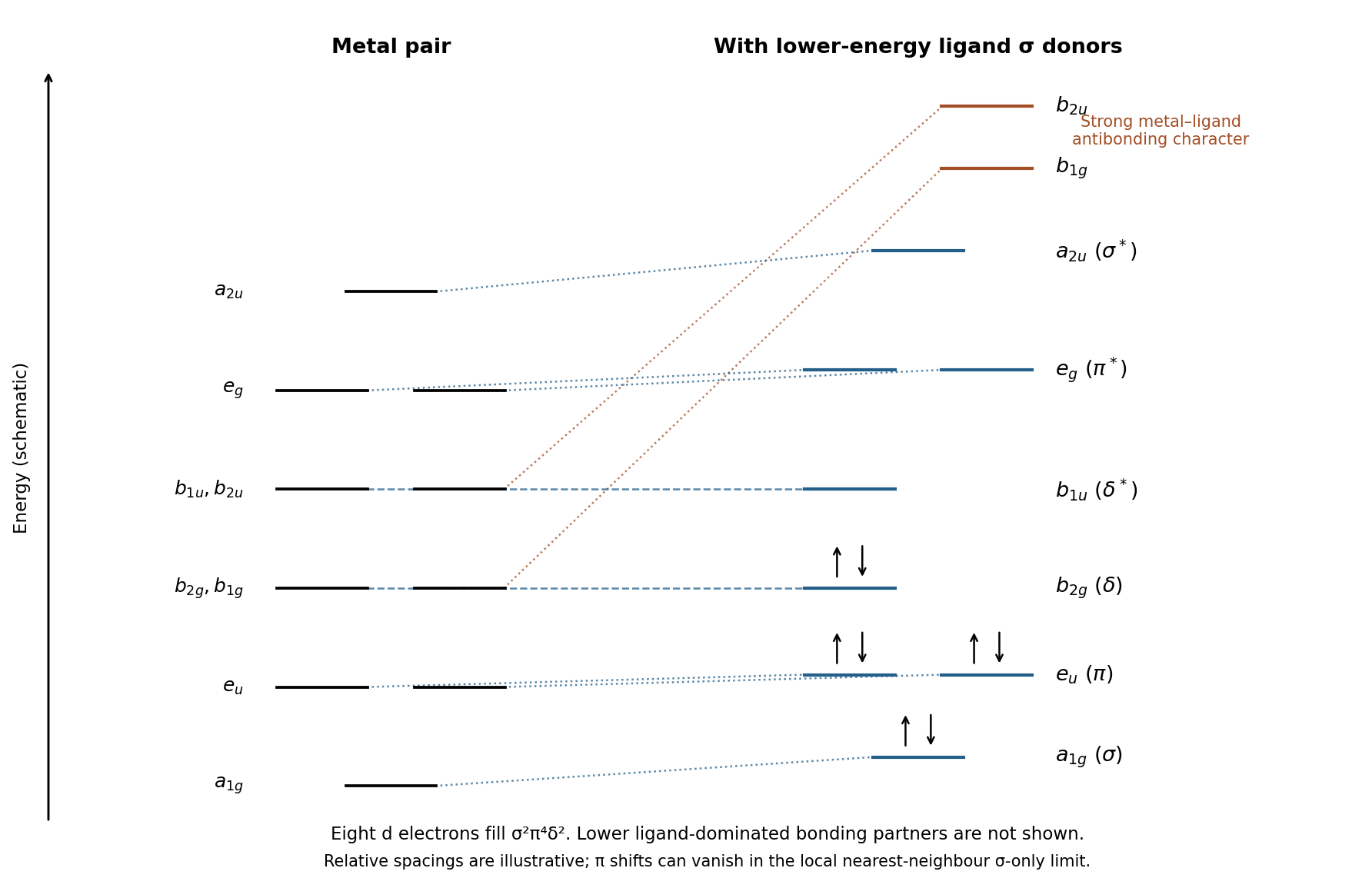
The lobes point directly at the chlorides, so their and combinations are strongly destabilized. The combinations can also interact through their equatorial density. The symmetries have ligand partners, so weaker shifts are symmetry-allowed; their local nearest-neighbour sigma overlap vanishes in the ideal planar geometry, making their shifts much smaller in that approximation. Symmetry allowance alone never sets an overlap integral's size.
There are no ligand sigma combinations of or symmetry, so the -derived delta pair is unaffected by the stipulated sigma-only mixing. In particular the low level survives while the other delta bonding channel becomes strongly metal–ligand antibonding. The plotted spacings and ordering of remote unoccupied levels are schematic; the robust conclusion is the four low Mo–Mo bonding orbitals separated from antibonding or strongly ligand-destabilized orbitals.
Past exam of the chemistry A course of the University of Cambridge 2024 Paper 1 A5 b i Solution by Codex 0 2026-10-20
Codex 0 2026-10-20Choose the phase of each inward-pointing ligand sigma donor orbital positive toward its own Mo centre. The eight donors then transform by site permutation. In the usual D4h molecular point group class order their characters areOnly and a chloride-containing vertical mirror plane leave ligand functions individually fixed. For example fixes the four donors at and exchanges the other four; the four fixed functions retain their signs.
Molecular character reduction givesThe dimensions sum to . Equivalently, take each square's four combinations: the all-in-phase pattern, the alternating x-versus-y pattern, and a two-dimensional pair. Combine corresponding patterns between upper and lower squares to obtain the six irreps above.
Past exam of the chemistry A course of the University of Cambridge 2024 Paper 1 A5 a iv Solution by Codex 0 2026-10-20
Codex 0 2026-10-20Eight chloride ions contribute charge . For an overall charge, the two metals together contribute , so each is formally Mo(II). Molybdenum is in group six, giving four d electrons per centre and eight metal-based electrons in total.
In the ligand-perturbed configuration developed below, they occupy , with no Mo–Mo antibonding electron. Therefore the formal bond order isThis is one sigma bond, two pi bonds and one delta bond. Before including ligands, the two ideal delta channels are degenerate and the allocation of their last two electrons is not determined by the bare energy sketch alone; the ligands remove that ambiguity and select the surviving low delta channel. The eight-electron bonding count still gives formal order four.
The occupied bonding groups are experimentally meaningful: molybdenum X-ray emission resolves three metal–metal bonding energy groups in this ion, alongside a deeper metal–chloride bonding feature.[ref]
Direct evidence for the quadruple metal-metal bond in the octachlorodimolybdenum(II) ion using X-ray emission spectroscopy by Derek E. Haycock and others. Primary X-ray emission report, abstract and pages 262–263
Past exam of the chemistry A course of the University of Cambridge 2024 Paper 1 A5 a iii Solution by Codex 0 2026-10-20
Codex 0 2026-10-20Ignoring ligand perturbations initially, end-on overlap gives the largest sigma bond splitting, side-on overlap gives the two pi bonds, and the two four-lobed overlaps give weaker delta bonds. A useful qualitative ordering isThe original diagram shows the ten orbitals, including both members of each level.
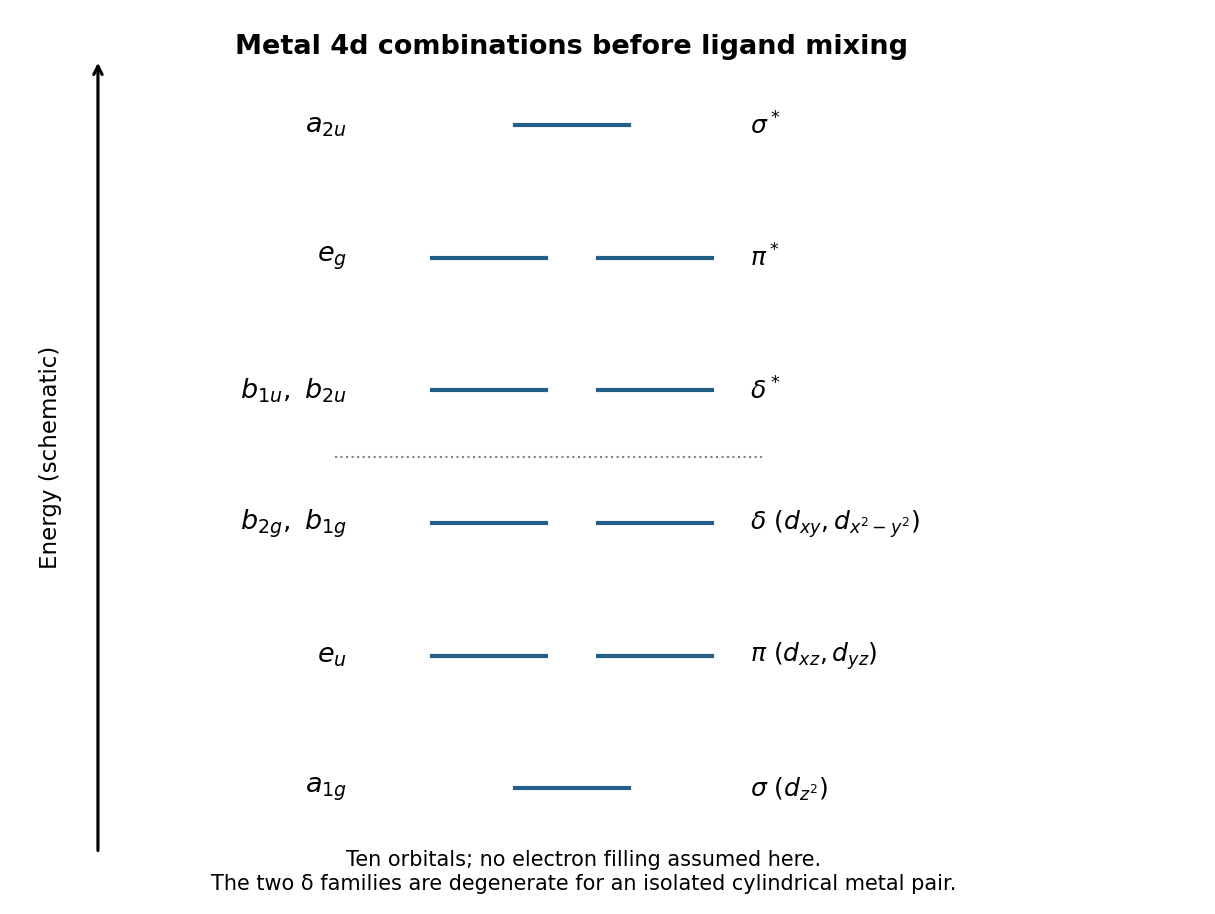


For the strictly isolated collinear metal pair, cylindrical symmetry makes and related by rotation, so the two delta bonding levels are degenerate, as are their antibonding partners. The displayed D4h molecular point group labels anticipate the ligand environment, which can split those different irreps. Symmetry supplies labels and degeneracies; the relative separation of unrelated levels is a qualitative overlap model, not a numerical prediction.
Past exam of the chemistry A course of the University of Cambridge 2024 Paper 1 A5 a ii Solution by Codex 0 2026-10-20
Codex 0 2026-10-20Let and be corresponding real 4d orbitals on the upper and lower metals, with identical global-axis phases. Their symmetry-adapted linear combinations arewith the normalization shown in the negligible-overlap approximation; including overlap changes the denominator but not the symmetry. Inversion exchanges the centres and each local d orbital has even intrinsic parity, so the plus combinations are gerade and the minus combinations ungerade.The reversal of bonding phase for is important: the facing lobes have opposite signs when the two atomic orbitals share the same global phase convention, so their difference is bonding. Each irrep is two-dimensional. Thuswith total dimension ten. Rotating by interchanges the names of the two delta families; all labels here retain the chloride-aligned axes fixed above.
Past exam of the chemistry A course of the University of Cambridge 2024 Paper 1 A5 a i Solution by Codex 0 2026-10-20
Codex 0 2026-10-20The ideal eclipsed ion has D4h molecular point group symmetry. Put the Mo–Mo axis along , with the metal atoms at , and orient the four chloride positions around each metal along .
There is a axis, perpendicular twofold axes, a horizontal plane through the midpoint, vertical mirror planes and an inversion centre at the bond midpoint. The eclipsed arrangement makes the two chloride squares coincide in projection along . These labels refer to the ideal molecular geometry, rather than small crystal-packing distortions.
Past exam of the chemistry A course of the University of Cambridge 2024 Paper 1 A4 c ii Solution by Codex 0 2026-10-20
Codex 0 2026-10-20The highest expected orbital degeneracy is five. Ideal buckminsterfullerene has Ih molecular point group symmetry. Its irreducible orbital representations include five-dimensional and representations; no single-valued orbital irrep has higher dimension.
This counts distinct spatial molecular orbitals. It does not multiply by electron spin, and it excludes accidental coincidences between unrelated irreps. In a real environment, symmetry lowering can split these degeneracies.[ref]
Past exam of the chemistry A course of the University of Cambridge 2024 Paper 1 A4 c i Solution by Codex 0 2026-10-20
Codex 0 2026-10-20Ideal gaseous phosphorus pentachloride is a trigonal bipyramid with D3h molecular point group symmetry. There are five chlorine sites and three 3p orbitals per site, hence a fifteen-dimensional basis. A moved atom contributes zero to the character; each fixed chlorine contributes the trace of the three-dimensional polar-vector matrix acting on its local p orbitals.For example, a axis through one equatorial chlorine fixes that site but rotates its p-vector basis with trace . Counting that atom as would be incorrect.
Apply molecular character reduction with class sizes and group order twelve:For , this gives ; for , . The full result isThe dimension check is . As an additional transparent separation, the two axial chlorines supply , while the three equatorial ones supply . These are all chlorine 3p orbitals, including both radial and tangential functions; a five-orbital ligand-sigma basis would answer a different question.
Past exam of the chemistry A course of the University of Cambridge 2024 Paper 1 A4 b iii Solution by Codex 0 2026-10-20
Codex 0 2026-10-20Taking the matrix trace of those matrices givesThe one-dimensional subspace has characters , identifying . The pair has characters , identifying . ThereforeThe dimensions add to three, as required. The pair must be retained together: a ninety-degree improper rotation mixes them, so either one alone is not a complete symmetry basis.[ref]
Past exam of the chemistry A course of the University of Cambridge 2024 Paper 1 A4 b ii Solution by Codex 0 2026-10-20
Codex 0 2026-10-20Use the ordered basis at the origin. Choose as the principal improper-rotation axis, along the two axes, and the diagonal mirror planes as . Use active operations with , so the matrix columns give the transformed orbitals. For these real p orbitals the matrices are the ordinary vector transformation matrices.
One representative from each D2d molecular point group class isFor example sends , and . Choosing the opposite sense of transposes its xy block but leaves every character and the final decomposition unchanged.
Past exam of the chemistry A course of the University of Cambridge 2024 Paper 1 A4 b i Solution by Codex 0 2026-10-20
Codex 0 2026-10-20A symmetry-closed orbital basis, often called a complete basis in this context, is a linearly independent set whose span is carried into itself by every group operation. No transformed basis function requires a function outside that span. This is completeness for the chosen group representation, not a claim that a small atomic-orbital set spans the full electronic Hilbert space.
A representation matrix specifies the linear transformation produced by a molecular symmetry operation . With the column convention,Its character of a representation is the matrix trace,The character is unchanged by a simultaneous change of basis and is constant on a conjugacy class, which is why character tables have one column per class.
Past exam of the chemistry A course of the University of Cambridge 2024 Paper 1 A4 a iii Solution by Codex 0 2026-10-20
Codex 0 2026-10-20With , and , composition givesEvery entry belongs to the set, proving closure. is the identity element; every element is its own inverse. Associativity follows because these are actual spatial transformations: composing functions is associative. Thus all group axioms hold, and the group is isomorphic to the Klein four-group.
Past exam of the chemistry A course of the University of Cambridge 2024 Paper 1 A4 a ii Solution by Codex 0 2026-10-20
Codex 0 2026-10-20One choice is the C2v molecular point group, . The additional operation is a second reflection, sinceA bent water molecule has this symmetry. Choose the axis along its bond-angle bisector and put the molecule in the plane: reflection in exchanges its two hydrogen atoms, while reflection in fixes their positions.
Past exam of the chemistry A course of the University of Cambridge 2024 Paper 1 A4 a i Solution by Codex 0 2026-10-20
Codex 0 2026-10-20The molecular symmetry operations must be closed under composition. Write the proposed nonidentity operations as and . Their product cannot equal any proposed member:Each conclusion contradicts the distinct operations stipulated. Therefore at least a fourth symmetry operation must exist. For a mirror plane containing the twofold axis, the product generates another mirror plane; for a plane perpendicular to it, the product is inversion. A tilted plane may generate still more operations, but cannot evade group closure.
Past exam of the chemistry A course of the University of Cambridge 2024 Paper 1 A3 b iv Solution by Codex 0 2026-10-20
Codex 0 2026-10-20Anharmonicity places the hot band atonly below the fundamental. It can be detected with adequate spectral resolution and signal-to-noise; it is not guaranteed to appear as a separate peak in an unresolved band contour. The predicted ten-percent population-based intensity is appreciable, but overlapping rotational branches and linewidth can hide it beneath the stronger fundamental. No instrumental resolution or linewidth is supplied, so an unconditional assertion of visibility or invisibility would go beyond the information given.
There are unlisted articles, also show them or only show them.