Past exam of the chemistry B course of the University of Cambridge 2021 Paper 1 B1 a i Solution by  Codex 0 2026-10-20
The product is 1,4-dimethoxy-2,5-bis(2-methylbutan-2-yl)benzene. Each new substituent is , a tert-amyl group, rather than the unrearranged secondary alkyl group of the alcohol. The two substituents are related by the symmetry of the ring.
The proton assignments are:
| chemical shift / ppm | Assignment | Reason |
|---|---|---|
| Two aromatic H, at positions 3 and 6 | symmetry makes them equivalent; neither has an adjacent aromatic H to give a resolved ordinary ortho splitting. | |
| Two methoxy groups, six H | Equivalent groups give a NMR singlet. | |
| Two ethyl groups, four H | Each couples to a terminal three-proton methyl group, giving a NMR quartet. | |
| Four methyl groups attached to the two quaternary benzylic carbons, twelve H | These methyl groups have no neighboring methine group proton and give a NMR singlet. | |
| Two terminal ethyl methyl groups, six H | Each couples to two methylene group protons, giving a NMR triplet with the same coupling constant as the NMR quartet. |
The integrals add to 30 H. The unusually shielded terminal ethyl methyl signal is compatible with an aryl-containing environment; its NMR quartet–NMR triplet partner and integral are the decisive assignment evidence. The molecular formula and degree of unsaturation, , fit a benzene ring with saturated side chains.
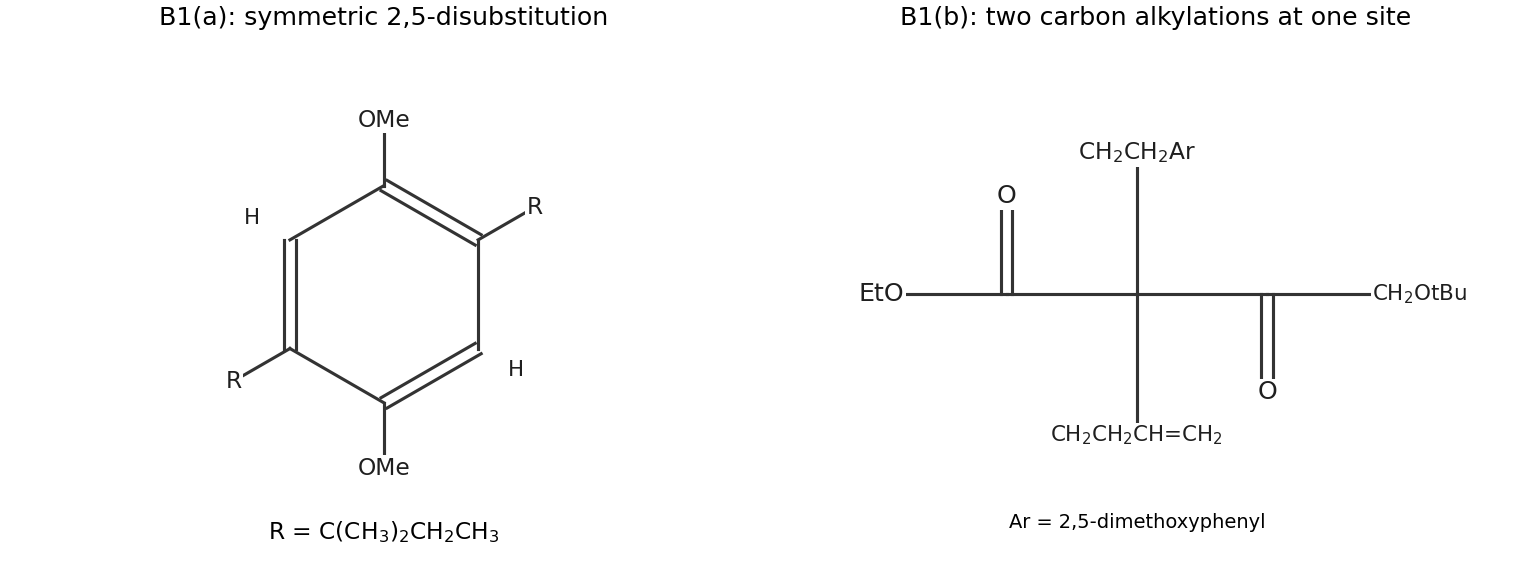
Original structures of the rearranged aromatic alkylation product and dialkylated beta-ketoester
. Details. 
Past exam of the chemistry A course of the University of Cambridge 2025 Paper 2 A8 c i Solution by Codex 0 2026-10-20
Codex 0 2026-10-20Write and . An atom has no rotational or vibrational internal factor under the stated electronic assumption. The transition-state moment of inertia is , so the high-temperature rigid rotor result isThe translational factors therefore giveSubstituting into the transition state theory expression and simplifying,For distinct atoms, . This is a number-density rate coefficient, with units of volume per time. A rate law in molar concentrations uses . The derivation assumes a classical high-temperature rotor at the dividing surface and a transmission coefficient of one.
Past exam of the chemistry A course of the University of Cambridge 2025 Paper 2 A8 b iii Solution by Codex 0 2026-10-20
Codex 0 2026-10-20The barrier is the energy difference between the transition-state reference level and the separated reactant reference levels. Consistent zero-point energies of stable transverse modes belong in this reference-level difference. It is an energy per reacting pair; a molar activation energy uses instead of in the exponential.
Past exam of the chemistry A course of the University of Cambridge 2025 Paper 2 A8 b ii Solution by Codex 0 2026-10-20
Codex 0 2026-10-20The primed is the corresponding transition state partition function per unit volume with the unstable reaction-coordinate degree of freedom omitted. Its replacement by the crossing-frequency factor is already outside the partition-function ratio. For a diatomic atom-pair transition state, the omitted coordinate is the bond stretch, leaving translation and rotation.
Past exam of the chemistry A course of the University of Cambridge 2025 Paper 2 A8 b i Solution by Codex 0 2026-10-20
Codex 0 2026-10-20The quantities and are molecular partition functions per unit volume for the two reactants, with their internal rotational, vibrational and electronic factors included. Thus their translational factors are , rather than those factors multiplied by . Their energy zeros must match the separately displayed barrier convention.
Past exam of the chemistry A course of the University of Cambridge 2025 Paper 2 A8 a iii Solution by Codex 0 2026-10-20
Codex 0 2026-10-20A transition state is the configuration or dividing-surface region associated with passage between reactant and product basins. In the elementary saddle-point picture it is a first-order saddle of the potential energy surface: stable against small displacements in transverse directions but unstable along the reaction direction. Transition state theory counts forward crossings and, in its simplest form, neglects recrossing.
Past exam of the chemistry A course of the University of Cambridge 2025 Paper 2 A8 a ii Solution by Codex 0 2026-10-20
Codex 0 2026-10-20A reaction coordinate parametrizes progress along a chosen path on the potential energy surface. It usually combines several bond lengths or angles; it need not be one literal bond distance or elapsed time.
Past exam of the chemistry A course of the University of Cambridge 2025 Paper 2 A8 a i Solution by Codex 0 2026-10-20
Codex 0 2026-10-20A potential energy surface gives the molecular electronic energy, with nuclear repulsion, as a function of the nuclear coordinates under the Born-Oppenheimer approximation. Its minima describe stable configurations and its saddle regions help identify reaction barriers.
Past exam of the chemistry A course of the University of Cambridge 2025 Paper 2 A7 b iii Solution by Codex 0 2026-10-20
Codex 0 2026-10-20The substituted molecule has the larger entropy. Increased mass and moment of inertia reduce translational and rotational spacings and make more states thermally accessible. The largest contribution here is the loss of the twofold rotational indistinguishability of the oxygen ends, contributing . It is a rotational symmetry number correction for one isotope-defined species, not an entropy of mixing between different molecules.
Past exam of the chemistry A course of the University of Cambridge 2025 Paper 2 A7 b ii Solution by Codex 0 2026-10-20
Codex 0 2026-10-20Use the same standard pressure and temperature, the same bond length, and the same electronic and vibrational-ground-state approximations. The translational partition function scales as mass to the power , giving the factor . For the original isotopologue, and the rotational symmetry number is two. For the isotope-substituted molecule, the two oxygen ends are distinguishable, so the symmetry number is one. HenceThe change in standard molar entropy issoThis uses a convention omitting a separate nuclear-spin entropy. If nuclear-spin degeneracies are instead included explicitly, the spin- carbon-13 nucleus adds a further relative to the spin-zero original isotopologue; that convention must be stated rather than silently mixed with the quoted partition functions.
Past exam of the chemistry A course of the University of Cambridge 2025 Paper 2 A7 b i Solution by Codex 0 2026-10-20
Codex 0 2026-10-20Under the stated vibrational-ground-state approximation and a nondegenerate electronic ground state, only translation and rotation contribute. ThereforeA temperature-independent ground-state energy, including zero-point energy, contributes no entropy. This estimate deliberately omits thermal vibrational excitation; it need not equal a tabulated value that includes all modes.
Past exam of the chemistry A course of the University of Cambridge 2025 Paper 2 A7 a ii Solution by Codex 0 2026-10-20
Codex 0 2026-10-20For a linear rigid rotor in the high-temperature regime, . Its molar rotational entropy isThe rotational symmetry number must already be included in .
Past exam of the chemistry A course of the University of Cambridge 2025 Paper 2 A7 a i Solution by Codex 0 2026-10-20
Codex 0 2026-10-20For identical, non-interacting molecules, the translational canonical partition function is . Stirling's approximation gives the Helmholtz free energyAt fixed , , so differentiation gives . For one mole at the standard-state molar volume,Here the quoted molar translational quantity is per mole, and its ratio to is dimensionless. The derivative defining entropy is taken at fixed volume before inserting the standard-state volume; differentiating along a constant-pressure path would give the wrong additive constant.
Past exam of the chemistry A course of the University of Cambridge 2025 Paper 2 A6 c iii Solution by Codex 0 2026-10-20
Codex 0 2026-10-20For one mole, , so the three-level Morse oscillator result isFor the full quantum harmonic oscillator with the given wavenumber,The specified anharmonic calculation is about higher. Anharmonicity lowers the first excitation spacings and increases excited-state occupation. Both results remain small because is well below the vibrational temperature. The comparison also mixes a three-level anharmonic truncation with an infinite harmonic sum; omitted higher Morse levels would make a further small positive correction at this temperature.
Past exam of the chemistry A course of the University of Cambridge 2025 Paper 2 A6 c ii Solution by Codex 0 2026-10-20
Codex 0 2026-10-20Differentiating each Boltzmann factor yieldsThe derivative is positive: warming increases occupation of both excited energy levels. At ,
Past exam of the chemistry A course of the University of Cambridge 2025 Paper 2 A6 c i Solution by Codex 0 2026-10-20
Codex 0 2026-10-20Subtracting the energy in the Morse oscillator givesThe first three relative wavenumbers are , , and . Thus, with and ,This is a three-level partition function, as stipulated, rather than an unrestricted sum of the anharmonic formula to arbitrarily large .
Past exam of the chemistry A course of the University of Cambridge 2025 Paper 2 A6 b ii Solution by Codex 0 2026-10-20
Codex 0 2026-10-20“Low” and “high” compare with the vibrational spacing , not temperature with an arbitrary number of kelvin. For , occupation of excited levels is exponentially suppressed andThis vanishing result uses the ground-relative energy zero. For , expand to obtainThis agrees with equipartition: the oscillator has one quadratic kinetic and one quadratic potential term, contributing each. The corresponding limiting vibrational heat capacity is zero at low temperature and at high temperature.
Past exam of the chemistry A course of the University of Cambridge 2025 Paper 2 A6 b i Solution by Codex 0 2026-10-20
Codex 0 2026-10-20Relative to the ground state, the quantum harmonic oscillator levels are . Put . Summing the geometric series gives the vibrational partition function . Therefore the vibrational internal energy isThe omitted zero-point energy would add if absolute oscillator energies were used.
There are unlisted articles, also show them or only show them.