Past exam of the chemistry A course of the University of Cambridge 2025 Paper 2 A10 d ii Solution by  Codex 0 2026-10-20
For the quoted cubic-phase gap,The same exciton binding argument can shift the actual emission to longer wavelength; impurity-bound transitions can also lie below the fundamental gap. The comparison must use at the operating temperature. Ordinary temperature-dependent gap changes can shift the band edge in the opposite direction, so the numerical values based on fixed supplied gaps are not universal lower bounds for every cooled device.
Past exam of the chemistry A course of the University of Cambridge 2025 Paper 2 A10 d i Solution by Codex 0 2026-10-20
Codex 0 2026-10-20Using and an ideal band-edge photon energy equal to the quoted gap,At low temperature an electron and hole can form a bound exciton. Its recombination releases approximately , so its wavelength is longer than evaluated using the gap at that same temperature. GaN excitation and emission measurements resolve such excitonic transitions below the fundamental gap.[ref]
Fundamental energy gap of GaN from photoluminescence excitation spectra by Bo Monemar. Photoluminescence-excitation, reflection and emission comparison; separation of exciton transition energy from the fundamental gap
Past exam of the chemistry A course of the University of Cambridge 2025 Paper 2 A10 b ii Solution by Codex 0 2026-10-20
Codex 0 2026-10-20A standard substitutional acceptor choice is Mg on a Ga site: a group-II atom replaces group III, leaving one fewer valence electron. Its size is sufficiently compatible with the cation sublattice to make substitution plausible. This identifies the intended acceptor chemistry; actual hole density also depends on activation, incomplete ionization and compensation. Size and valence rules alone do not guarantee a shallow, fully ionized acceptor.
Past exam of the chemistry A course of the University of Cambridge 2025 Paper 2 A10 b i Solution by Codex 0 2026-10-20
Codex 0 2026-10-20Suitable substitutional donors include Si on a Ga site and O on an N site. The former replaces a group-III atom with a group-IV atom; the latter replaces a group-V atom with a group-VI atom. Each provides an extra valence electron relative to its host site. Si is a plausible substitutional cation-site dopant, and the compact oxygen atom is compatible with an anion site. Site compatibility matters: merely choosing an element with an extra electron without considering which sublattice it occupies is insufficient.
Past exam of the chemistry A course of the University of Cambridge 2025 Paper 2 A10 a iii Solution by Codex 0 2026-10-20
Codex 0 2026-10-20At , the same approximation givesAs temperature rises, the relative advantage from a fixed gap difference becomes smaller, even while the intrinsic carrier densities of both phases increase.
Past exam of the chemistry A course of the University of Cambridge 2025 Paper 2 A10 a ii Solution by Codex 0 2026-10-20
Codex 0 2026-10-20 Past exam of the chemistry A course of the University of Cambridge 2025 Paper 2 A10 a i Solution by Codex 0 2026-10-20
Codex 0 2026-10-20For an intrinsic, nondegenerate semiconductor, charge neutrality and the Boltzmann approximation to the Fermi-Dirac distribution give . Assume the two polymorphs have equal effective-density-of-states prefactors and retain the quoted band gaps at the temperature being estimated. Their carrier-density ratio is thenwith expressed in eV per kelvin. At ,Both absolute intrinsic densities are extremely small at this temperature; a large ratio does not imply that either material is a good intrinsic conductor. Defects or unintended dopants can dominate real “undoped” specimens.
Past exam of the chemistry A course of the University of Cambridge 2025 Paper 1 A4 c ii Solution by Codex 0 2026-10-20
Codex 0 2026-10-20There are three stretching fundamentals, although four stretching-region features are listed. The low feature at is predominantly C=O stretch (). The two features at and are the symmetric and antisymmetric C–H stretches; their order is not determined by this mode count alone.
The feature is consistent with the first C=O vibrational overtone, close to and shifted downward by anharmonicity. Its symmetry is , so symmetry permits the weak anharmonic transition. It is not a fourth stretching fundamental. The combination-band evidence in the next part distinguishes the two C–H assignments.
Past exam of the chemistry A course of the University of Cambridge 2025 Paper 1 A4 c i Solution by Codex 0 2026-10-20
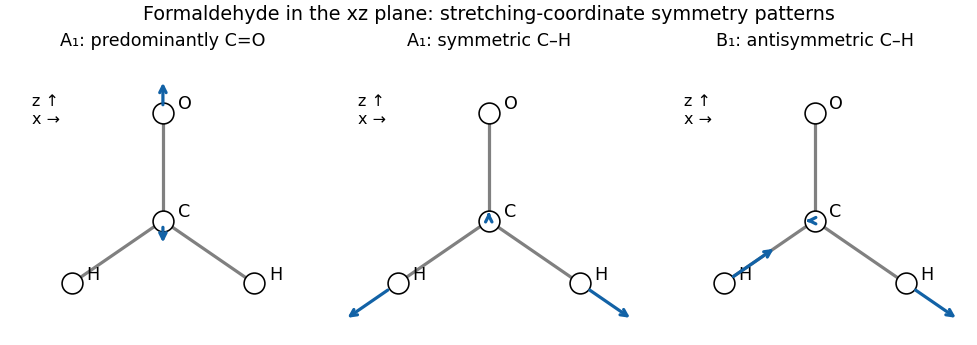
Codex 0 2026-10-20The C=O length is invariant under every operation, so its stretch is . If are the two C–H bond-length changes, their sum and difference giveHence . These are stretching symmetry coordinates; the two motions can mix in actual normal modes, and mass-weighted atomic motions need not have the schematic arrow lengths below.
Past exam of the chemistry A course of the University of Cambridge 2025 Paper 1 A4 b iii Solution by Codex 0 2026-10-20
Codex 0 2026-10-20In this C2v point group convention, , , and . Therefore all six normal modes have symmetry-allowed infrared fundamentals: , absent accidental coincidences or vanishing intensities.
For Raman spectroscopy, examine the polarizability tensor: , , and ; is also Raman-allowed but no vibration occurs here. All six vibrations are therefore Raman-active too, giving . The centrosymmetric mutual-exclusion rule does not apply to formaldehyde.
Past exam of the chemistry A course of the University of Cambridge 2025 Paper 1 A4 b ii Solution by Codex 0 2026-10-20
Codex 0 2026-10-20For operations ordered as , the characters of the twelve Cartesian displacements areOnly atoms left fixed contribute: all four for and , but only C and O for and . Multiplying their counts by the Cartesian traces gives these numbers. Subtractto obtain . The character table reduction givesThe dimensions sum to , as required. The mode is the out-of-plane wag with this axis convention.
Past exam of the chemistry A course of the University of Cambridge 2025 Paper 1 A4 b i Solution by Codex 0 2026-10-20
Codex 0 2026-10-20With along C=O and the molecule in the plane, formaldehyde has , , and . It belongs to the C2v point group, . Keeping this axis convention is essential when assigning the labels and .
Past exam of the chemistry A course of the University of Cambridge 2025 Paper 1 A3 d iii Solution by Codex 0 2026-10-20
Codex 0 2026-10-20Read the stronger members of the inset doublets at about , and . Their spacings are roughly –, so the common- estimate isUsing the harmonic wavenumber from the preceding calculation and labelling lines by the lower-state ,These are graph-based estimates. Finite reading precision and different upper/lower rotational constants limit their accuracy to a few cm−1; extra decimal places would not be justified. The R1 result refers to , while R0 is the line nearest the high-wavenumber side of the band gap.
Past exam of the chemistry A course of the University of Cambridge 2025 Paper 1 A3 d ii Solution by Codex 0 2026-10-20
Codex 0 2026-10-20Use the two-body reduced mass, rather than the chlorine mass or hydrogen mass alone:The bond force constant givesThe requested “frequency in cm−1” is a spectroscopic wavenumber; the ordinary frequency is the value in s−1 above. This calculation uses the question's force constant in the harmonic model, rather than replacing it with a tabulated spectroscopic constant.
Past exam of the chemistry A course of the University of Cambridge 2025 Paper 1 A3 d i Solution by Codex 0 2026-10-20
Codex 0 2026-10-20This is a rovibrational spectrum: the vibrational excitation is accompanied by quantized molecular rotation. The high-wavenumber R branch has , and the low-wavenumber P branch has . In the simplest common- approximation,Consecutive lines within either branch are therefore separated by roughly , while the gap between P(1) and R(0) is roughly . There is no Q branch: for this diatomic parallel transition, the electric-dipole rotational selection rule allows , and the line strength vanishes.
The intensity envelope comes from rotational populations, approximately , together with the rotational line strengths. The paired peaks arise from the two chlorine isotopologues, and : their different reduced masses shift both rotational and vibrational spacings. The more abundant gives the stronger member. The changing spacing away from the band centre reflects and, at higher , centrifugal distortion; it is not evidence for additional vibrational fundamentals.
Past exam of the chemistry A course of the University of Cambridge 2025 Paper 1 A3 c ii Solution by Codex 0 2026-10-20
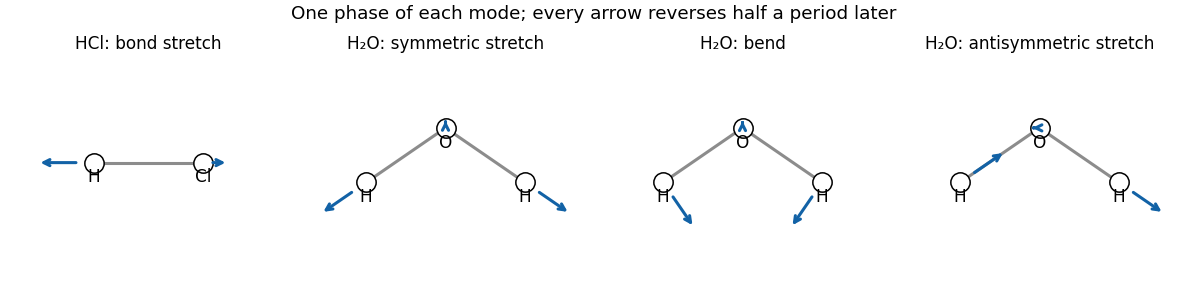
Codex 0 2026-10-20A nonlinear triatomic molecule has vibrational normal modes. For water they are the symmetric O–H stretch, the H–O–H bend, and the antisymmetric O–H stretch, shown above. In the symmetric stretch both O–H lengths increase together; in the antisymmetric stretch one increases while the other decreases; the bend predominantly changes the bond angle. All three change a component of the electric dipole moment and are infrared-active. Every arrow reverses half a period later; motion of oxygen maintains the molecular centre of mass.
Past exam of the chemistry A course of the University of Cambridge 2025 Paper 1 A3 c i Solution by Codex 0 2026-10-20
Codex 0 2026-10-20A diatomic molecule has vibrational normal mode: the bond stretch. For hydrogen chloride, opposite longitudinal displacements change the electric dipole moment, so the mode has vibrational infrared activity. The following original sketches show one phase of this motion and the three water modes; arrow lengths are schematic, not mass-weighted amplitudes.


Past exam of the chemistry A course of the University of Cambridge 2025 Paper 1 A3 a iv Solution by Codex 0 2026-10-20
Codex 0 2026-10-20A hot band starts from a thermally populated vibrationally excited state, for example . It can satisfy and need not have a small transition moment, but its lower-state population is reduced by the Boltzmann distribution:It is therefore usually weak at low temperature and grows relative to the fundamental on heating. Anharmonicity shifts its frequency away from the transition; in a polyatomic molecule, excitation in another mode can also produce a hot-band sequence.
Past exam of the chemistry A course of the University of Cambridge 2025 Paper 1 A3 a iii Solution by Codex 0 2026-10-20
Codex 0 2026-10-20The second vibrational overtone is , with , near three times the fundamental wavenumber. It requires higher-order departures from the linear-dipole harmonic model and is ordinarily weaker again. These are qualitative intensity trends; resonances can redistribute intensity between nearby vibrational states.
Past exam of the chemistry A course of the University of Cambridge 2025 Paper 1 A3 a ii Solution by Codex 0 2026-10-20
Codex 0 2026-10-20The first vibrational overtone is , with . It lies near twice the fundamental wavenumber, generally slightly below it because of anharmonicity. The linear-dipole harmonic model forbids it; anharmonic wavefunctions or higher terms in the dipole expansion give a weak intensity. Thus it is generally weaker than the corresponding fundamental.
There are unlisted articles, also show them or only show them.