Past exam of the chemistry A course of the University of Cambridge 2025 Paper 1 A3 a i Solution by  Codex 0 2026-10-20
For one normal mode, the fundamental is , with other modes initially in their ground levels. In the linear-dipole harmonic approximation, the transition moment is nonzero for , so a vibrational fundamental is normally much stronger than its overtones, provided the mode has vibrational infrared activity.
Past exam of the chemistry A course of the University of Cambridge 2025 Paper 1 A1 b iii Solution by Codex 0 2026-10-20
Codex 0 2026-10-20The quantum variational principle states that the energy expectation of an admissible trial wavefunction is at least the ground state energy:For the discrete, complete orthonormal basis assumed here, expand in Hamiltonian operator eigenfunctions, , with and . ThenEvery summand is nonnegative. Equality holds precisely when all occupied components lie in the ground eigenspace. Thus minimizing trial energies supplies upper bounds on , with exact equality if the trial family contains a ground state.
Past exam of the chemistry A course of the University of Cambridge 2025 Paper 1 A1 b ii Solution by Codex 0 2026-10-20
Codex 0 2026-10-20The decisive observation is that is itself an eigenfunction:On the regular Legendre polynomial domain, integration by parts has endpoint factor , so the boundary form vanishes for regular functions at . The interval alone is not an endpoint condition; regularity is the usual condition selecting the Legendre polynomials. Their eigenvalues are , and the normalized function isThereforeEquivalently, the Hermitian operator identity gives , and nondegeneracy leaves only one possible nonzero coefficient. The unnormalized function has squared norm , consistent with this coefficient.
Past exam of the chemistry A course of the University of Cambridge 2025 Paper 1 A1 b i Solution by Codex 0 2026-10-20
Codex 0 2026-10-20Multiply the eigenfunction expansion by and integrate over the common domain. Orthogonality and wavefunction normalization giveThus . For a normalized , the Born rule identifies as the probability of this basis outcome.
Past exam of the chemistry A course of the University of Cambridge 2025 Paper 1 A1 a i Solution by Codex 0 2026-10-20
Codex 0 2026-10-20Take with real , and . The operator domain matters: use sufficiently smooth wavefunctions for which the following boundary terms vanish at both infinities. A real multiplication operator givesTwo applications of integration by parts giveThus the potential energy and kinetic energy operators obey the stated Hermitian operator identity on this common domain. For , one application of integration by parts instead givesThe derivative is anti-Hermitian, rather than Hermitian; the minus sign cannot generally be removed. Multiplication by makes the corresponding momentum operator Hermitian. These integrations establish the requested symmetry identities; full self-adjointness of an unbounded operator additionally requires equality of its domain with its adjoint's domain.
Past exam of the chemistry A course of the University of Cambridge 2024 Paper 2 A8 d ii Solution by Codex 0 2026-10-20
Codex 0 2026-10-20Differentiation of the restricted free energy gives the magnetizationIn the weak-field limit , , soThe printed coefficient is inconsistent with the stated moment . The requested expression without the factor four would follow from in this restricted model. This discrepancy is present in the original PDF, rather than introduced by its transcription.
For completeness, differentiating the full thermal free energy givesIts weak-field form isAt this approaches , so restoring the two nonmagnetic ground states does not recover the printed coefficient either. The inverse-temperature Curie law form is valid, but the population factor and moment squared must be retained consistently.
Past exam of the chemistry A course of the University of Cambridge 2024 Paper 2 A8 d i Solution by Codex 0 2026-10-20
Codex 0 2026-10-20Following the restricted model in the preceding part, its electronic factor for independent magnetic molecules is . Its field-dependent Helmholtz free energy is thereforewhere denotes terms independent of the field. Equivalently, the change from zero field is . Retaining the excited-state offset simply adds to the restricted free energy.
If instead counts all molecules in thermal equilibrium, the correct electronic expression isThe ordinary translational indistinguishability factor is field independent and does not alter either magnetic derivative.
Past exam of the chemistry A course of the University of Cambridge 2024 Paper 2 A7 c iv Solution by Codex 0 2026-10-20
Codex 0 2026-10-20The negative activation volume means the transition state occupies less partial molar volume than the two separated reactants. Pressure therefore favours reaching it and increases the forward rate, consistent with a compact associative cycloaddition in which new bonds begin to form.
Past exam of the chemistry A course of the University of Cambridge 2024 Paper 2 A7 c iii Solution by Codex 0 2026-10-20
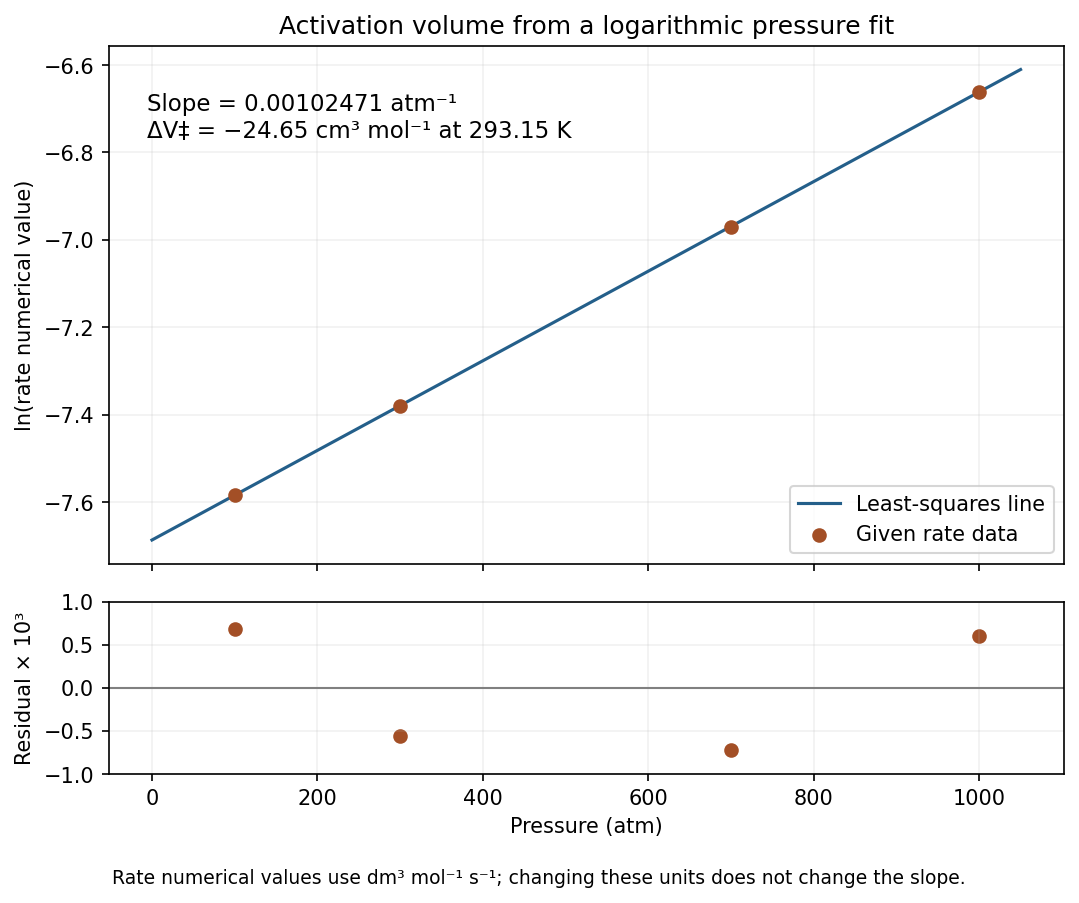
Codex 0 2026-10-20Using the numerical rate constants in , the logarithms areA straight-line least-squares fit isEvery logarithmic residual has magnitude below , so the rates follow the fitted exponential to within ; . Thus a constant activation volume describes these data well.

Past exam of the chemistry A course of the University of Cambridge 2024 Paper 2 A7 c ii Solution by Codex 0 2026-10-20
Codex 0 2026-10-20At fixed temperature, differentiating the Eyring equation with a pressure-independent prefactor and fixed concentration convention givesSince , the derivative is the difference between the activated complex's partial molar volume and the sum for the reactants:If activation volume is approximately constant over the pressure range, integration givesThus plot against pressure: its slope is . Use pressure in pascals for a volume in . The model neglects pressure dependence of the transmission coefficient, substantial changes in mechanism, and strong curvature from a pressure-dependent activation volume. Fixed concentration-unit conventions and compression corrections matter for non-first-order rates.[ref]
Past exam of the chemistry A course of the University of Cambridge 2024 Paper 2 A7 c i Solution by Codex 0 2026-10-20
Codex 0 2026-10-20For an elementary bimolecular forward step, . A liquid solution is much less compressible than a gas, so applying pressure changes its volume and reactant concentrations only modestly. With composition and temperature otherwise fixed, the observed substantial acceleration is therefore most naturally assigned to a change in the rate constant.
This is an approximation, not exact incompressibility: for precise pressure kinetics, correct the concentrations for compression and distinguish them from pressure-dependent activities.
Past exam of the chemistry A course of the University of Cambridge 2024 Paper 2 A7 b iv Solution by Codex 0 2026-10-20
Codex 0 2026-10-20Use the same transition state and consistent standard states in both directions. Subtracting their definitions givessoRing-forming association normally has . Hence the reverse activation entropy should be more positive, or less negative, than the forward value: a single adduct approaches a bond-breaking configuration rather than two molecules losing their relative motion. Its precise value and even whether it crosses zero cannot be deduced without the reaction entropy. The reverse elementary reaction is first order, so its Eyring equation has the corresponding first-order standard-state prefactor.
Past exam of the chemistry A course of the University of Cambridge 2024 Paper 2 A7 b iii Solution by Codex 0 2026-10-20
Codex 0 2026-10-20The activation enthalpy is obtained from the slope across the measured interval. The activation entropy comes from the intercept at , far outside that interval, so a small slope uncertainty can produce a much larger uncertainty in the extrapolated intercept. Slope and intercept errors are consequently strongly correlated.
The entropy is also sensitive to the assumed prefactor and standard concentration, whereas a constant multiplicative calibration error shifts the intercept without changing the slope. This explains why its inferred precision is often poorer. Since enthalpy and entropy have different units, a claim about which absolute numerical uncertainty is larger requires a stated comparison convention.
Past exam of the chemistry A course of the University of Cambridge 2024 Paper 2 A7 b ii Solution by Codex 0 2026-10-20
Codex 0 2026-10-20The large negative activation entropy is consistent with a strongly organized bimolecular cycloaddition. Two separately translating and rotating molecules must approach with a restricted orientation to form a compact ring-forming transition state. Losing relative positional and orientational freedom lowers entropy.
Past exam of the chemistry A course of the University of Cambridge 2024 Paper 2 A7 b i Solution by Codex 0 2026-10-20
Codex 0 2026-10-20The slope is K, so the activation enthalpy isFor , using in gives the numerical prefactor . The intercept therefore yieldsThe large logarithm must be subtracted; identifying with the activation entropy would omit the transition-state attempt-frequency factor. Changing rate units without changing the standard-concentration prefactor consistently would also give a spurious entropy.
Past exam of the chemistry A course of the University of Cambridge 2024 Paper 2 A7 a ii Solution by Codex 0 2026-10-20
Codex 0 2026-10-20Resolve the activation free energy into enthalpy and entropy in the Eyring equation:Taking logarithms of numerical values in fixed, consistent units givesThus for slope and intercept ,The logarithms imply reference units, as made explicit in the supplied numerical plot. Approximate linearity requires the activation parameters and transmission coefficient to vary little over the temperature interval; a significant activation heat-capacity difference produces curvature.
Past exam of the chemistry A course of the University of Cambridge 2024 Paper 2 A7 a i Solution by Codex 0 2026-10-20
Codex 0 2026-10-20In transition state theory, is the dimensionless equilibrium-like constant for forming the activated complex from the reactants under the chosen standard-state convention. It is not the equilibrium constant for forming the stable product.
is the standard activation free energy, the standard activation enthalpy, and the standard activation entropy. Each is the activated-complex quantity minus the corresponding sum for the reactants, with the unstable reaction-coordinate motion treated by the transition-state flux construction.
is the standard concentration, conventionally for the rate units used here. Its inverse converts the attempt frequency into the units of a bimolecular rate constant. The stated Eyring equation assumes unit transmission coefficient.
Past exam of the chemistry A course of the University of Cambridge 2024 Paper 2 A6 c ii Solution by Codex 0 2026-10-20
Codex 0 2026-10-20Convert the new standard concentration to the number-density convention:For this association, , so it is proportional to . ThereforeBoth dimensionless constants describe the same physical equilibrium; changing the reference changes the numerical activity quotient because two reactant molecules form one product molecule.
There are unlisted articles, also show them or only show them.