Past exam of the chemistry A course of the University of Cambridge 2024 Paper 1 A3 b iii Solution by  Codex 0 2026-10-20
The relevant allowed absorption is . Under the stipulated population-only intensity model, the vibrational levels are nondegenerate andSet this ratio to and solve:The energy in the exponential is the measured gap, not the harmonic constant . At this temperature, , so considering the first thermally excited manifold is sensible. Actual band intensity ratios also involve transition moments and rotational structure; the calculation follows the question's simplifying assumption.
Past exam of the chemistry A course of the University of Cambridge 2024 Paper 1 A3 b ii Solution by Codex 0 2026-10-20
Codex 0 2026-10-20The strong band is , while the weak band is the first vibrational overtone . Let and . Subtracting the Morse oscillator levels givesTwice the fundamental is , slightly above the overtone because the higher vibrational gap is smaller. Eliminate :soThe implied dimensionless anharmonicity constant is . The overtone's weakness follows from its being forbidden in the leading harmonic/linear-dipole model, rather than a lack of population in its lower state.
Past exam of the chemistry A course of the University of Cambridge 2024 Paper 1 A3 b i Solution by Codex 0 2026-10-20
Codex 0 2026-10-20A vibrational fundamental is the transition . A first vibrational overtone is . A hot band starts from a thermally populated vibrationally excited level, such as .
For a strictly harmonic potential and a dipole linear in displacement, the allowed transitions have . A fundamental and a hot band then share the same frequency, while the overtone has zero intensity. Anharmonicity separates the adjacent gaps and can give overtone intensity; nonlinear displacement dependence of the dipole can also contribute. A hot band is defined by its lower state, not merely by being weak.
Past exam of the chemistry A course of the University of Cambridge 2024 Paper 1 A3 a iii Solution by Codex 0 2026-10-20
Codex 0 2026-10-20An equilibrium bond length requires , not merely the ground-vibrational-state constant. Extrapolating the linear vibration-rotation interaction law givesUsing integer isotope masses, the reduced mass isFor two nuclei , soUsing instead gives pm, an effective vibrational separation. The small difference is precisely why the weaker vibrational progressions matter when the target is equilibrium geometry. Higher terms in and the rigid-rotor approximation limit this estimate's precision.
Past exam of the chemistry A course of the University of Cambridge 2024 Paper 1 A3 a ii Solution by Codex 0 2026-10-20
Codex 0 2026-10-20The two extra progressions are rotational transitions within thermally populated and vibrational levels. Isotopic purity rules out attributing them to different isotope masses. Their rotational constants areThe Boltzmann distribution makes each higher vibrational manifold less populated, so its rotational spectrum is weaker. A Morse oscillator explores larger separations as it is excited: the bond's vibrationally averaged moment of inertia increases and the rotational spacing decreases. More precisely, involves an average of the inverse square separation; it is not simply the inverse square of the mean separation.
The observed decrement is constant to the given precision:This fits the leading vibration-rotation interaction law .
Past exam of the chemistry A course of the University of Cambridge 2024 Paper 1 A3 a i Solution by Codex 0 2026-10-20
Codex 0 2026-10-20A polar diatomic molecule can absorb microwaves through its permanent electric dipole moment. In the linear rigid rotor approximation,The electric-dipole selection rule is in absorption. It givesso adjacent lines are separated by . ThereforeAssign a line near to for positive integer . The first member is , the next , and so on; if the recorded window misses the lowest lines, their absolute frequencies fix the integer offset. At high temperature many rotational states are populated, so the strongest line need not be .
This is the leading rotational pattern, not a claim that real ZnF lacks spin or hyperfine structure. Fine splittings and centrifugal distortion can perturb the ideal lines; they do not explain the three systematically displaced progressions as economically as vibrational excitation.
Past exam of the chemistry A course of the University of Cambridge 2024 Paper 1 A1 b iv Solution by Codex 0 2026-10-20
Codex 0 2026-10-20For the allowed states, the normalized standing wave is a quantum superposition of two opposite angular momentum eigenstates:The Born rule therefore predictsThe expectation value is zero, but a single measurement never gives zero for these states. Their uncertainty is . The two components have the same rotor energy , so a definite energy does not imply definite angular momentum.
Past exam of the chemistry A course of the University of Cambridge 2024 Paper 1 A1 b iii Solution by Codex 0 2026-10-20
Codex 0 2026-10-20Solving gives an exponential. The periodic boundary condition quantizes its phase winding:These are normalized with respect to . The corresponding complex Fourier series isUnlike the wrapped sine subset, this orthonormal basis includes the constant state and both sine and cosine combinations. If one retains arc-length normalization instead, replace by and integrate with .
Past exam of the chemistry A course of the University of Cambridge 2024 Paper 1 A1 b ii Solution by Codex 0 2026-10-20
Codex 0 2026-10-20A smooth quantum rotor with no flux or twist requires bothFor the sine family, holds for every positive integer , butThe derivatives match only for . Equivalently, must be periodic for every , not merely vanish at the chosen join. Odd would produce a cusp in a periodic continuation and do not belong to the smooth free-ring Hamiltonian's domain.
Past exam of the chemistry A course of the University of Cambridge 2024 Paper 1 A1 b i Solution by Codex 0 2026-10-20
Codex 0 2026-10-20Set and . The wrapped spatial form isHence the differential expression for the quantum rotor acts asThe box expression becomes , so consistency givesthe moment of inertia of a point mass a distance from the axis. Equivalently, transforms the kinetic operator directly. Being an eigenfunction of this differential expression is not yet sufficient: the ring boundary conditions must also hold.
For a wavefunction normalized with the angular measure , use . This change of normalization convention does not change the energy eigenvalue.
Past exam of the chemistry A course of the University of Cambridge 2024 Paper 1 A1 a v Solution by Codex 0 2026-10-20
Codex 0 2026-10-20Project the expansion onto one normalized basis function. Orthogonality removes every other coefficient:Consequently,This is a Fourier sine series in normalized form. For a square-integrable , completeness gives convergence in the norm of the function space; pointwise convergence requires the usual additional regularity. If is a normalized wavefunction, the Born rule gives probabilities and .
Past exam of the chemistry A course of the University of Cambridge 2024 Paper 1 A1 a iv Solution by Codex 0 2026-10-20
Codex 0 2026-10-20For distinct positive integers , use the product-to-sum identity in the inner product:Every endpoint sine vanishes. For , the normalization integral is one; the expression with a denominator should not be substituted directly. Thus the normalized functions form an orthonormal set, .
Past exam of the chemistry A course of the University of Cambridge 2024 Paper 1 A1 a iii Solution by Codex 0 2026-10-20
Codex 0 2026-10-20Within the well, the potential is zero and the Hamiltonian is purely kinetic:The infinite walls are encoded in the operator's boundary conditions , rather than differentiated as part of the interior expression. Sincewe obtainThese positive energy eigenvalues grow quadratically with the quantum number; the ground state has a nonzero confinement energy.
Past exam of the chemistry A course of the University of Cambridge 2024 Paper 1 A1 a ii Solution by Codex 0 2026-10-20
Codex 0 2026-10-20Wavefunction normalization requires unit total probability:Choosing an irrelevant overall phase to be zero givesThe amplitude has units of inverse square root length, so is dimensionless.
Past exam of the chemistry A course of the University of Cambridge 2024 Paper 1 A1 a i Solution by Codex 0 2026-10-20
Codex 0 2026-10-20Inside the infinite square well, the stationary wavefunctions can be chosen real:They vanish outside the well and at its impenetrable endpoints. A sine meets the left boundary condition; the right one requires . The putative function is identically zero, so it is not a quantum state. The constants are fixed by wavefunction normalization.
Past exam of the chemistry A course of the University of Cambridge 2023 Paper 2 A9 b vi Solution by Codex 0 2026-10-20
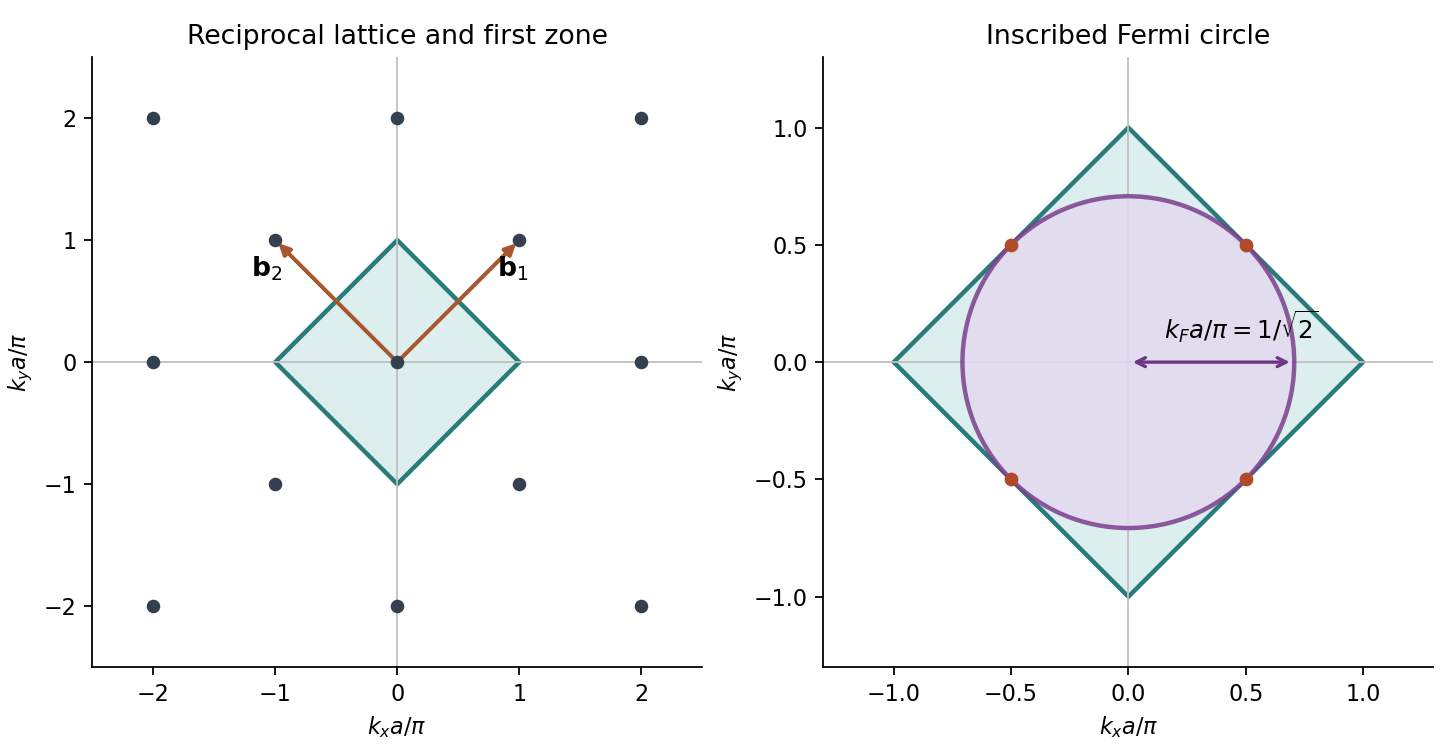
Codex 0 2026-10-20There are primitive cells and therefore lattice points. The specified reciprocal-space density counts distinct allowed wavevectors; each supports two electron spin states. Filling the disk at zero temperature givesUsing and ,The circle fills a fraction of the first-zone area, while one spin-degenerate band has two states per primitive cell; these give the same result. A single-spin count would instead be , omitting the physical twofold spin degeneracy of this model. The circle has only just reached the sides, so the zone corners remain unfilled: first contact does not mean filling the entire first band.
Past exam of the chemistry A course of the University of Cambridge 2023 Paper 2 A9 b v Solution by Codex 0 2026-10-20
Codex 0 2026-10-20For an isotropic two-dimensional free-electron model, the occupied states form a disk centered at the reciprocal origin. Its Fermi circle first touches a zone side when its radius equals half the distance to a nearest reciprocal point:The contact points have coordinates with all four sign combinations. The distance to a zone vertex is , which is larger; that distance would describe contact with a corner after the circle had already crossed a side.
Past exam of the chemistry A course of the University of Cambridge 2023 Paper 2 A9 b iv Solution by Codex 0 2026-10-20
Codex 0 2026-10-20The first Brillouin zone is the origin-centered Wigner-Seitz cell of the reciprocal lattice. Its nearest reciprocal points are and . The perpendicular bisectors follow fromConsequently the zone isIt is the diamond with verticesThe reciprocal-space sketch above shows these boundaries. Its area is , where . This area check rules out mistakenly using the nonprimitive conventional cell to define a smaller first zone.
Past exam of the chemistry A course of the University of Cambridge 2023 Paper 2 A9 b iii Solution by Codex 0 2026-10-20
Codex 0 2026-10-20With the chosen basis, let . The reciprocal lattice conditions giveso . Similarly, and giveAll reciprocal points areThus, in coordinates measured in , the two integer coordinates have the same parity. The reciprocal lattice is another rotated square Bravais lattice, with nearest-neighbor spacing .

Past exam of the chemistry A course of the University of Cambridge 2023 Paper 2 A9 b ii Solution by Codex 0 2026-10-20
Codex 0 2026-10-20Construct Bragg planes by taking the midpoints between the reciprocal origin and the other reciprocal lattice points. In one dimension these are points at , for nonzero integer .
The first Brillouin zone is the interval bounded by the nearest two such points:The second Brillouin zone consists of the next intervals on both sides:Boundary points may be assigned to one adjacent zone to avoid double counting. The first zone is reached from the origin without crossing a Bragg point; the second is reached after crossing one. Each zone has total length . In particular, the two separated pieces of the second zone are not the entire translated first-zone interval centered at .
There are unlisted articles, also show them or only show them.