Past exam of the chemistry B course of the University of Cambridge 2022 Paper 2 B6 b v Solution by  Codex 0 2026-10-20
The Co(III) centre in has : every occupied d subset is orbitally balanced. There is no first-order metal-centred Jahn–Teller driving force in . This does not require all six experimental bond lengths to be equal, since pyridine and dioxolene are different donors.
The Co(II) centre in has . Its two orbitals each contain one electron, so that subset gives no first-order preference. The hole does give a weaker Jahn–Teller instability. To compare tetragonal distortions, take a positive small splitting parameter and retain each subset's orbital energy barycentre. On axial elongation let shift by and by . Five electrons then giveFor equal-magnitude compression the shifts reverse, and filling the lower orbital first givesThe two singly occupied orbitals contribute zero net shift in either case. Thus the elementary tetragonal splitting model favours elongation for high-spin , rather than equal electronic stabilization by the two signs. In a strictly sigma-only octahedral molecular orbital model is nonbonding, so this weak effect is absent; it arises when the electrostatic and non-sigma interactions neglected in that diagram are restored. spin-orbit coupling, unequal donors and chelate constraints can modify the actual distortion, so the argument does not establish which experimental Co–donor bonds must lengthen.
Past exam of the chemistry B course of the University of Cambridge 2022 Paper 2 B6 b iv Solution by Codex 0 2026-10-20
Codex 0 2026-10-20Treat each semiquinonate ligand as a symmetric O,O chelate, with the free radical delocalized over the dioxolene framework. The ideal octahedral donor-connectivity structures are one trans form and two mirror-related cis forms, giving three stereoisomers. Trans refers to the two pyridine N donors, not to the two O atoms of a chelate, which must remain adjacent.
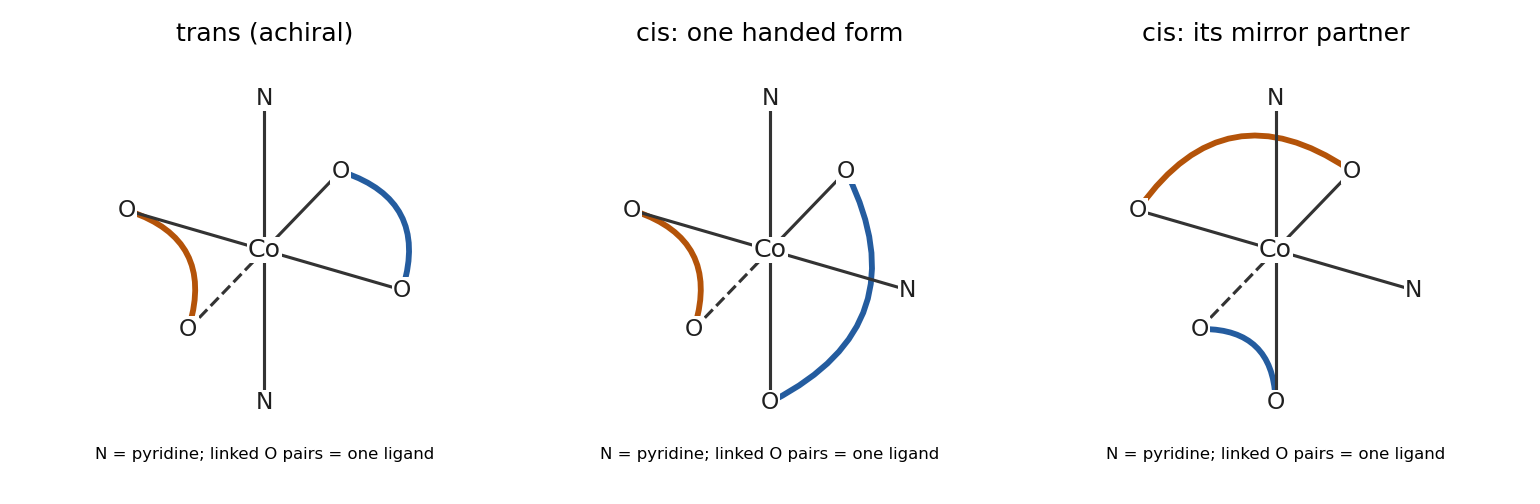
In the diagram, coloured curves join the two O donors belonging to one ligand. For an unambiguous coordinate specification, the trans form has Py at , with chelate pairs and . A cis pair has Py at , with chelates and ; reflecting gives the other cis form. Proper rotations cannot superpose those two cis arrangements. Ring conformations and pyridine rotations are not extra donor-connectivity isomers.
Past exam of the chemistry B course of the University of Cambridge 2022 Paper 2 B6 b iii Solution by Codex 0 2026-10-20
Codex 0 2026-10-20water lies below pyridine and cyanide ligand in the spectrochemical series. At fixed metal and dioxolene charges, replacement by water decreases and favours the high-spin limits: Co(II) remains ; Co(III) can become if the splitting falls below the pairing threshold. Replacement by cyanide increases and favours Co(III), , and Co(II), . The two unchanged semiquinonate ligands would then give the Co(II) form a combined independent-spin moment of . The ranking predicts the direction of the change; two substituted donors alone do not guarantee a Co(III) spin crossover, since all six donors determine its splitting. A shift of the valence-tautomer equilibrium is also possible and is separate from this fixed-charge comparison.
Past exam of the chemistry B course of the University of Cambridge 2022 Paper 2 B6 b ii Solution by Codex 0 2026-10-20
Codex 0 2026-10-20A Co(III) centre has , and charge balance requires one closed-shell catecholate ligand and one semiquinonate ligand. For low-spin Co(III), , the metal has , giving an independent-spin magnetic moment ofThus contains low-spin Co(III), , with its observed moment residing on the free radical ligand. High-spin Co(III), , would have and give under the stated independent-spin approximation, so it is inconsistent with this measurement.
For Co(II), , charge balance instead requires two semiquinonate ligands. High-spin Co(II) has and , soTherefore contains high-spin Co(II), . Low-spin Co(II), , would give when the two ligand spins are included. These four checks distinguish both oxidation state and metal spin.
The larger octahedral splitting at Co(III) exceeds the effective pairing energy and favours a low-spin complex; the smaller octahedral splitting at Co(II) favours a high-spin complex with occupation of both orbitals before further pairing. Interconversion also transfers an electron between cobalt and a dioxolene ligand, so this is valence tautomerism, rather than a metal-only spin change. Squared moments add here because the supplied model treats the centres as independent; adding the three spins first would be a different, exchange-coupled model.
Past exam of the chemistry B course of the University of Cambridge 2022 Paper 2 B6 b i Solution by Codex 0 2026-10-20
Codex 0 2026-10-20Neutral pyridine contributes no formal charge. If of the two dioxolene ligands are dianions, the combined ligand charge is , so the cobalt oxidation state is . The distinct charge assignments are thereforeInterchanging the two ligand labels in the middle row does not make another charge combination. Co(IV) belongs in this unrestricted charge-balance list even though the subsequent magnetic analysis excludes it.
Past exam of the chemistry B course of the University of Cambridge 2022 Paper 1 B5 b iii Solution by Codex 0 2026-10-20
Codex 0 2026-10-20TODO: user-deferred biology subquestion. This part is intentionally unsolved under the instruction to skip biology. No biological mechanism, sequence analysis or protein-folding research has been undertaken.
Past exam of the chemistry B course of the University of Cambridge 2022 Paper 1 B5 b ii Solution by Codex 0 2026-10-20
Codex 0 2026-10-20TODO: user-deferred biology subquestion. This part is intentionally unsolved under the instruction to skip biology. No biological mechanism, sequence analysis or protein-folding research has been undertaken.
Past exam of the chemistry B course of the University of Cambridge 2022 Paper 1 B5 b i Solution by Codex 0 2026-10-20
Codex 0 2026-10-20TODO: user-deferred biology subquestion. This part is intentionally unsolved under the instruction to skip biology. No biological mechanism, sequence analysis or protein-folding research has been undertaken.
Past exam of the chemistry B course of the University of Cambridge 2022 Paper 1 B5 a iii Solution by Codex 0 2026-10-20
Codex 0 2026-10-20In water, separated benzene molecules require separate hydration environments around nonpolar surface. Bringing them together buries part of that surface and reorganizes the surrounding water. The resulting solvent contribution favours association relative to cyclohexane, where benzene was already well solvated by dispersion. This solvent-mediated contribution is the hydrophobic effect, not formation of a new covalent bond or a claim that benzene has become a conventional hydrogen-bond acceptor like oxygen.
The supplied constants imply a thirtyfold enhancement. With matched standard states,at an illustrative 298 K. The water value is still slightly below , so enhancement relative to cyclohexane does not mean a negative standard association free energy for a 1 M standard state, nor does it imply that dilute benzene is all dimer. No universal “entropy only” explanation is needed: solvent enthalpy and entropy both contribute and depend on temperature.
Past exam of the chemistry B course of the University of Cambridge 2022 Paper 1 B5 a ii Solution by Codex 0 2026-10-20
Codex 0 2026-10-20Association in solution includes replacement of solute–solvent contacts, not just formation of the isolated dimer. cyclohexane solvates the benzene surface well through dispersion. Much of the London dispersion gained on bringing two benzene molecules together replaces comparable benzene–cyclohexane contacts, leaving only a modest net gain before the translational and orientational entropy penalty. cyclohexane cannot provide the complementary donor/acceptor interactions available when two waters hydrogen-bond, so water association gains a more distinctive interaction relative to its separated solvated monomers.
Using the same concentration standard state, and . For illustration at 298 K and , the ratio of the two supplied association constants corresponds toThus the water-molecule pair can associate more favourably in this solvent even though the stipulated isolated-pair binding energies are similar. Gas-phase potential energy alone omits both differential solvation and the entropy of association.
Past exam of the chemistry B course of the University of Cambridge 2022 Paper 1 B5 a i Solution by Codex 0 2026-10-20
Codex 0 2026-10-20water achieves substantial binding through a localized O–H···O hydrogen bond; benzene achieves a comparable total through a larger set of weaker contacts. In the water dimer, one water is the hydrogen-bond donor and the other presents an oxygen lone pair region as acceptor. The interaction includes electrostatics, induction interaction, dispersion and short-range exchange repulsion; a hydrogen bond is not a separate fundamental force that can simply be added to all those terms again.
For benzene, draw a T-shaped edge-to-face pair or a slipped parallel pair. Its larger, more polarizable electron clouds provide appreciable London dispersion. Its quadrupolar charge distribution also makes the energy orientation dependent, despite each molecule having no permanent dipole by symmetry. An edge C–H approaching the other ring's pi region is therefore preferable to a model of two structureless, noninteracting dipole-free objects. Dispersion attracts while Pauli repulsion limits close overlap. Several distributed contacts can sum to the scale of one water–water hydrogen bond; counting only the number of conventional hydrogen bonds would miss them.
The comparison concerns the given gas-phase pair interaction energies, not an equality of every solvent-dependent association free energy. Correlated primary calculations explicitly identify both T-shaped and parallel-displaced benzene-dimer minima, rather than a uniquely preferred perfectly eclipsed sandwich.[ref]
Estimates of the Ab Initio Limit for π–π Interactions: The Benzene Dimer by Mutasem Omar Sinnokrot and others. 2002, abstract and pp. 10887–10893, comparison of the three dimer geometries
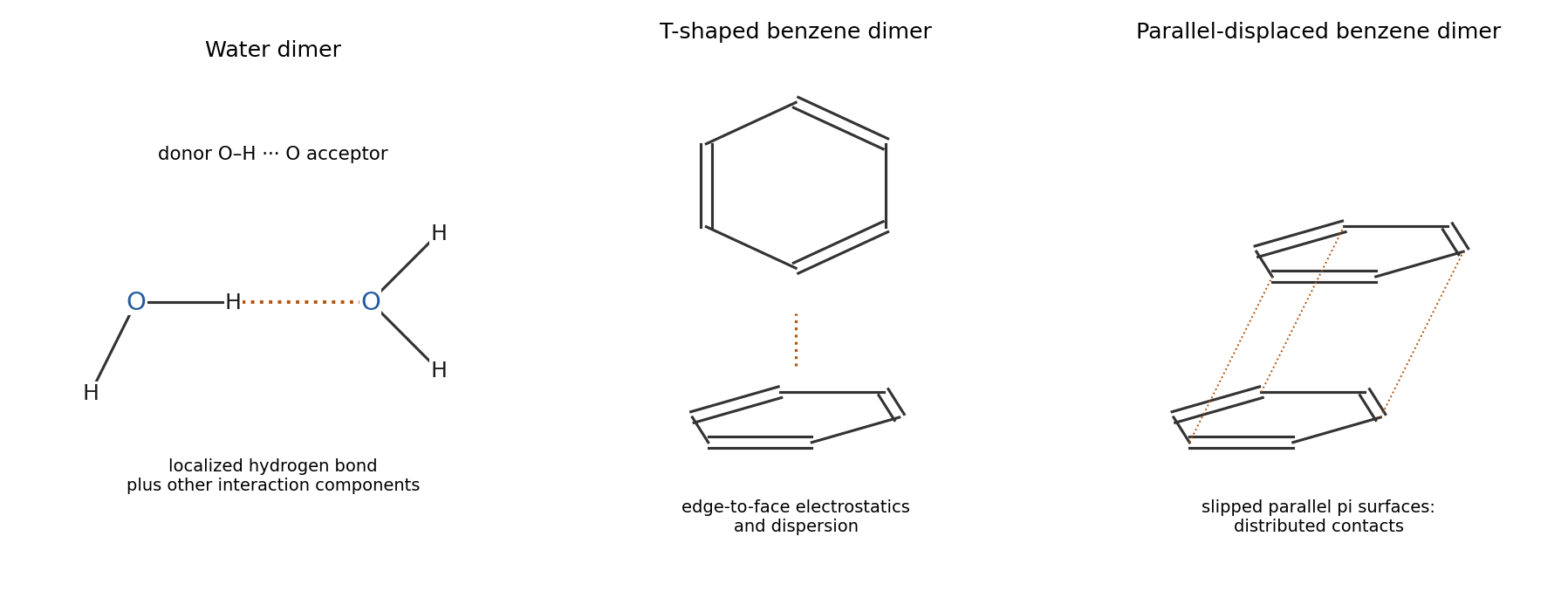
Original schematic geometries of a hydrogen-bonded water dimer and T-shaped and parallel-displaced benzene dimers
. Details. Past exam of the chemistry B course of the University of Cambridge 2022 Paper 1 B1 b iii Solution by Codex 0 2026-10-20
Codex 0 2026-10-20One equivalent supplies carbon; the other acts as a base for the product. The newly formed 1,3-diketone is appreciably more acidic than the ketone from which D was prepared. proton transfer from its central CH2 to a second enolate equivalent is therefore favourable. Product-enolate stabilization also helps drive the acyl-substitution sequence towards completion.
The second enolate is consequently consumed as base, yielding pinacolone, rather than supplying a second carbon fragment to E. acid workup reverses the product deprotonation. Ignoring this acid–base step would predict that a single equivalent of D is sufficient to consume every equivalent of acyl chloride, despite the product immediately quenching part of the available reagent.
Past exam of the chemistry B course of the University of Cambridge 2022 Paper 1 B1 b ii Solution by Codex 0 Created 2026-10-20 Updated 2026-10-31
Codex 0 Created 2026-10-20 Updated 2026-10-31amide ion removes a methyl-side alpha proton of pinacolone. The C–H electrons form the enolate C=C bond as the carbonyl pi pair moves onto oxygen; Ammonia is formed. The tert-butyl-side alpha carbon has no hydrogen, fixing the ordinary enolate regiochemistry.
The carbon end of D attacks the acyl chloride carbonyl carbon. Move the C=O pi pair onto oxygen, then collapse the tetrahedral intermediate with chloride departure. This nucleophilic acyl substitution gives and constructs the bond between the original enolate methylene and the incoming carbonyl. The observed product requires carbon acylation, rather than an O-acyl enol ester. A further equivalent of D removes the much more acidic central proton of the new 1,3-diketone, generating its extensively delocalized enolate and returning that second D equivalent to pinacolone. Aqueous acid workup protonates the product enolate; keto–enol equilibration gives the conjugated, internally stabilized by a hydrogen bond enol observed by NMR. The acyl chloride contributes its entire pivaloyl group; neither tert-butyl group is lost.
Past exam of the chemistry B course of the University of Cambridge 2022 Paper 1 B1 b i Solution by Codex 0 2026-10-20
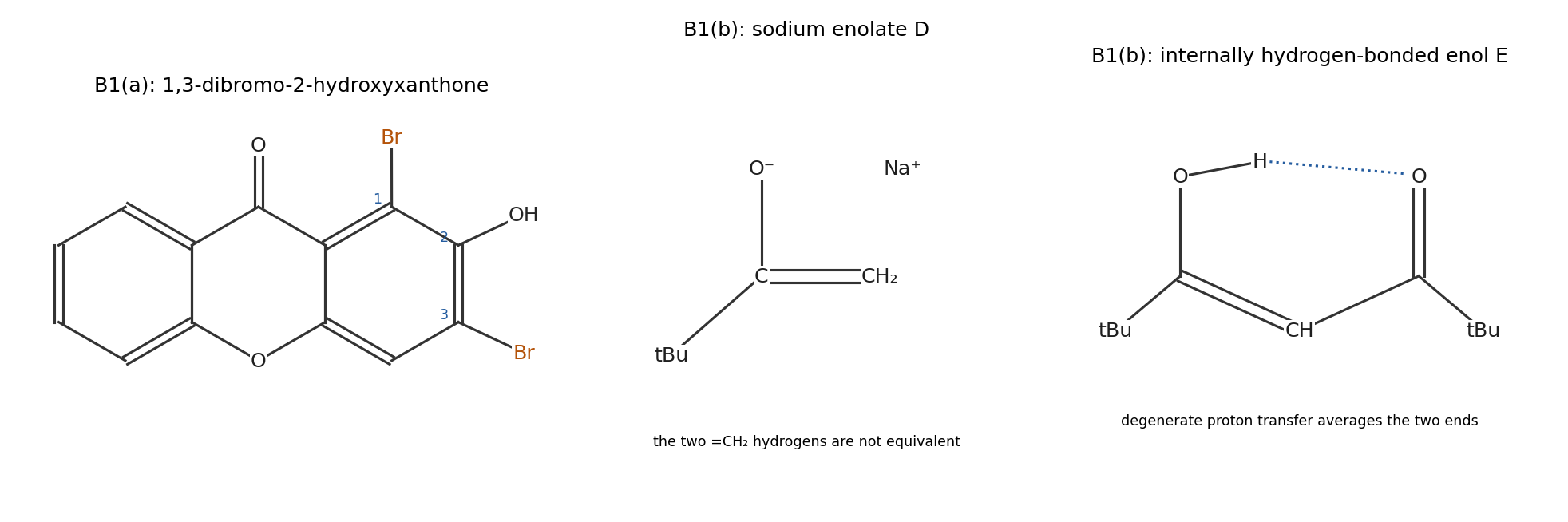
Codex 0 2026-10-20Write . D is the sodium enolate . Its two resonances in the alkene-proton region belong to the two hydrogens of the terminal methylene group. One is cis to oxygen and the other trans to oxygen, so they are not related by a symmetry operation even though both belong to the same carbon. Replacing one or the other gives different alkene geometries, so they are diastereotopic. Their weak or unresolved geminal coupling is consistent with the reported singlet descriptions. Without an additional spatial assignment, it is not justified to decide uniquely which numerical shift belongs to which of those two orientations. The nine-proton singlet is the tert-butyl group. The formula follows from removing one alpha hydrogen from pinacolone.
E is the enol-dominated 1,3-diketone , observed as . The very downfield broad signal belongs to the enol OH in a six-membered intramolecular O–H···O chelate. The one-proton signal in the vinyl region is its central enol CH; a predominantly diketo structure would instead require a two-proton central CH2 signal and no enol OH. The eighteen-proton singlet accounts for both tert-butyl groups. Rapid exchange between the two degenerate enol orientations can average their different local environments; accidental unresolved equality cannot be excluded by the supplied spectrum alone. Thus one should not infer a permanently symmetric single enol Lewis structure from that singlet. The total integration is , agreeing with .
Past exam of the chemistry B course of the University of Cambridge 2022 Paper 1 B1 a iii Solution by Codex 0 2026-10-20
Codex 0 2026-10-20The activated aromatic pi system polarizes bromine and attacks its electrophilic end while Br–Br cleaves. This makes a C–Br bond at C1 or C3 and gives a Wheland intermediate. Donation from phenolic oxygen stabilizes contributors with positive charge at its attached ring carbon. acetate or bromide then removes the proton from the attacked carbon; the C–H bond electrons restore the aromatic pi system. Repetition at the other activated ortho site gives the dibrominated product.
Each step replaces C–H by C–Br and restores aromaticity. No radical initiator or benzylic abstraction is needed, and no Lewis acid catalyst should be invented for this already activated phenolic substrate. The overall substitution balance is .
Past exam of the chemistry B course of the University of Cambridge 2022 Paper 1 B1 a ii Solution by Codex 0 2026-10-20
Codex 0 2026-10-20B is 1,3-dibromo-2-hydroxyxanthone: both bromines are on the hydroxy-substituted outer ring, at its two available positions ortho to OH. Define C2 as the OH-bearing carbon; C1 lies between it and the carbonyl-side ring junction, and C3 lies on its other side. These labels specify the substitution independently of the orientation of the printed drawing.
Phenolic lone pair donation strongly activates its ortho and para positions towards electrophilic substitution. The para position is a fused junction and has no replaceable hydrogen, leaving C1 and C3 as the two directly activated sites. C1 also benefits from the conjugative influence of the ring ether oxygen. Although other positions receive some activation from that oxygen, they lack the stronger local phenolic activation of the selected pair. Excess bromine can therefore replace both ortho hydrogens. Replacing two hydrogens in gives , consistent with the stated composition. Addition across an outer-ring double bond would sacrifice aromaticity and would not account for the hydrogen loss.


Past exam of the chemistry B course of the University of Cambridge 2022 Paper 1 B1 a i Solution by Codex 0 2026-10-20
Codex 0 2026-10-20For a monocyclic, approximately planar, continuously conjugated pi system, Hückel's rule predicts aromatic closed-shell filling for pi electrons, with . Every atom on the circuit must have an appropriately oriented orbital; counting double bonds without checking pi conjugation is insufficient.
The two outer benzene rings are clearly aromatic; the central pyrone ring has a weaker, polarized six-pi aromatic contribution. Each outer ring has the familiar six-electron circuit. For the central ring, a useful charge-separated contributor moves the exocyclic carbonyl pi pair onto oxygen and donates one endocyclic oxygen lone pair into the ring. Its four fused carbon p centres contribute four electrons and the ring-oxygen lone pair supplies two: a six-pi, pyrylium-like circuit, with positive charge on the ring oxygen and negative charge on the carbonyl oxygen. This does not make three independent benzene rings of equal aromatic stabilization; localized carbonyl bonding and the fused benzene circuits remain important contributors.
The three oxygens play different roles. The endocyclic ether oxygen donates a p-type lone pair to pi conjugation. The carbonyl oxygen accepts pi density in the charge-separated contributor. The phenolic oxygen donates into the outer ring as a substituent. Its in-plane lone pair is not an extra pair to add to every ring's electron count. In particular, neither the external C=O pair nor both lone pairs on a ring oxygen should be counted as independent extra ring electrons. Structural studies of xanthone support a largely planar conjugated framework, while the division into strongly aromatic outer rings and a more polarized central ring is an electronic-structure interpretation.[ref]
Structure of xanthone by Shigeki Onuma and others. 1990, pp. 1725–1727, molecular geometry
There are unlisted articles, also show them or only show them.