Past exam of the physics course of the year 1 of the natural sciences course of the University of Cambridge 2014 Paper 1 E14 Solution by  Codex 0 2026-10-20
An inverse-square field spreads through area proportional to squared distance. More generally the flux contribution of a point source is proportional to the solid angle subtended by a surface element; the oriented solid angles sum to for an enclosed source and zero for an exterior one. Superposition extends this to a mass distribution.
Newton's law of universal gravitation gives for a point mass. A surrounding sphere therefore has flux , soFor the tunnel, approximate its water as an infinite uniform cylinder with and density . The bob is at radial distance . A coaxial Gaussian surface givesFor the plumb-line deflection from cylindrical gravity, horizontal equilibrium gives . Draining removes the attraction toward the tunnel, so the bob shifts away byThe unchanged rock and ordinary gravitational field cancel in the before/after comparison; end effects and mechanical disturbances are neglected.
For the tidal water loading of a spring balance, approximate the extra water at high tide as an infinite plane slab of thickness , with the suspended mass above it. The gravitational field of an infinite plane sheet, derived with a pillbox Gaussian surface, gives added downward field . With initial spring extension ,The extension increases at high tide. These estimates use and the stated water-density approximation; salinity, finite estuary geometry and terrestrial tidal deformation alter a real measurement.
Past exam of the physics course of the year 1 of the natural sciences course of the University of Cambridge 2014 Paper 1 D13 Solution by Codex 0 2026-10-20
Codex 0 2026-10-20Represent each wave by a complex phasor. Add phasors before squaring: two amplitudes give . For equally illuminated narrow slits, adjacent phasors differ by , soAll phasors align when , giving the grating equationThe nearest zero has adjacent-phase increment : the phasor polygon closes once. Thus , givingThe angular linearization is valid away from grazing directions; the underlying exact first-zero condition is .
For the first subsidiary maximum of a large slit array, use the stipulated phasor wraps: relative to a principal maximum. Its amplitude is approximately times one slit's amplitude. ThereforeThis uses the question's approximate maximum position, not the exact extremum of the slit-array intensity.
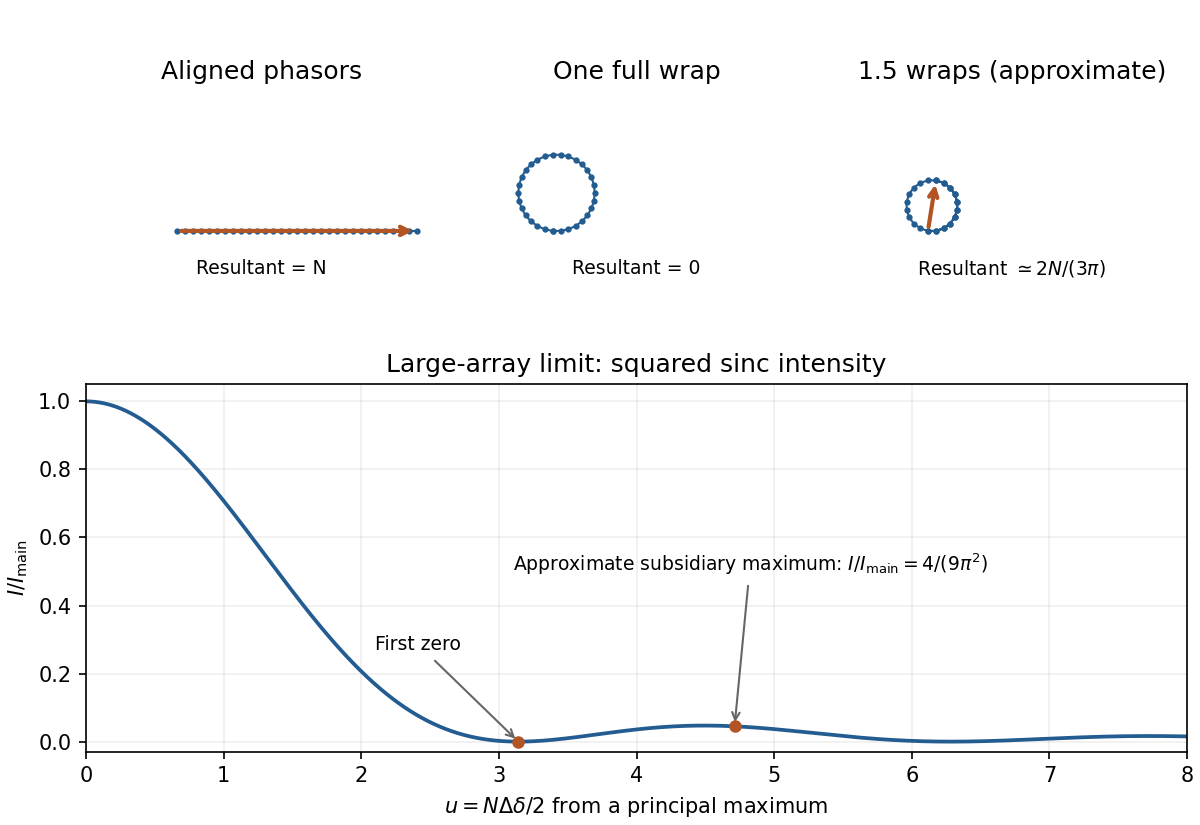
Original phasor sums for a principal maximum, the adjacent zero and the approximate first subsidiary maximum; calculated large-array intensity shown below
. Details. 
The Rayleigh criterion places one line's principal maximum at the other's first minimum. Grating dispersion then gives . Combining with normal incidence, , gives the normal-incidence grating width bound:The value is an ideal lower bound approached near grazing diffraction. A usable finite angle needs greater width; for example requires about . The exact sine first-zero relation still gives the lower bound when the local angular approximation fails near grazing.
Such a coherently illuminated grating is very large and needs accurate groove placement and suitable collection optics; an unaided far-field screen would require distances much greater than . Focusing optics avoid that screen distance but not the required resolving power of a diffraction grating. Real linewidth, slit width and aberrations can require more resolution. The unequal isotope abundances also make this ideal Rayleigh estimate less decisive than for equally bright lines.
There are unlisted articles, also show them or only show them.