For a particle of rest mass , and , with . The low-speed expansion is , separating invariant rest energy from the nonrelativistic kinetic energy term.
Conserve the total laboratory energy and momentum at coalescence: and . Since , the combined particle moves at . Its rest mass is . The incident particle is not of mass : its stated energy and momentum imply . ThusThe extra is internal rest energy retained by the composite after a perfectly inelastic collision; total energy and four-momentum are conserved, while the sum of individual rest masses need not be.
The composite's Lorentz factor is . For a rest-frame lifetime , the corresponding laboratory time is and its travel distance isIf denotes a mean radioactive lifetime, this is the mean flight distance, not a fixed distance for every decay. The separate frame diagrams below use the common positive collision axis.
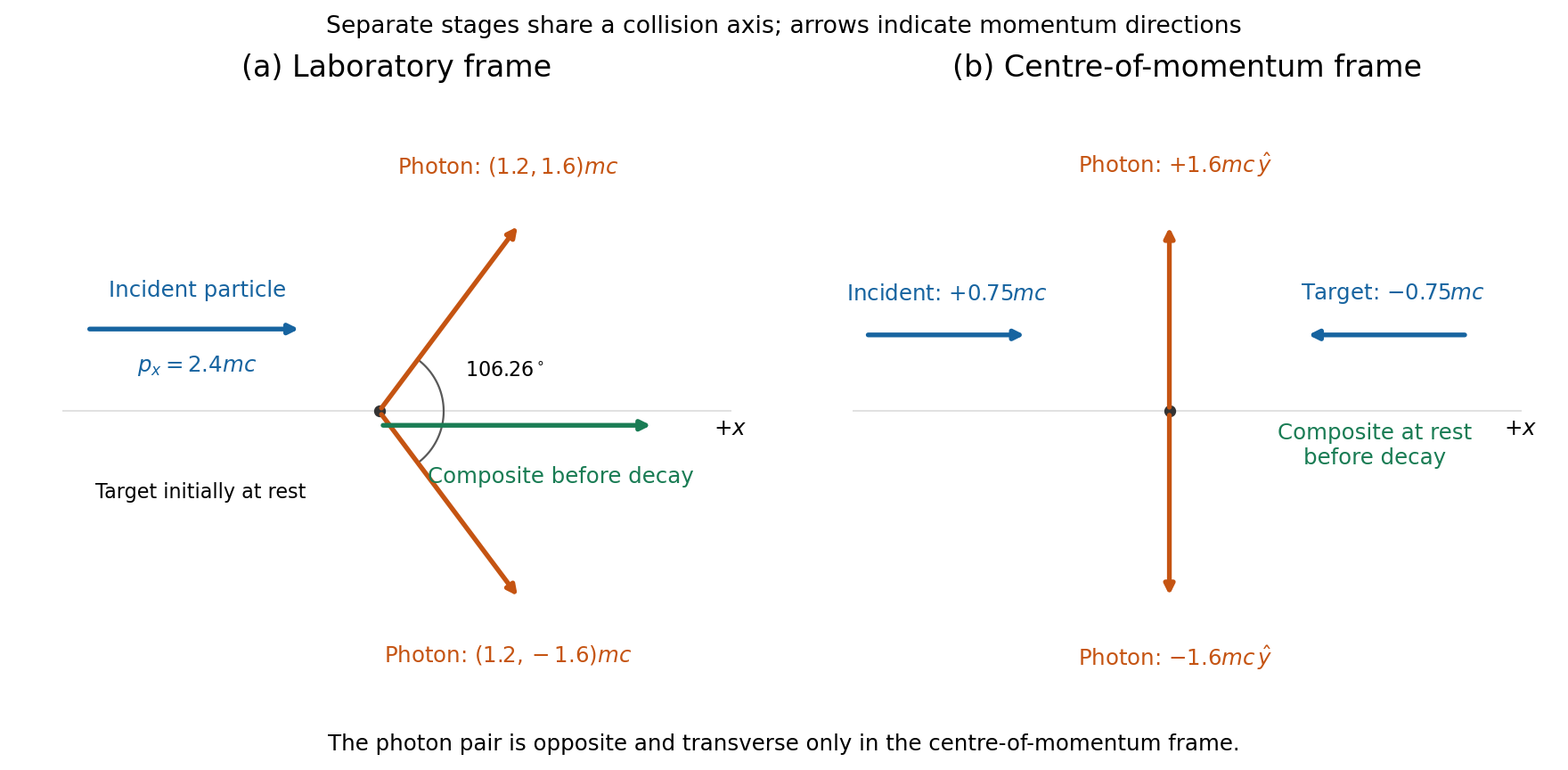
Original momentum-direction diagrams for the laboratory and centre-of-momentum frames, with equal-energy photons and the composite at rest in its own frame
. Details. 
In the laboratory frame the incoming particle and the composite move along , while the target is initially at rest. In the equal-energy two-photon decay of a moving particle, zero total transverse momentum makes the two photon directions symmetric about . Each photon has energy and momentum magnitude , so longitudinal momentum conservation gives . ThereforeTheir momenta can be written . The opening angle is not in this frame, because the parent carried nonzero total momentum.
Boost along at into the centre-of-momentum frame. The composite is stationary. The incoming particle has , while the target has . After decay the two photons have energies and opposite momenta.
Equal laboratory photon energies require the rest-frame photons to have zero momentum component along the boost: must be equal for two opposite photons. Their directions are therefore and in the centre-of-momentum diagram, perpendicular to the incoming collision axis. Boosting those transverse photons gives exactly the laboratory momenta in part (a). A stationary composite has no direction-of-travel arrow in this frame.
Articles by others on the same topic
There are currently no matching articles.