Past exam of the physics course of the year 4 of the natural sciences course of the University of Cambridge 2014 Paper 1 B8 Solution by  Codex 0 2026-10-20
Here is magnetic field intensity, free electric current density, and electric displacement. In vacuum, and . Integrating the equation gives Ampère's circuital law with displacement current; in a steady state the displacement term vanishes.
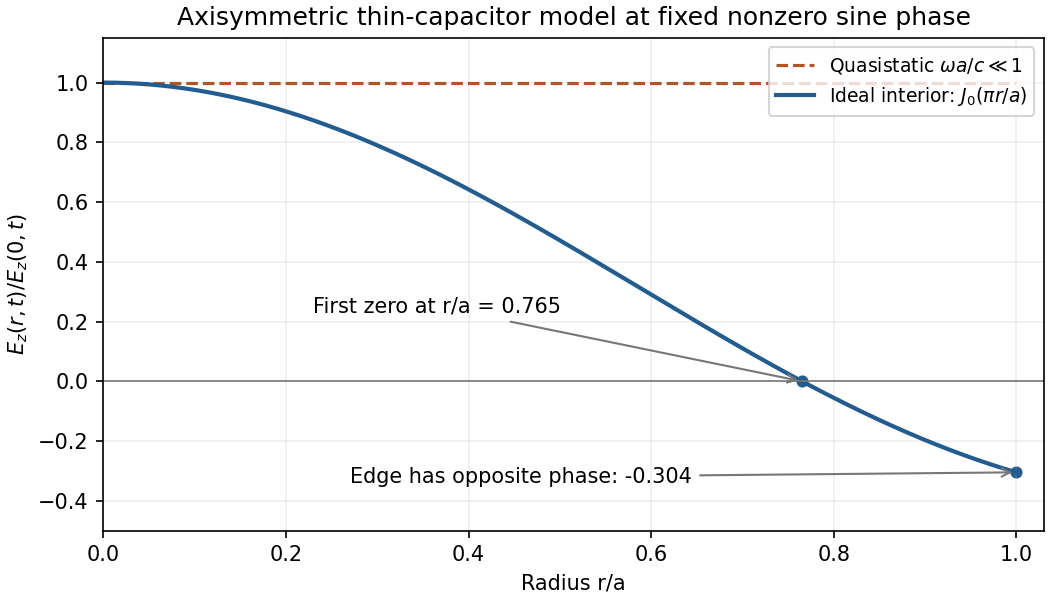
Take upward and define . Neglect fringing and use the low-frequency thin-capacitor approximation. ThenInside the gap, a circular Ampère loop encloses only displacement current:Because , the Poynting vector isIt points inward while the electrical energy is increasing and outward while it decreases. The net power entering the curved side isThis is the leading quasistatic energy balance. The time-averaged field energies areFor the axisymmetric high-frequency capacitor field when is not small, induction and radial propagation prevent a spatially uniform . In an ideal axially uniform axisymmetric interior model, Faraday's and Ampère's equations giveThe solution regular at the axis and normalized to the central voltage is approximatelyAt , the radial profile is : its first zero is at , and the edge has opposite phase, . This is an illustrative thin-disc interior profile; the exact driven high-frequency field also depends on the feed and edge/radiation boundary conditions. Continuing the uniform quasistatic field would be inconsistent.
Past exam of the physics course of the year 4 of the natural sciences course of the University of Cambridge 2014 Paper 1 B7 Solution by Codex 0 2026-10-20
Codex 0 2026-10-20Fresnel diffraction retains quadratic aperture-dependent propagation phases and generally depends on both aperture and screen distance. Fraunhofer diffraction neglects those phases and gives the Fourier transform of the aperture in angle space, either sufficiently far away or in a suitable lens's focal plane.
The calculations below use the Fraunhofer, paraxial approximation. For an overall aperture scale , free propagation requires . The printed alone only makes the separation small relative to distance; it is not by itself the full far-field condition.
Past exam of the physics course of the year 4 of the natural sciences course of the University of Cambridge 2014 Paper 1 B6 Solution by Codex 0 2026-10-20
Codex 0 2026-10-20A normal mode is a motion in which all generalized coordinates oscillate at one frequency with fixed amplitude ratios. Small oscillations about stable equilibrium in a time-independent conservative system give , with positive mass matrix and symmetric stiffness matrix, allowing a generalized normal-mode eigenproblem.
For the three-to-one mass double-pendulum modes, the angles are absolute displacements from vertical, as printed. To quadratic order,For and , the determinant isThusThe low mode has the strings leaning together, with the lower angle twice as large; the high mode has opposite angular signs. Both reverse together after half their respective periods.
For the specified release, decompose . Thereforeand the lower mass's horizontal displacement isThis is the supremum of two incommensurate harmonic modes, conventionally described as the maximum-amplitude estimate. Strictly, is irrational, so the opposite cosine extrema are approached arbitrarily closely but never coincide at a finite time. The quoted value is a supremum of the ideal linearized motion.
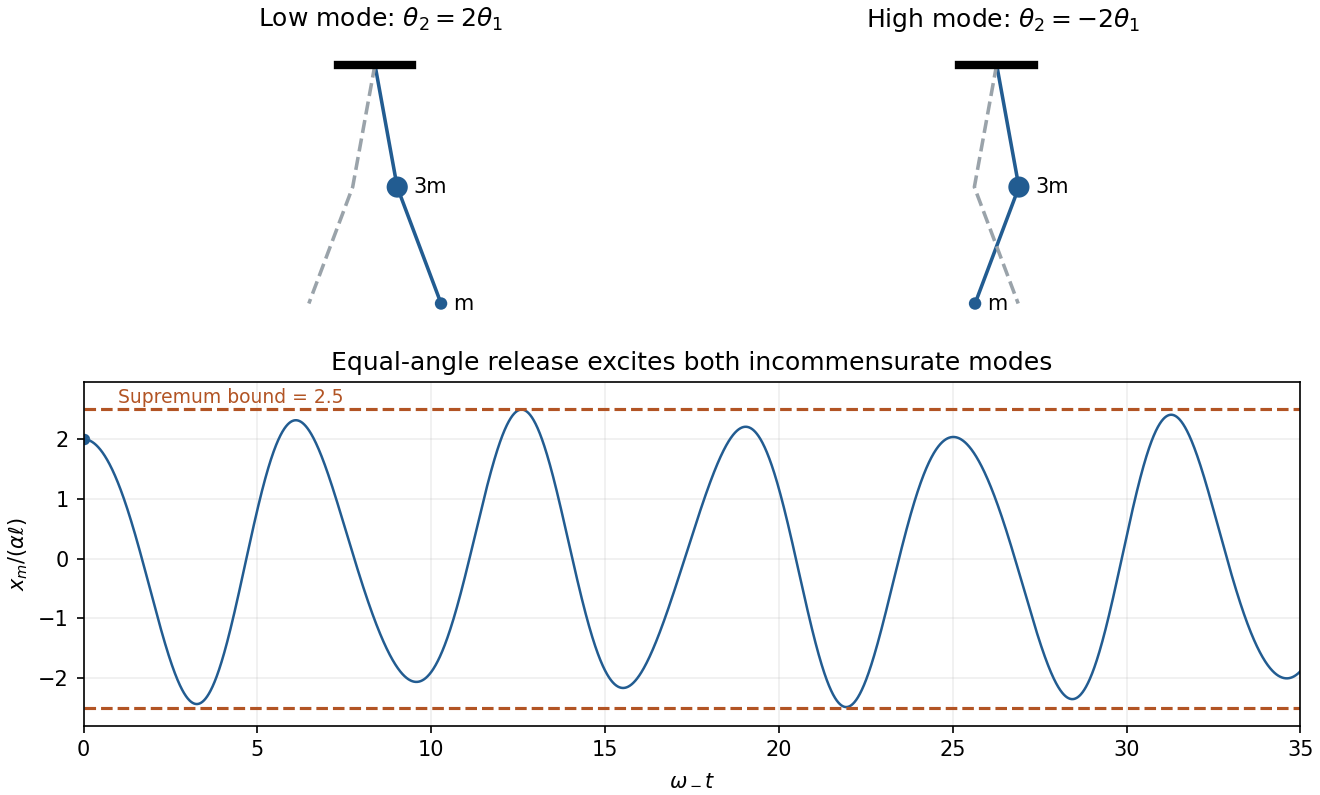
Original normal-mode motion sketches and the lower-mass displacement after equal-angle release, with the limiting amplitude bound marked
. Details. Past exam of the physics course of the year 4 of the natural sciences course of the University of Cambridge 2014 Paper 1 B5 Solution by Codex 0 2026-10-20
Codex 0 2026-10-20The method of images replaces conductors by fictitious charges outside the physical solution domain. Choose images so the real-plus-image potential obeys the specified conductor boundary values. The electrostatic uniqueness theorem then identifies that potential in the physical domain; fields inside the replaced conductor are not physical predictions.
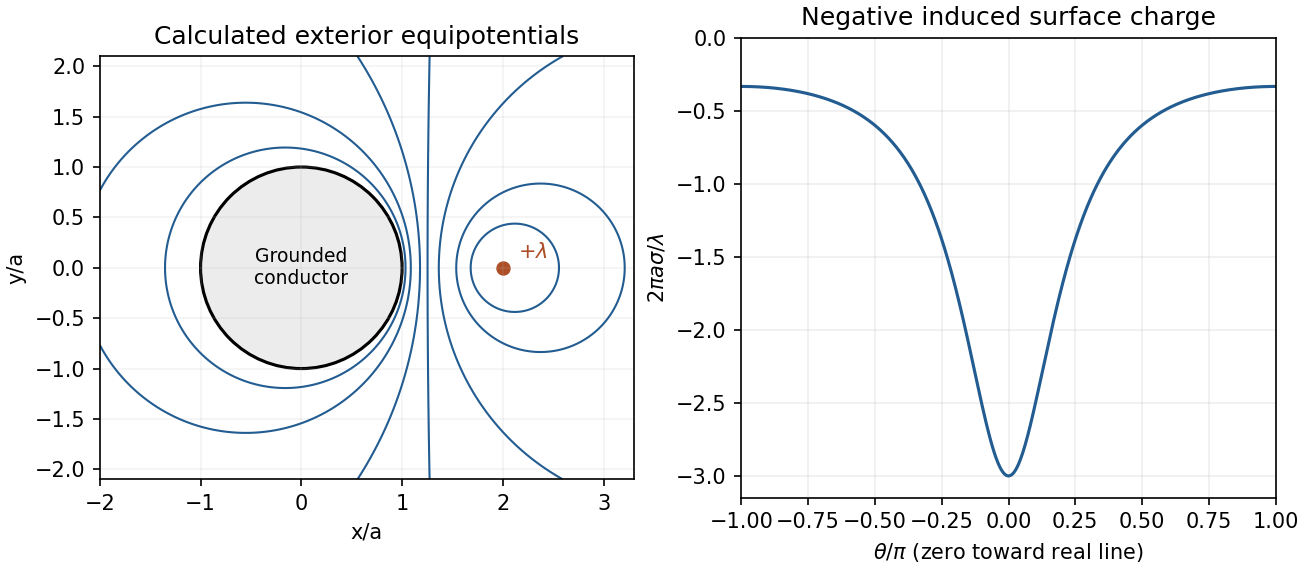
Put the cylinder axis at the origin, real line at and image at . Let be distances from these lines. The exterior potential can be writtenOn the surface, and , so everywhere as required. The additive constant is essential for a grounded cylinder; the two-dimensional potential need not also be zero at infinity.
The physical line feels the image field at separation . Its force per unit length is attractive:Measure from the radius toward the real line, as in the original diagram. The radial field just outside the surface isSince the interior field is zero,Integrating around the circumference gives total induced charge per unit length.


There are unlisted articles, also show them or only show them.