Past exam of the chemistry B course of the University of Cambridge 2023 Paper 1 B1 a Solution by  Codex 0 2026-10-20
Number the ring with chlorine at C1 and the methylsulfonyl group at C4. The new nitro group is at C2, equivalently C6 by the starting ring's symmetry: the product is 1-chloro-2-nitro-4-(methylsulfonyl)benzene. Both substituents favour this site. Although chlorine deactivates the ring inductively, its lone pair donation stabilizes ortho/para Wheland intermediates. The sulfone is strongly electron withdrawing and meta directing; attack ortho or para to it produces especially unfavourable cationic contributors to resonance in chemistry. C2 is ortho to chlorine and meta to sulfone, whereas C3 has the opposite, less favourable relationship.
sulfuric acid protonates nitric acid, followed by loss of water to produce the nitronium ion. A ring pi bond attacks nitrogen, giving the Wheland intermediate with the new C–N bond. deprotonation at the attacked carbon restores aromaticity. This is electrophilic aromatic substitution: the aryl chloride and the sulfone both remain attached. The formula check is . It confirms replacement of one ring hydrogen rather than chlorine, but directing effects, rather than the formula alone, establish the position.
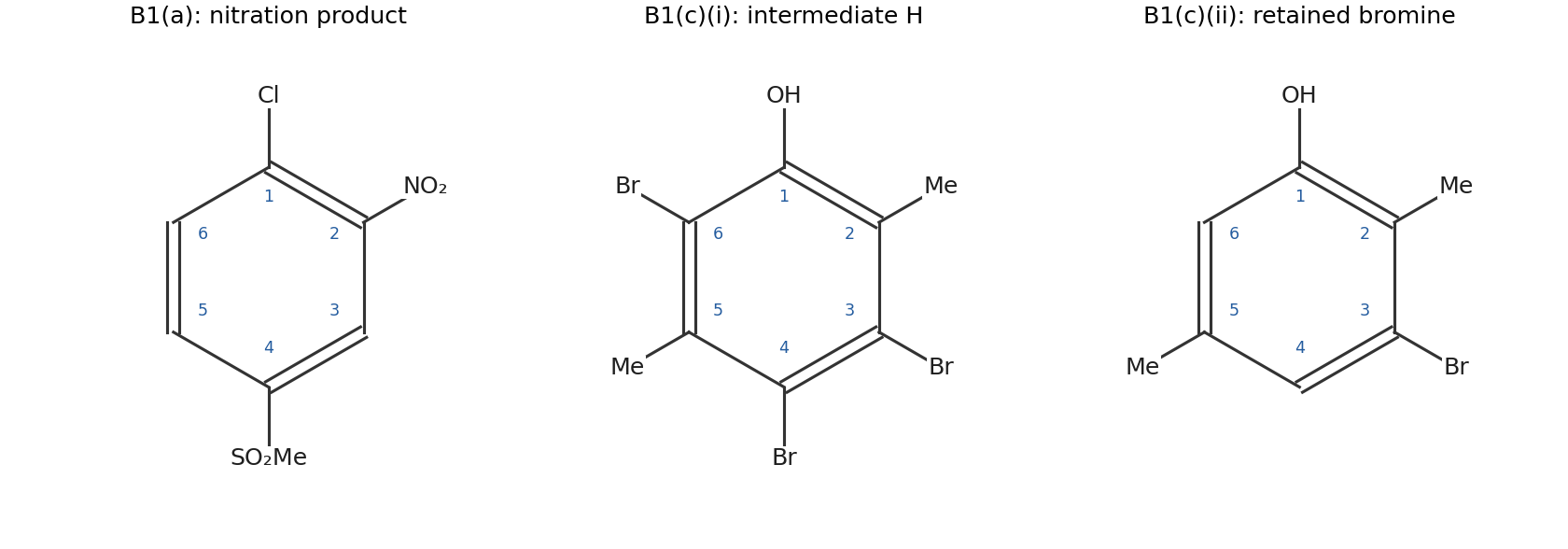
Independently drawn aromatic substitution products and the sites selected by protodebromination
. Details. 
Past exam of the chemistry B course of the University of Cambridge 2022 Paper 2 B9 e Solution by Codex 0 2026-10-20
Codex 0 2026-10-20A reasonable product is sodium facial trimetaphosphate–molybdenum tricarbonyl, with the anionOne terminal O from each phosphorus binds Mo; the three O donors occupy one octahedral face, while the three carbonyls occupy the opposite face. The ring bridges remain P–O–P bridges and are not replaced by Mo–P bonds. Mo remains Mo(0), , and electrons. Overall,acetonitrile can transiently replace CO during heating, but it is not required in the final six-coordinate proposal. The same anion has been structurally characterized with a different counterion: that primary study independently supports the facial O/CO connectivity, without establishing identical solubility or yield for the sodium salt.[ref]
Synthesis and characterization of the trimetaphosphate molybdenum tricarbonyl anion [(P3O9)Mo(CO)3]3- as its tris(bis(triphenylphosphine)iminium) salt by Christopher R. Clough and others. pp. 195–196, Scheme 2 and Fig. 1; §4.3 for Mo(CO)6 in refluxing acetonitrile
Past exam of the chemistry B course of the University of Cambridge 2022 Paper 2 B9 d Solution by Codex 0 2026-10-20
Codex 0 2026-10-20Three PO tetrahedra share corners in a ring. Each phosphorus has two ring-bridging oxygens and two terminal oxygens, sois one conventional Lewis representation of trimetaphosphate. Its three P and nine O atoms consist of three bridging and six terminal O atoms. Within each phosphate unit the two terminal bonds have delocalized character; drawing one P=O and one P–O is not a claim that every free anion has permanently different terminal oxygens.
A puckered six-membered P–O ring is expected. The tetrahedral phosphorus geometry and P–O–P torsional preferences allow folding without losing a required continuous perpendicular-p orbital system. This differs from the planar trigonal-boron arrangement. Tetrahedral P alone is not a geometrical proof of nonplanarity, since its two ring bonds could lie in a plane; the argument is that puckering is energetically accessible and relieves conformational strain without sacrificing a strong planar pi-conjugation benefit. The precise chair-like or boat-like distortion depends on environment and counterions.
Past exam of the chemistry B course of the University of Cambridge 2022 Paper 2 B9 c Solution by Codex 0 2026-10-20
Codex 0 2026-10-20Join three trigonal BO units corner to corner. The resulting alternating six-membered B–O ring has one terminal oxygen on each boron:The superscript records the total charge; the three explicit O labels each carry one share of it. Atom counting gives three B, three bridging O and three terminal O. Boron is three-coordinate and approximately trigonal planar. The original structure diagram shows the ring connectivity and terminal atoms.
A planar arrangement permits the perpendicular empty boron p orbitals to accept pi donation from suitable oxygen lone pairs. The terminal oxygens can donate effectively toward one boron, giving their B–O linkages more multiple-bond character and explaining why they are shorter than bridging B–O linkages. A bridging oxygen shares its interactions between two boron centres. An approximately planar ring is therefore expected from the trigonal units and favourable orbital alignment. This reasoning does not require describing the entire anion as benzene-like with an assumed six-electron aromatic ring; the oxygen lone pairs and terminal donations must actually be counted before making an aromaticity claim.
Past exam of the chemistry B course of the University of Cambridge 2022 Paper 2 B9 b Solution by Codex 0 2026-10-20
Codex 0 2026-10-20The larger value for the carbonyl bond means that its dissociation costs more for the supplied comparison. A carbonyl combines a strong sigma bond with efficient pi overlap between spatially compatible C 2p and O 2p orbitals. This gives a substantial localized multiple-bond contribution.
The short P–O linkage in a phosphine oxide is also strong, but it is more polar, with a substantial contribution. P 3p and O 2p orbitals have less favourable radial and energy matching than C 2p/O 2p for a simple localized pi bond. oxygen donation into P–R antibonding orbitals adds stabilization, but it is not identical to the carbonyl pi bond. Therefore the formal double-bond notation does not imply equal bond strength. A substantial P-3d contribution is not needed to explain the bonding. The stated bond-dissociation values compare complete dissociation processes, so their magnitudes should not be derived solely from one overlap integral or from the two atoms' electronegativity difference.
Past exam of the chemistry B course of the University of Cambridge 2022 Paper 2 B8 b Solution by Codex 0 2026-10-20
Codex 0 2026-10-20Use ionic electron counting, counting each ordinary donor atom once and keeping ligand charge distinct from denticity. A is 16-electron, B is 14-electron and C is 16-electron, so none is an 18-electron complex under this convention.
A contains a modified, monoanionic PNP pincer: the exocyclic double bond and altered pyridine-ring bond pattern in the drawing matter. Its two phosphines and its central N donor provide six electrons altogether, while neutral N provides two. Neutrality then gives Co(I), , and . Treating the modified pincer as a neutral intact pyridine ligand would incorrectly produce Co(0) and a 17-electron count. A four-coordinate approximately square planar molecular geometry in a complex can leave the strongly sigma-antibonding orbital empty and be stable at 16 electrons. The underlying modified-pincer chemistry has been examined using structure, spectroscopy and electronic-structure calculations.[ref]
Four-Coordinate Cobalt Pincer Complexes: Electronic Structure Studies and Ligand Modification by Homolytic and Heterolytic Pathways by Scott P. Semproni and others. JACS 136, 9211–9224; modified PNP framework and dinitrogen derivative
B has a neutral tertiary amine donor at the centre of its tripod and three anionic amido arms. Their combined charge is , so Re is Re(III), . The four N donors give eight electrons and N gives two: . Such an electron count is not inherently unexpected in an amido-supported complex: strong amido pi donation and the imposed five-coordinate geometry alter the orbital energies, and the empty orbitals are not nine equivalent slots that must all be filled. Steric protection and chelation also help stabilize this coordinatively restricted structure. The 14-electron figure uses the usual two-electron ionic count for each amido donor; pi bonding should not be appended to it inconsistently.
C has an anionic acyl carbon donor and a neutral phosphine in the chelate, together with two neutral PMe donors. Thus Co(I), , receives ligand electrons, giving . This is again a reasonable four-coordinate structure. The acyl C=O is part of a carbon-bound acyl ligand, not an additional free CO donor.
Past exam of the chemistry B course of the University of Cambridge 2022 Paper 2 B7 d Solution by Codex 0 2026-10-20
Codex 0 2026-10-20The anionic nitrogen donor replaces iodide to giveHere Cp denotes cyclopentadienyl and specifies attachment through the ring nitrogen of the pyrrolyl anion, . Fe(II), , receives six electrons from Cp, four from the two CO ligands and two from an N-bound pyrrolyl ligand: .
Two coupled CO stretching modes, approximately symmetric and antisymmetric combinations, account for the two strong carbonyl-region absorptions. The bent two-CO arrangement of this piano-stool complex permits both combinations to be infrared active. They are not evidence for two different chemical products.
Heating expels two CO molecules and changes the binding of the pyrrolyl ligand from to , giving the sandwich azaferrocene,The four electrons lost with CO are replaced by the four additional electrons donated on changing the hapticity of the pyrrolyl ligand. Thus is also Fe(II), , and 18-electron: . Each complex has one time-averaged Cp proton environment, two pairs of protons from the pyrrolyl ligand, one adjacent to N and one farther from N. Hence three proton environments, with integrals , fit both structures. For proton nuclear magnetic resonance, three signals means three chemical shift environments; the individual resonances can still show coupling.
There are unlisted articles, also show them or only show them.