Past exam of the chemistry B course of the University of Cambridge 2022 Paper 2 B7 c Solution by  Codex 0 2026-10-20
Oxidizing cobaltocene removes its antibonding nineteenth electron and gives the particularly favourable 18-electron cobaltocenium cation. iodine can accept the electrons, giving cobaltocenium iodide at the simple stoichiometryEach cobalt changes from Co(II), , to Co(III), ; each iodine atom changes from 0 to . Excess iodine can change the isolated counterion to a polyiodide such as . In contrast, oxidation of 18-electron ferrocene would remove an electron from its occupied closed-shell manifold to form 17-electron ferrocenium. iodine is insufficient to drive that reaction under the conditions implicit here. ferrocene can still be oxidized by suitable stronger oxidants; an electron count is a useful rationale for the comparative redox behaviour, not a universal proof of a numerical electrode potential.
Past exam of the chemistry B course of the University of Cambridge 2022 Paper 2 B7 b Solution by Codex 0 2026-10-20
Codex 0 2026-10-20In ionic counting, two cyclopentadienyl anions donate electrons. Therefore ferrocene, cobaltocene and nickelocene contain 18, 19 and 20 valence electrons, respectively: Fe(II) is , Co(II) and Ni(II) . ferrocene fills the bonding and approximately nonbonding levels while leaving the next metal–ring antibonding pair empty. cobaltocene and nickelocene add one and two electrons to that antibonding set.
Increasing antibonding occupation lowers the net metal–ring bond order. It therefore explains the simultaneous increase in M–C distance and decrease in dissociation enthalpy from Fe to Co to Ni. The trend does not follow the shrinking size of the isolated metal ions; the orbital occupation is decisive here. The specified enthalpy separates the entire sandwich into a gaseous metal dication and two gaseous ring anions. It measures that complete ionic dissociation process, not ten independent localized M–C bond energies, so dividing it by ten is not a justified bond-energy determination.
Past exam of the chemistry B course of the University of Cambridge 2022 Paper 2 B6 c Solution by Codex 0 2026-10-20
Codex 0 2026-10-20Four equivalents of base remove the four carboxylic-acid protons from two ligand molecules, giving two dianionic pyridine-2,5-dicarboxylate linkers per Pt/Mn pair. The ring nitrogen and neighbouring 2-carboxylate supply a five-membered N,O chelate. A consistent chain has Pt(II), NO, with square planar molecular geometry, and Mn(II), O, with octahedral molecular geometry.
At each Pt, two ligands bind through their ring N and one O of the adjacent 2-carboxylate; their remote 5-carboxylates point toward successive Mn sites. At each Mn, a remote carboxylate from each of two neighbouring Pt-containing units binds through both O atoms. Two coordinated water molecules complete Mn's six-coordinate sphere. The repeating connectivity, with each bracket denoting a single organic linker, isEach Pt has a second N,O chelate extending in the opposite chain direction; each Mn similarly receives two carboxylate chelates. The original donor-connectivity diagram makes those counts explicit.
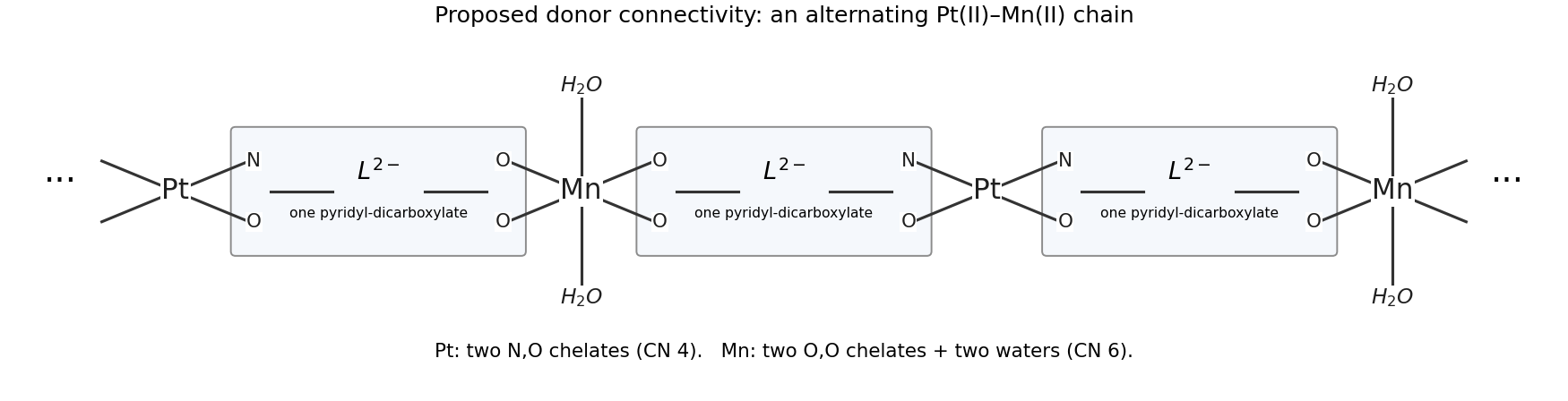

Pt(II) is and strongly favours square planar molecular geometry. Its affinity for the pyridyl N donor and the chelate effect select the mixed N,O pocket. Mn(II) is high-spin , is harder, and favours the carboxylate and water O donors; six-coordinate octahedral molecular geometry is natural in water. Charge balance per repeat is . A suitable repeat formulation is . This is a justified proposed coordination chain, not a unique crystal structure established from stoichiometry alone; water content, carboxylate bridging modes and actual porosity require structural characterization.
Past exam of the chemistry B course of the University of Cambridge 2022 Paper 2 B6 a Solution by Codex 0 2026-10-20
Codex 0 2026-10-20Six inward-directed donor orbitals form symmetry-adapted linear combinations of symmetry. They mix respectively with metal , and orbitals. Thus the sigma framework contains six occupied bonding molecular orbitals and six corresponding antibonding molecular orbitals. The metal orbitals have no sigma-compatible partner and remain nonbonding orbitals in this model. The important metal-dominated octahedral splitting isThe orbitals point directly toward the donors; the orbitals point between them. The original diagram shows the entire sigma framework, rather than treating the five metal d levels as the whole molecular-orbital diagram.
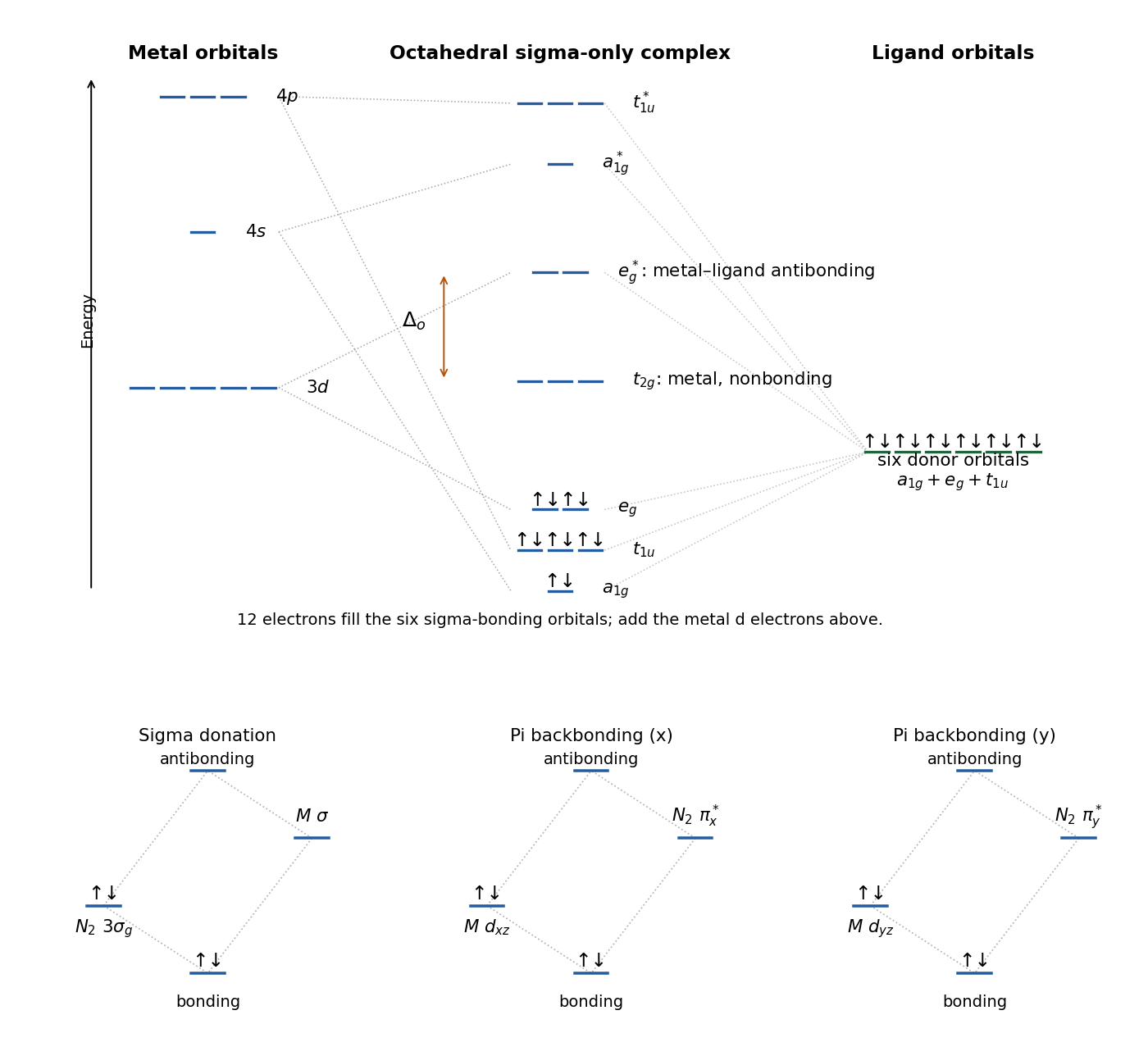
Sigma-only octahedral orbitals and the donation/backbonding channels of end-on dinitrogen
. Details. 
For the same donor set and approximately the same geometry, . The higher metal charge usually shortens the metal–donor distances and strengthens the interaction that raises . This comparison holds other chemical variables fixed: changing the ligand at the same time could reverse a comparison between two unrelated complexes.
Past exam of the chemistry B course of the University of Cambridge 2022 Paper 2 B10 a Solution by Codex 0 2026-10-20
Codex 0 2026-10-20Label the carbon next to the carbonyl and the OH-bearing carbon . The three limiting routes are E1, E1cb and E2 elimination. They differ in whether C–O cleavage, C–H cleavage, or both occur in the first elementary event. In the following original transition-state structures, dotted lines denote changing bonds, marks developing partial charge, and the bracketed structures carry . Unmarked skeletal bonds remain present. The dotted line parallel to C–C denotes the developing pi bond, in addition to its existing sigma bond.
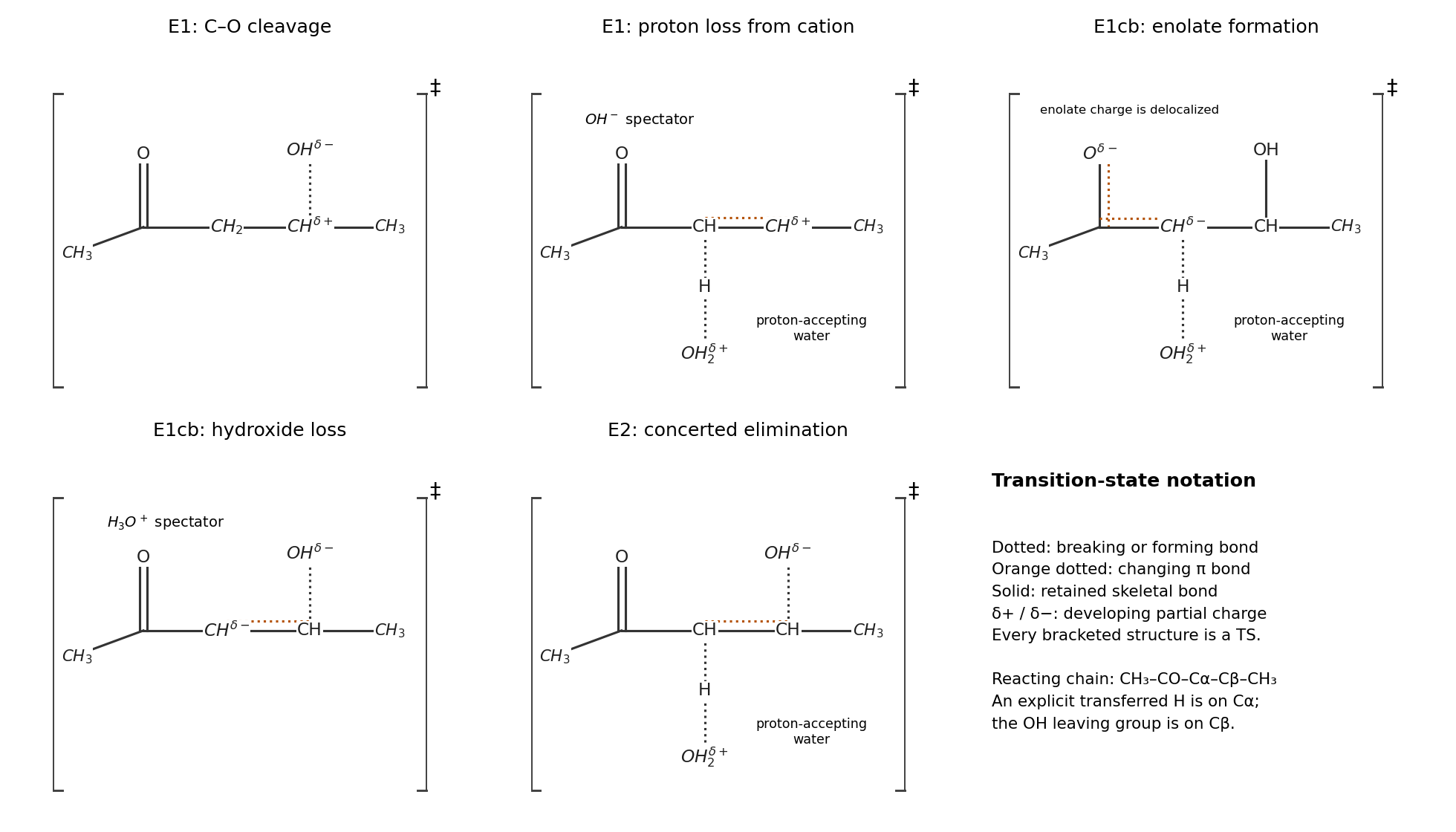
The five transition states in E1, E1cb and concerted E2 limiting elimination pathways
. Details. 
For E1, C–OH heterolysis occurs first. The electron pair in that bond goes to O, producing . Its first transition state has a partly broken C–O bond, developing positive charge on C and negative charge on the leaving O. Next, water uses a lone pair to remove the alpha proton; the C–H electron pair forms the C=C pi bond. This second transition state has partly broken C–H, partly formed water-O–H, and a partly formed C–C pi bond. Positive charge is transferred from the organic cation toward the incoming water/hydronium unit. hydroxide from the first step is a spectator in the second.
For E1cb, water first removes the alpha proton to form a resonance-stabilized enolate plus hydronium:The first transition state has partly broken C–H and partly formed O–H, with developing negative charge delocalized over the alpha-carbon/carbonyl-oxygen system and positive charge on the proton-accepting water unit. The enolate then expels hydroxide: use the carbon-centred contributor to send its alpha-carbon lone pair into C–C, while the C–O pair goes to oxygen. This second transition state has a partly formed alkene pi bond and partly broken C–O, with negative charge moving from the enolate framework onto the departing hydroxide. hydronium is a spectator in this second step.
For E2, water removes the alpha proton as hydroxide leaves in the same elementary step. Three electron-pair movements are simultaneous: water lone pair to H, C–H to the C–C pi bond, and C–O to O. Its single transition state therefore contains all three changing bonds: C–H, water-O–H and C–O, together with the developing pi bond. The departing O becomes negative, the proton-accepting water unit becomes positive, and partial charge at carbon depends on the synchrony of proton loss and leaving-group departure. The reacting conformation should align C–H and C–O approximately in an antiperiplanar conformation for efficient elimination.
These are formal limiting pathways for the displayed net process, not three claims of equal reaction rates in neutral water. In particular, unassisted loss of OH to a secondary carbocation is strongly disfavoured, and water is a weak base for making an enolate. The enolate pathway benefits from resonance stabilization and the final product is a conjugated enone, but actual rate and dominant pathway depend on chemical conditions. The displayed hydroxide and hydronium also rapidly neutralize each other; retaining them separately here tracks which bond cleavage supplied each species. No biological catalysis is needed to describe these chemical mechanisms.
Past exam of the chemistry B course of the University of Cambridge 2022 Paper 1 B5 c Solution by Codex 0 2026-10-20
Codex 0 2026-10-20TODO: user-deferred biology subquestion. This part is intentionally unsolved under the instruction to skip biology. No biological mechanism, sequence analysis or protein-folding research has been undertaken.
There are unlisted articles, also show them or only show them.