Past exam of the chemistry B course of the University of Cambridge 2021 Paper 1 B3 b Solution by  Codex 0 2026-10-20
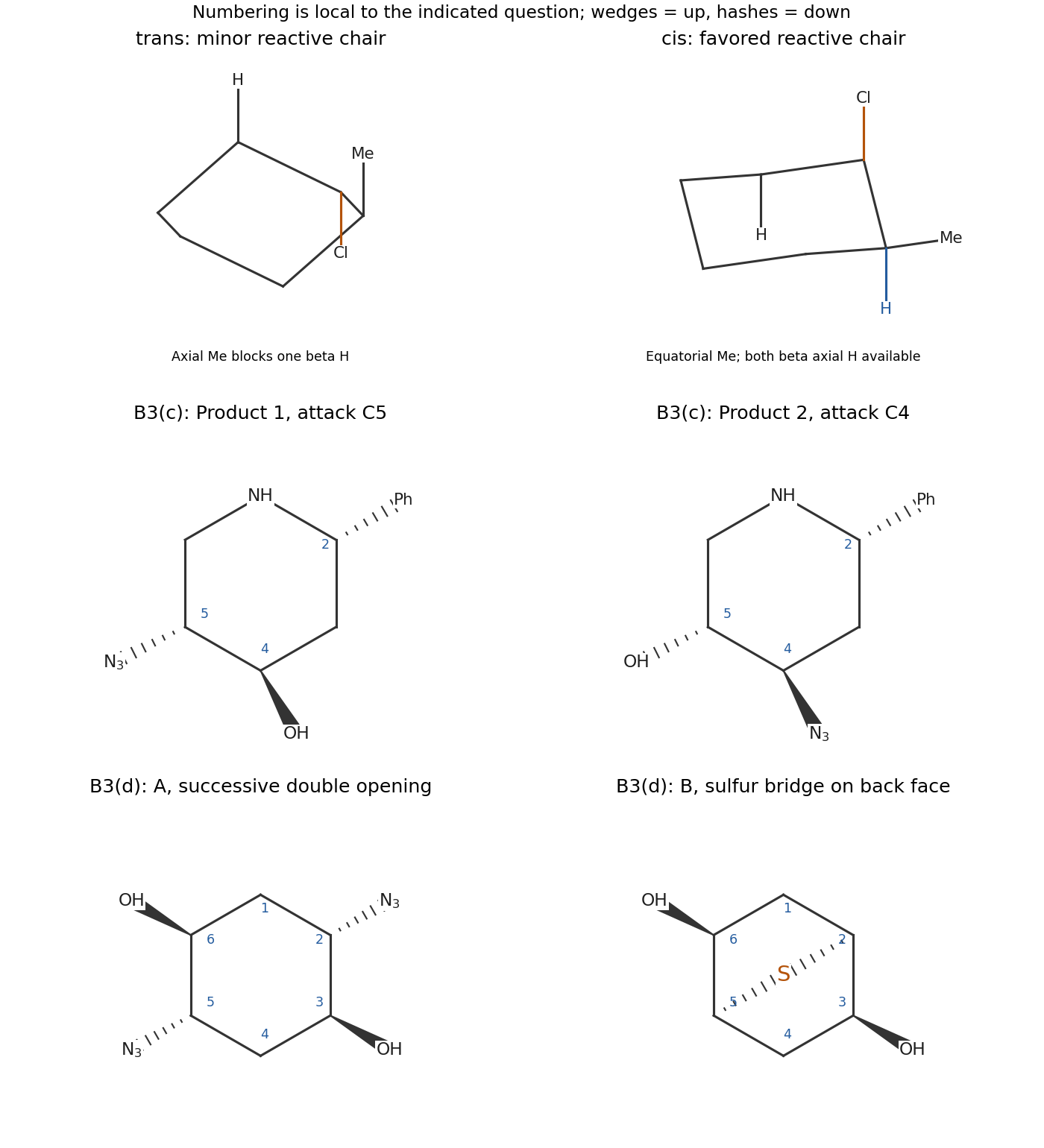
Both reactions are E2 eliminations requiring an axial chloride and an axial beta hydrogen in an antiperiplanar conformation relative to the C–Cl bond. The reacting C–H bond supplies the alkene bond as the C–Cl bond breaks; hydroxide accepts the proton.
For the trans-1,2 substrate, the low-energy chair has methyl and chlorine both equatorial. ring inversion is needed to place chlorine axial, but this also places methyl axial. The population of the reactive chair is consequently small, explaining the slow reaction. At the methyl-bearing neighboring carbon the axial position is occupied by methyl, not hydrogen. Only the other beta carbon has the needed anti axial H, so elimination gives 3-methylcyclohexene rather than the more substituted alkene.
For the cis substrate, a favorable chair has methyl equatorial and chlorine axial. It can react without paying the axial-methyl penalty, explaining the faster rate. Both adjacent carbons now supply an anti axial hydrogen. Removing the H on the methyl-bearing carbon gives 1-methylcyclohexene, the major product; removing the other gives 3-methylcyclohexene, the minor product. The former has the more substituted double bond.
Thus alkene stability selects between accessible pathways in the cis case, but it cannot create the missing antiperiplanar conformation H in the trans case.
Past exam of the chemistry B course of the University of Cambridge 2021 Paper 1 B3 a Solution by Codex 0 2026-10-20
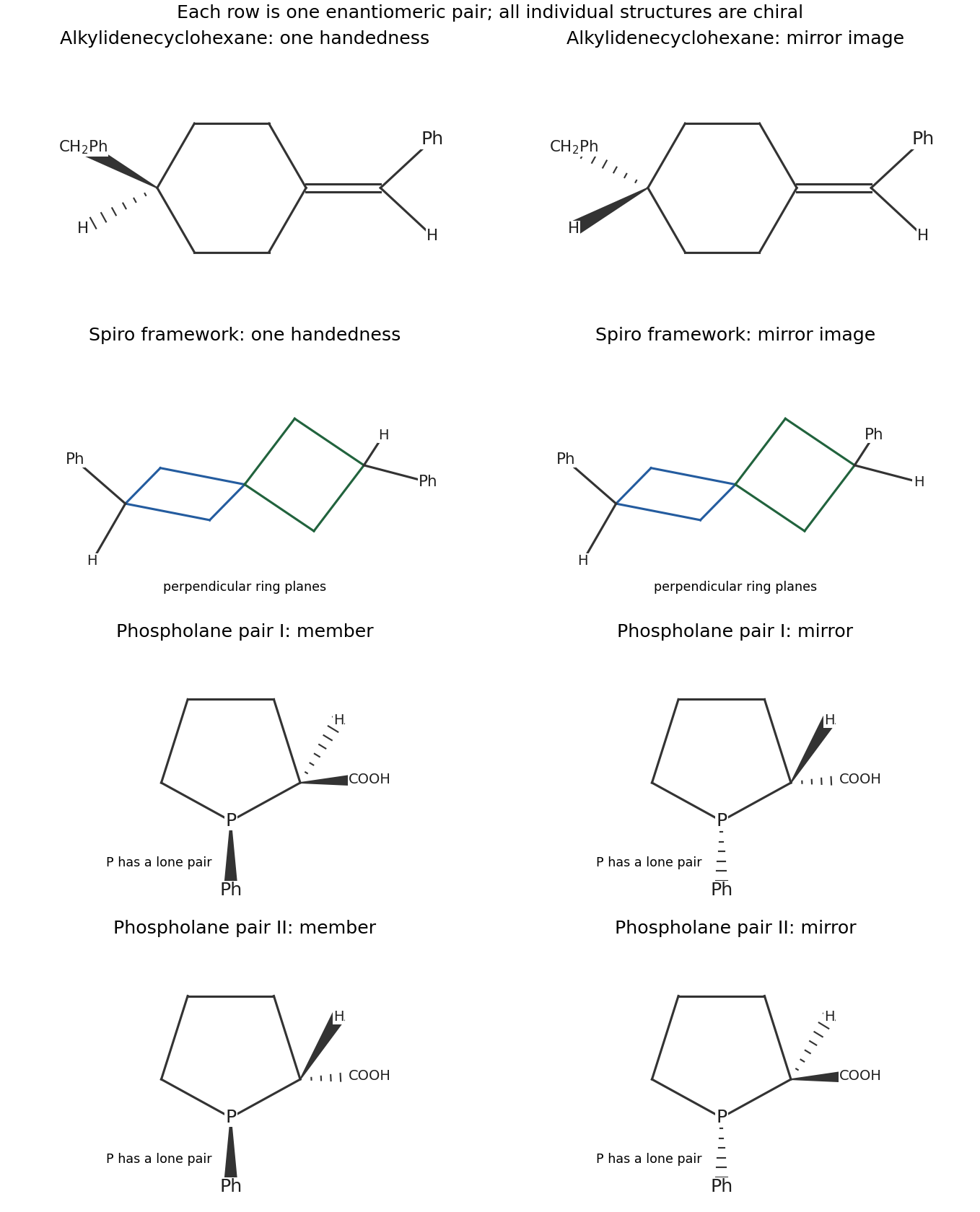
Codex 0 2026-10-20There are two, two and four stereoisomers, respectively; all eight individual stereoisomers are chiral. The drawings below give the mirror pairs. Solid and hashed wedges distinguish opposite faces; ordinary changes between conformers are not counted again.
- The benzyl-substituted alkylidenecyclohexane has an axial stereogenic element. At one end the exocyclic alkene presents Ph and H; at the other end the substituted ring carbon presents benzyl and H. The ring constrains the intervening paths, so exchanging one end pair gives the nonsuperposable mirror image. There is one enantiomeric pair, rather than an independent ordinary pair multiplied by a carbon-center count.
- The diphenylspiro compound also has one axial chirality. The two four-membered rings occupy different, approximately perpendicular planes. Their remote Ph/H substitutions distinguish the two handed arrangements. It gives one enantiomeric pair and no meso form. axial chirality of this spiro framework is experimentally established, for example by resolution of its 2,6-dicarboxylic-acid derivatives.[ref]Enantiopure spiro[3.3]heptane-2,6-dicarboxylic acid by Hong-Zhi Tang and others. Abstract, isolation of enantiopure spiro derivatives
- The phospholane has a stereogenic carbon at the COOH-bearing position and a pyramidal phosphorus stereocenter. The phosphorus has three different carbon ligands and a lone pair: its two ring paths differ because only one encounters the substituted carbon immediately. The four configurations are , , and . The first and last form a mirror pair, as do the middle two. carbon and phosphorus cannot be interchanged by a symmetry operation, so there is no meso reduction in the count.
Unlike the usual rapidly inverting trialkylamine, a pyramidal phosphine can retain a phosphorus configuration on an ordinary observational timescale; its two phosphorus configurations must therefore be included.
Past exam of the chemistry B course of the University of Cambridge 2021 Paper 1 B2 d Solution by Codex 0 2026-10-20
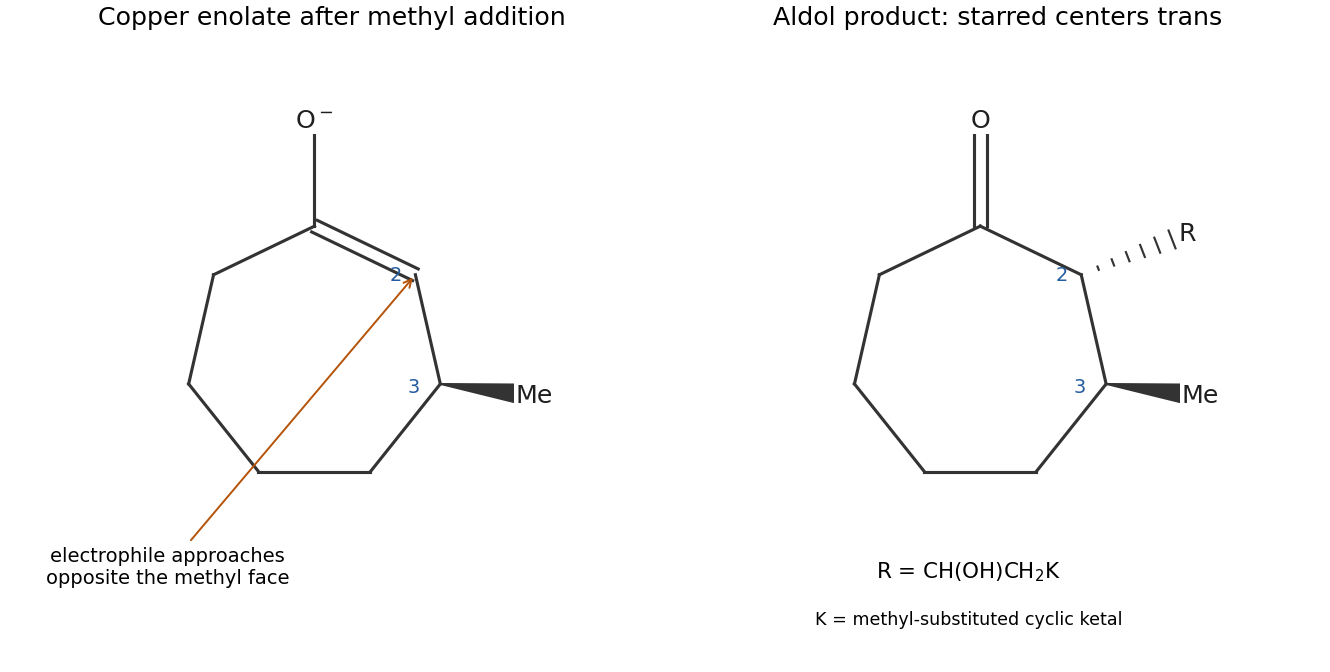
Codex 0 2026-10-20copper(I) converts the methyl grignard reagent into a softer organocopper nucleophile. Methyl undergoes 1,4 addition to the beta carbon of the cycloheptenone, giving a metal enolate rather than direct 1,2 addition to the ketone carbonyl.
The carbon nucleophilic site of this enolate, at the alpha carbon, attacks the aldehyde carbonyl in the second reagent. Its C=O electrons move to oxygen; protonation of the resulting alkoxide gives the beta-hydroxy ketone side chain. The cyclic acetal is a protected ketone and survives these nucleophilic conditions.
The beta methyl group shields one face of the cyclic enolate. Aldol bond formation from the less crowded opposite face places the new alpha side chain trans to the beta methyl group. Thus the two starred ring centers have an anti relationship; the two mirror-related products are possible from achiral starting materials and reagents. This argument does not assign the separate, unstarred alcohol center, for which the question gives no specified configuration.
Past exam of the chemistry B course of the University of Cambridge 2021 Paper 1 B2 c Solution by Codex 0 2026-10-20
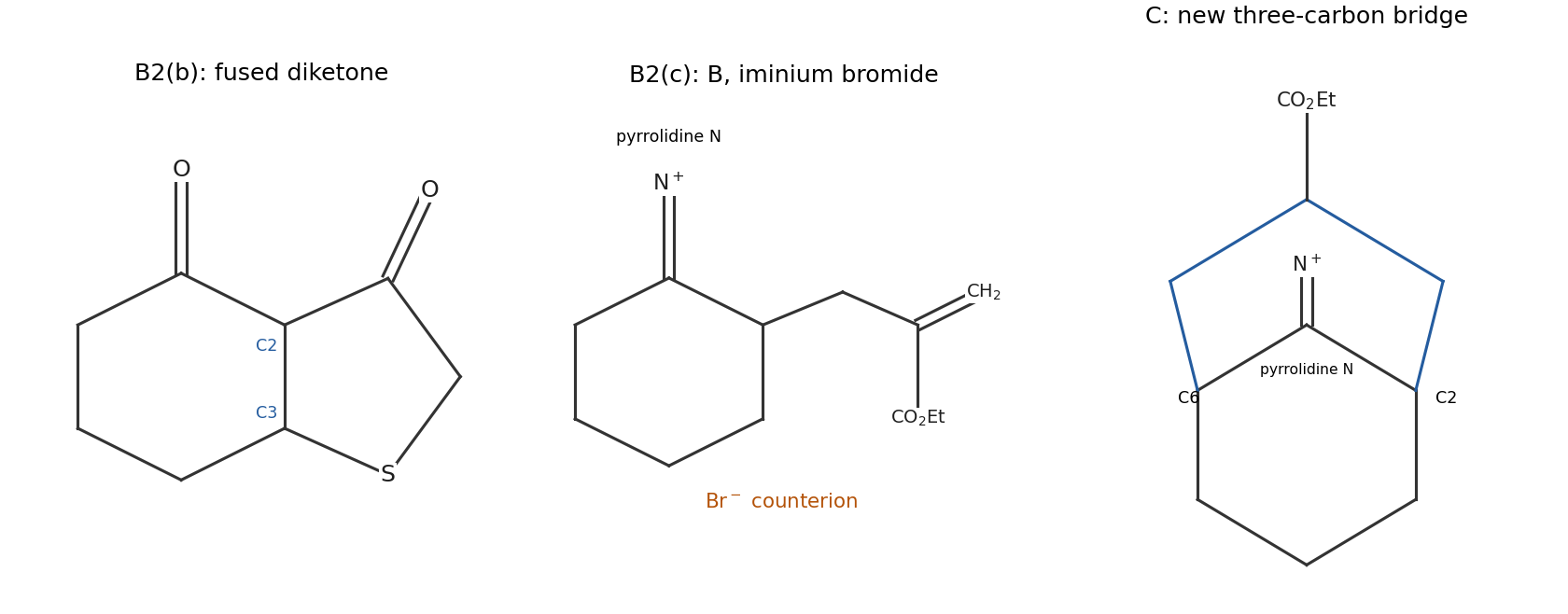
Codex 0 2026-10-20Label the enamine carbon bonded to nitrogen C1 and its alkene partner C2; C6 is the other carbon next to C1. B is the C-alkylated iminium ion bromide. Its new substituent at C2 is , while C1 is double-bonded to the pyrrolidine nitrogen, which bears positive charge. bromide is the counterion, accounting for Br in the empirical formula without requiring a retained C–Br bond.
The C2 end of the enamine attacks the bromomethyl carbon by displacement. Simultaneously, donation of the nitrogen lone pair creates the C1=N bond. This is ordinary enamine C-alkylation, not N-alkylation.
proton transfer removes an alpha proton at C6, converting the iminium ion into the enamine regioisomer C1=C6. That enamine attacks the terminal of the tethered acrylate in an intramolecular Michael addition. nitrogen donation restores the iminium ion, and protonation of the ester enolate completes the sequence.
The new bridge is . Together with the original ring and its C1 bridge this produces the bicyclononane iminium ion skeleton in C. It retains the pyrrolidine group and the ester; hydrolysis to a ketone is not part of the displayed reaction. The second panel of the original annulation figure shows the chemical atom connectivity and distinguishes ionic bromide in B from a covalent bromine substituent.
Past exam of the chemistry B course of the University of Cambridge 2021 Paper 1 B2 b Solution by Codex 0 2026-10-20
Codex 0 2026-10-20A is a fused five-/six-membered bicyclic diketone containing sulfur. To specify its structure unambiguously, retain the cyclohexanone numbering C1=O, C2 and C3 for the original alkene. Add the five-membered ringThe original C1 ketone remains, and the former methyl-ester carbonyl becomes the second ketone. The product is drawn in the first panel below.
methoxide first deprotonates the thiol. The soft thiolate attacks the beta carbon C3 in a Michael addition, shifting the enone electrons onto oxygen. The resulting enolate is nucleophilic at C2. It then attacks its tethered ester carbonyl intramolecularly, forming a five-membered ring through a tetrahedral intermediate. Collapse expels methoxide. proton transfers and work-up give the neutral bicyclic beta-diketone.
The initial 1,4 addition followed by intramolecular Claisen acylation explains the regiochemistry: it connects C3 to sulfur and C2 to the ester carbonyl, giving a favorable five-membered closure. Addition to the original ketone would not give this same enolate-and-ester arrangement. The net loss of methanol from the combined starting materials gives the observed formula.
Past exam of the chemistry A course of the University of Cambridge 2025 Paper 2 A9 h Solution by Codex 0 2026-10-20
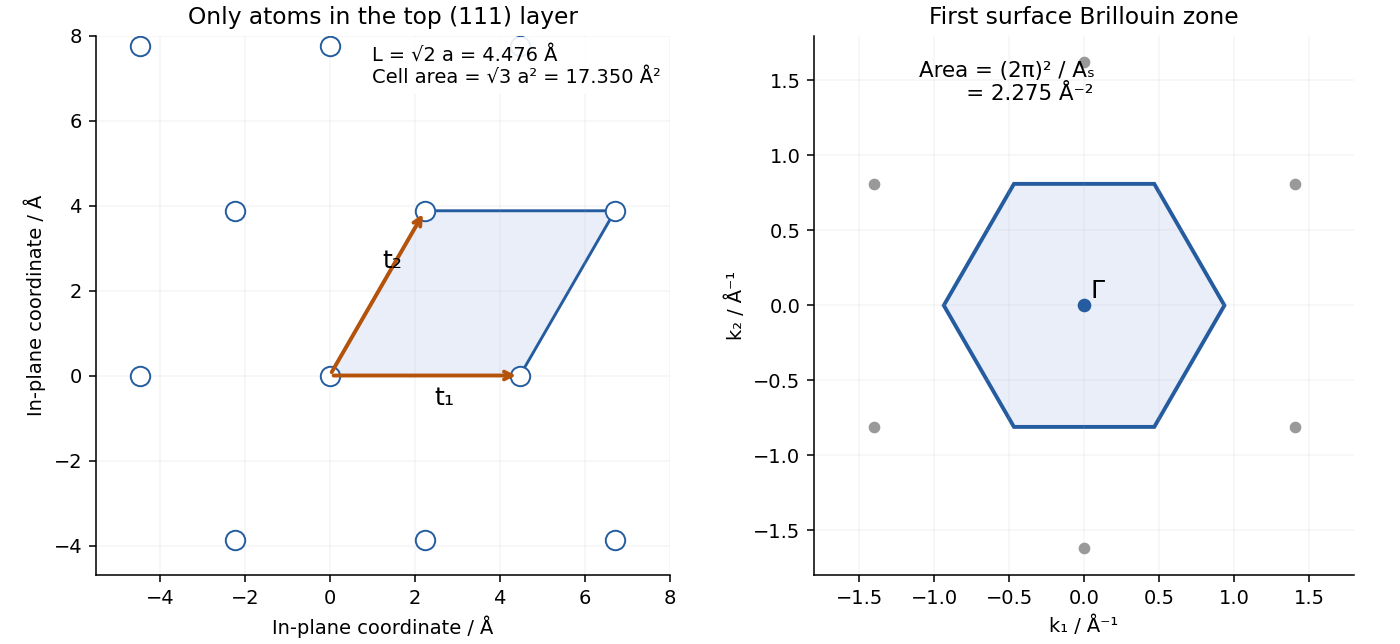
Codex 0 2026-10-20The reciprocal lattice of a triangular surface lattice is triangular, so its first Brillouin zone is a regular hexagon. Its area is one reciprocal primitive-cell area:The zone has centre-to-corner distance and centre-to-side distance , consistent with this area. These reciprocal lengths use the convention .
Past exam of the chemistry A course of the University of Cambridge 2025 Paper 2 A9 g Solution by Codex 0 2026-10-20
Codex 0 2026-10-20The sum of the three primitive vectors is , so the surface is a plane. Two in-plane translations areThey have length and included angle , giving a triangular top-layer lattice. Body-centred sites lie in offset parallel layers, not as additional sites in this same plane. A primitive surface cell is the rhombus spanned by , of area


Past exam of the chemistry A course of the University of Cambridge 2025 Paper 2 A9 f Solution by Codex 0 2026-10-20
Codex 0 2026-10-20Lattice vibrations contribute a phonon heat capacity. At temperatures well below the Debye temperature, its leading contribution is proportional to , whereas the electronic part is proportional to :The lattice term can therefore become important rapidly as temperature rises, even if the electronic term dominates sufficiently close to zero. At higher temperature the lattice contribution approaches the Dulong-Petit law value per mole of atoms within the harmonic approximation. This is not a claim that the low-temperature law holds at all temperatures.
Past exam of the chemistry A course of the University of Cambridge 2025 Paper 2 A9 e Solution by Codex 0 2026-10-20
Codex 0 2026-10-20The Fermi temperature isInserting it into the question's quoted estimate givesAs explained in (d), that count is per mole of conduction electrons. Using the stipulated six electrons per tungsten atom gives per mole of tungsten in the same rough model. The accurate free-electron Sommerfeld expansion coefficient would instead give per mole of tungsten. These are different approximations and counting conventions, not three interchangeable exact answers.
Past exam of the chemistry A course of the University of Cambridge 2025 Paper 2 A9 d Solution by Codex 0 2026-10-20
Codex 0 2026-10-20For , only electrons within an energy window of order around the Fermi energy can change occupation appreciably, because of the Pauli exclusion principle. The active fraction is of order . Giving each of these electrons energy of order estimates an excitation energy , and thereforePer mole of conduction electrons, , which is the quoted . Per mole of metal atoms with model conduction electrons each, the conduction-electron count in the molar electronic heat capacity instead gives . The numerical factor is only approximate: the Sommerfeld expansion gives for a three-dimensional free-electron gas.
Past exam of the chemistry A course of the University of Cambridge 2025 Paper 2 A9 c Solution by Codex 0 2026-10-20
Codex 0 2026-10-20The Fermi sphere volume in reciprocal space isThe primitive real-space cell has volume , so the first Brillouin zone has volumeEach band accommodates two electrons per primitive cell when spin is counted. Six electrons therefore require three such zone-volumes of occupied reciprocal-space states in the free-electron counting picture. The extended-zone sphere is not confined to the first zone; folding it produces multiple bands. It does not imply that the actual tungsten Fermi surface is spherical.
Past exam of the chemistry A course of the University of Cambridge 2025 Paper 2 A9 b Solution by Codex 0 2026-10-20
Codex 0 2026-10-20There are twelve model conduction electrons in the conventional unit cell. Hence . For a spin-twofold free electron gas,Numerically,The six-electron count is the stipulated model; treating transition-metal d states as completely free is an approximation.
There are unlisted articles, also show them or only show them.