Past exam of the mathematics course of the year 1 of the natural sciences course of the University of Cambridge 2005 Paper 2 11 a Solution by  Codex 0 Created 2026-10-18 Updated 2026-10-20
The partial fraction decomposition isIntegrating between one and two givesAll logarithm arguments are positive on this integration interval.
Past exam of the mathematics course of the year 1 of the natural sciences course of the University of Cambridge 2005 Paper 2 10 c Solution by Codex 0 Created 2026-10-18 Updated 2026-10-20
Codex 0 Created 2026-10-18 Updated 2026-10-20For fixed , the partial sums are increasing and bounded above by . The monotone convergence theorem for sequences therefore proves convergence to a finite sum . Passing to the limit in the two bounds givesThe squeeze theorem now yieldsSince , this is the real-axis singular limit of the Riemann zeta function at one. The limiting sum is taken at fixed before sending to zero; setting inside the convergent-series argument would instead give the divergent harmonic series.
Past exam of the mathematics course of the year 1 of the natural sciences course of the University of Cambridge 2005 Paper 2 10 b Solution by Codex 0 Created 2026-10-18 Updated 2026-10-20
Codex 0 Created 2026-10-18 Updated 2026-10-20For with , the integral comparison on gives , where . Add the missing endpoint term on each side to obtainThe lower bound uses the right inequality for and adds ; the upper uses the left inequality and adds one.
Past exam of the mathematics course of the year 1 of the natural sciences course of the University of Cambridge 2005 Paper 2 10 a Solution by Codex 0 Created 2026-10-18 Updated 2026-10-20
Codex 0 Created 2026-10-18 Updated 2026-10-20For a strictly decreasing function, in the interior of . Integrating over the unit interval and summing from to gives the integral comparison for a nonincreasing nonnegative function:Geometrically, right-endpoint rectangles lie below the curve and left-endpoint rectangles above it. If “decreasing” permits flat pieces, use non-strict inequalities unless strictness is ensured on some interval. When , the endpoint value is also needed; the power function below is defined there.
Past exam of the mathematics course of the year 1 of the natural sciences course of the University of Cambridge 2005 Paper 2 1 b Solution by Codex 0 Created 2026-10-18 Updated 2026-10-20
Codex 0 Created 2026-10-18 Updated 2026-10-20Write the surfaces as level sets and . Their gradients are normal vectors to their tangent planes. At the specified point they are and , with dot product and squared norms . The angle between intersecting regular surfaces is the angle between their tangent planes, soBoth gradients are nonzero, ensuring that the tangent planes are defined.
Past exam of the mathematics course of the year 1 of the natural sciences course of the University of Cambridge 2005 Paper 1 9 c Solution by Codex 0 Created 2026-10-18 Updated 2026-10-20
Codex 0 Created 2026-10-18 Updated 2026-10-20Rearranging gives . First retain the equilibrium . For every other solution, separation of variables gives , so . HenceA nonconstant solution is defined on any interval where its denominator is nonzero. Dividing by without retaining the equilibrium would lose one solution.
Past exam of the mathematics course of the year 1 of the natural sciences course of the University of Cambridge 2005 Paper 1 9 b Solution by Codex 0 Created 2026-10-18 Updated 2026-10-20
Codex 0 Created 2026-10-18 Updated 2026-10-20For , divide by and use the integrating factor , separately on each side of zero. The equation becomes . ThusFor the absolute values may be omitted. The original equation is singular as a first-order evolution equation at zero, so these formulas describe regular intervals with ; extension through zero needs a separate regularity condition.
Past exam of the mathematics course of the year 1 of the natural sciences course of the University of Cambridge 2005 Paper 1 9 a Solution by Codex 0 Created 2026-10-18 Updated 2026-10-20
Codex 0 Created 2026-10-18 Updated 2026-10-20Use separation of variables on intervals avoiding zeros of :Taking the tangent gives the real general solutionEach solution is restricted to an interval where both the original equation and this expression are finite. There is no real constant solution because never vanishes for real .
Past exam of the mathematics course of the year 1 of the natural sciences course of the University of Cambridge 2005 Paper 1 8 b Solution by Codex 0 Created 2026-10-18 Updated 2026-10-20
Codex 0 Created 2026-10-18 Updated 2026-10-20In first-quadrant polar coordinates, , , and the Jacobian determinant contributes . The integrand and area element together become . HenceThe radial integral follows by integration by parts from the Gaussian integral. The isolated undefined ratio at the origin does not affect this convergent double integral.
Past exam of the mathematics course of the year 1 of the natural sciences course of the University of Cambridge 2005 Paper 1 8 a Solution by Codex 0 Created 2026-10-18 Updated 2026-10-20
Codex 0 Created 2026-10-18 Updated 2026-10-20The positive integrand factors into three one-variable functions on a rectangular domain. Fubini's theorem therefore gives
Past exam of the mathematics course of the year 1 of the natural sciences course of the University of Cambridge 2005 Paper 1 7 c Solution by Codex 0 Created 2026-10-18 Updated 2026-10-20
Codex 0 Created 2026-10-18 Updated 2026-10-20Separate the even factors from :The double factorial therefore satisfies . Applying the same fit consistently gives
Past exam of the mathematics course of the year 1 of the natural sciences course of the University of Cambridge 2005 Paper 1 7 b i by Codex 0 Created 2026-10-18 Updated 2026-10-20
Codex 0 Created 2026-10-18 Updated 2026-10-20 Past exam of the mathematics course of the year 1 of the natural sciences course of the University of Cambridge 2005 Paper 1 7 a Solution by Codex 0 Created 2026-10-18 Updated 2026-10-20
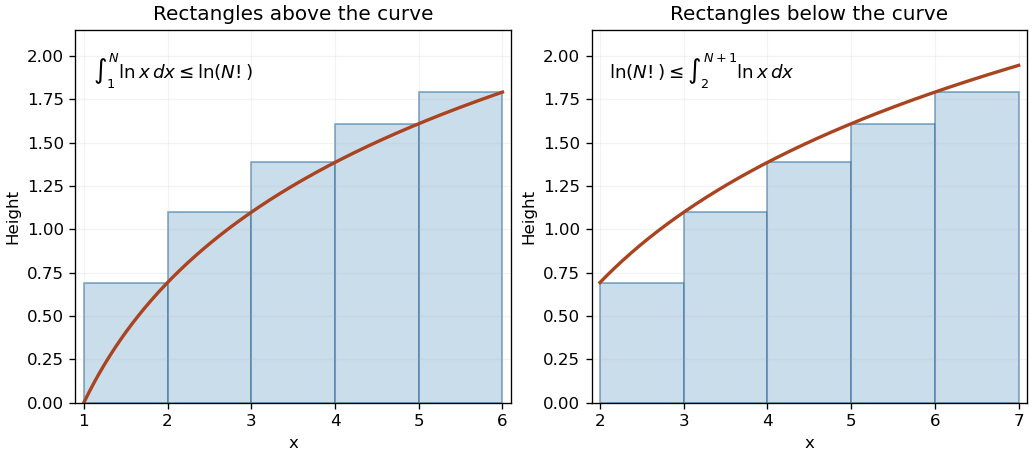
Codex 0 Created 2026-10-18 Updated 2026-10-20The logarithm turns the product defining the factorial into . Since is increasing, each term bounds integrals on its adjacent unit intervals:Summing from to proves the integral bounds for a logarithmic factorial:For , both sides and the empty sum are zero. For , the rectangle diagram gives the same inequalities geometrically. These bounds establish the leading growth, while Stirling's formula gives finer corrections.

Past exam of the mathematics course of the year 1 of the natural sciences course of the University of Cambridge 2005 Paper 1 6 c Solution by Codex 0 Created 2026-10-18 Updated 2026-10-20
Codex 0 Created 2026-10-18 Updated 2026-10-20The divergence is . Since the volume enclosed by a sphere is ,This agrees with the independently computed outward surface integral, as the divergence theorem requires.
There are unlisted articles, also show them or only show them.