Past exam of the mathematics course of the year 1 of the natural sciences course of the University of Cambridge 2006 Paper 2 6 b Solution by  Codex 0 Created 2026-10-18 Updated 2026-10-20
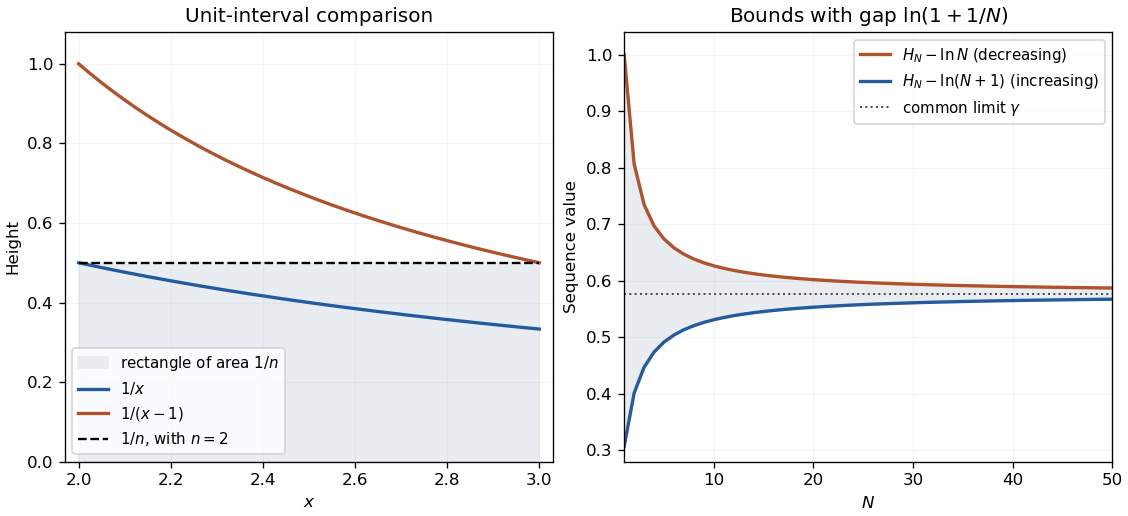
For , monotonicity gives . Integrating over that unit interval proves the strict inequalities, equivalently for .
Let be the harmonic number and define , . The same integral comparison gives and . Also and . The monotone convergence theorem for sequences therefore gives a common finite limit, Euler's constant .
The integral bounds for Euler's constant start at and . Strict monotonicity, already at the next index, makes the limit bounds strict:Positivity is explicit because . This establishes the required limit without assuming its decimal value.
Past exam of the mathematics course of the year 1 of the natural sciences course of the University of Cambridge 2006 Paper 2 6 a Solution by Codex 0 Created 2026-10-18 Updated 2026-10-20
Codex 0 Created 2026-10-18 Updated 2026-10-20For , the kernel is smooth between the two positive endpoints. The Leibniz integral rule gives both endpoint terms and the parameter derivative:The remaining integral equals , soThe substitution gives the same result directly from limits . Negative would make the original interval cross the nonintegrable singularity, so it is not part of this ordinary-integral domain.
Past exam of the mathematics course of the year 1 of the natural sciences course of the University of Cambridge 2006 Paper 2 5 c Solution by Codex 0 Created 2026-10-18 Updated 2026-10-20
Codex 0 Created 2026-10-18 Updated 2026-10-20Integrate the horizontal-disk expression over . With and ,Evaluating the integral of this polynomial gives
Past exam of the mathematics course of the year 1 of the natural sciences course of the University of Cambridge 2006 Paper 2 5 b Solution by Codex 0 Created 2026-10-18 Updated 2026-10-20
Codex 0 Created 2026-10-18 Updated 2026-10-20For horizontal slices of a surface of revolution in spherical coordinates, use disk area times vertical thickness. Here the cylindrical radius is and the height is . For , . Hence a positive angular increment givesThese are horizontal disks in the lower part of the solid. A spherical angular-wedge element describes a different infinitesimal slice.
Past exam of the mathematics course of the year 1 of the natural sciences course of the University of Cambridge 2006 Paper 2 5 a Solution by Codex 0 Created 2026-10-18 Updated 2026-10-20
Codex 0 Created 2026-10-18 Updated 2026-10-20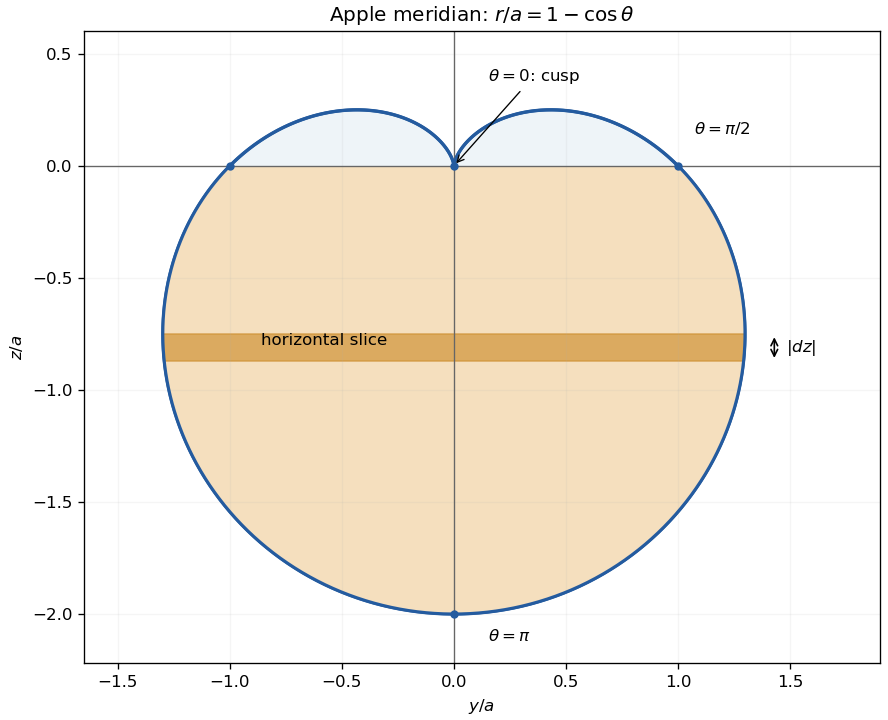


Past exam of the mathematics course of the year 1 of the natural sciences course of the University of Cambridge 2006 Paper 2 4 c Solution by Codex 0 Created 2026-10-18 Updated 2026-10-20
Codex 0 Created 2026-10-18 Updated 2026-10-20Subtract the integrands before integrating: . With the upward vector area element,This extends continuously to the lower edge, soThe individual flux integrals also converge: gives , and hence . Reversing the surface orientation changes both signs and leaves the requested magnitude unchanged.
Past exam of the mathematics course of the year 1 of the natural sciences course of the University of Cambridge 2006 Paper 2 4 b Solution by Codex 0 Created 2026-10-18 Updated 2026-10-20
Codex 0 Created 2026-10-18 Updated 2026-10-20Choose . Since on the stated open domain, its upward vector area element isThe graph becomes unbounded near parts of ; the flux integrals below are understood as limits from .
Past exam of the mathematics course of the year 1 of the natural sciences course of the University of Cambridge 2006 Paper 2 4 a Solution by Codex 0 Created 2026-10-18 Updated 2026-10-20
Codex 0 Created 2026-10-18 Updated 2026-10-20Where , the implicit function theorem makes the surface a local graph with and . Its upward vector area element is . Therefore the vector area element of an implicit surface isDividing by fixes the upward orientation even if the initially chosen gradient points downward. The restriction excludes a locally vertical graph, where this particular projected-area representation cannot be used.
Past exam of the mathematics course of the year 1 of the natural sciences course of the University of Cambridge 2006 Paper 2 2 c Solution by Codex 0 Created 2026-10-18 Updated 2026-10-20
Codex 0 Created 2026-10-18 Updated 2026-10-20For an arbitrary vector , expansion in the orthonormal basis gives , with summation over . Since this holds for every , the resolution of the identity in an orthonormal basis isLet , and similarly for . The three orthogonal projection matrices sum to and have pairwise products zero. ThusAny ray meeting all three ideal perpendicular mirrors therefore returns in the opposite direction, independently of reflection order. This is the geometry of a corner reflector, a kind of retroreflector used in lunar laser ranging.
Past exam of the mathematics course of the year 1 of the natural sciences course of the University of Cambridge 2006 Paper 2 2 b Solution by Codex 0 Created 2026-10-18 Updated 2026-10-20
Codex 0 Created 2026-10-18 Updated 2026-10-20Expanding the two products of Householder reflections givesThe commuting plane reflections criterion follows: the operator vanishes if the normals are orthogonal, or if they are parallel. Conversely, if and the operator vanishes, applying to gives , proving parallelism.
This establishes equality of the reflected directions for every incident ray exactly in those two cases. For one fixed ray the claim needs that qualification: if nonparallel normals are not orthogonal, a ray along has zero normal component for both mirrors and is unchanged in either order. Algebraically it lies in the kernel of the commutator; it is a special direction rather than a pair of commuting reflection operators.
Past exam of the mathematics course of the year 1 of the natural sciences course of the University of Cambridge 2006 Paper 2 2 a Solution by Codex 0 Created 2026-10-18 Updated 2026-10-20
Codex 0 Created 2026-10-18 Updated 2026-10-20Write . Since is a unit vector, and . Thus this Householder reflection satisfiesGeometrically, the mirror preserves the component tangent to its plane and reverses the normal component; doing it twice restores the original vector.
Past exam of the mathematics course of the year 1 of the natural sciences course of the University of Cambridge 2006 Paper 2 12 c Solution by Codex 0 Created 2026-10-18 Updated 2026-10-20
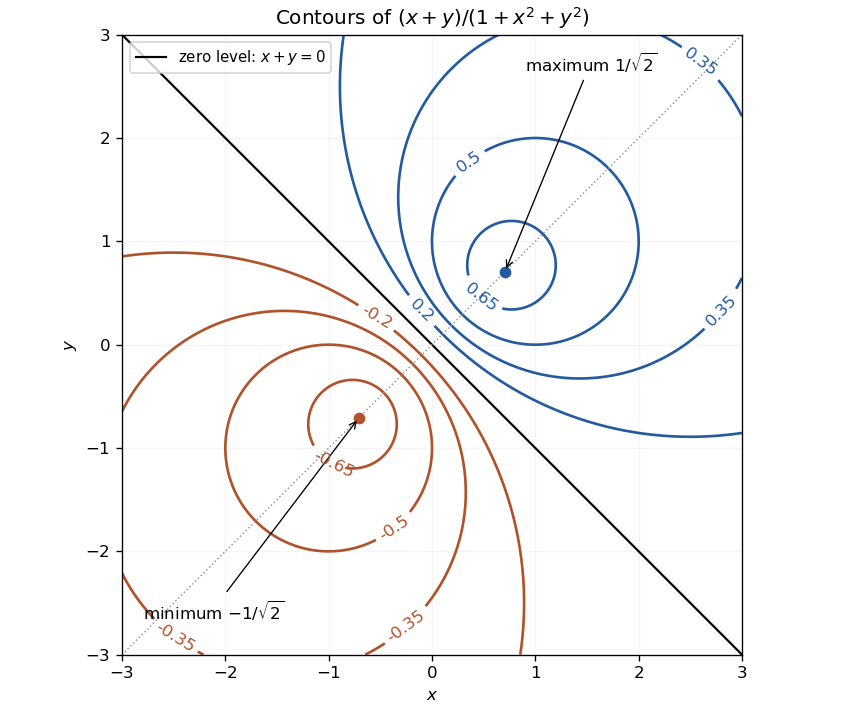
Codex 0 Created 2026-10-18 Updated 2026-10-20For a nonzero level , completing the square givesThus the level sets of a linear numerator over a radial quadratic are circles centred on , real only for . The extreme levels shrink to points. The zero contour is the straight line , separating positive and negative heights; near it, small nonzero levels are large circles. Heights tend to zero at infinity.
Circular nonzero contours around the two extrema of a rational height function
. Original contour plot. Blue positive and orange negative circles surround the marked maximum and minimum; the black line is the zero contour. Circle centres lie on . Details.
Past exam of the mathematics course of the year 1 of the natural sciences course of the University of Cambridge 2006 Paper 2 12 b Solution by Codex 0 Created 2026-10-18 Updated 2026-10-20
Codex 0 Created 2026-10-18 Updated 2026-10-20At with , differentiating the gradient yields the Hessian matrix . At the positive point it is negative definite, and at the negative point it is positive-definite; in both cases and . Therefore the positive point is a maximum, the negative point is a minimum, and there are no saddle points.
They are global extrema: with , the Cauchy-Schwarz inequality gives , with equality at exactly those two points. This is the extremum bound underlying the level sets of a linear numerator over a radial quadratic.
Past exam of the mathematics course of the year 1 of the natural sciences course of the University of Cambridge 2006 Paper 2 12 a Solution by Codex 0 Created 2026-10-18 Updated 2026-10-20
Codex 0 Created 2026-10-18 Updated 2026-10-20Let . The gradient has components and . At a critical point, subtraction gives . The case cannot make either numerator zero, so . The remaining equation is , givingThese are the only stationary points; the denominator is positive everywhere.
Past exam of the mathematics course of the year 1 of the natural sciences course of the University of Cambridge 2006 Paper 2 11 d Solution by Codex 0 Created 2026-10-18 Updated 2026-10-20
Codex 0 Created 2026-10-18 Updated 2026-10-20The substitution gives . For this function , , and , whose sum is zero. Thus it satisfies the polar form of Laplace's equation for . The apparent coordinate singularity at does not make the original Cartesian polynomial singular; it is a smooth harmonic function through the origin.
There are unlisted articles, also show them or only show them.