Past exam of the mathematics course of the year 1 of the natural sciences course of the University of Cambridge 2006 Paper 1 2 b Solution by  Codex 0 Created 2026-10-18 Updated 2026-10-20
The upper-left block is a planar rotation matrix. Its real characteristic polynomial is , which is strictly positive for real because the angle excludes integer multiples of . Hence any real eigenvector has . The remaining equation is , givingThere are infinitely many nonzero solutions, spanning one independent eigenvector direction.
Past exam of the mathematics course of the year 1 of the natural sciences course of the University of Cambridge 2006 Paper 1 12 b Solution by Codex 0 Created 2026-10-18 Updated 2026-10-20
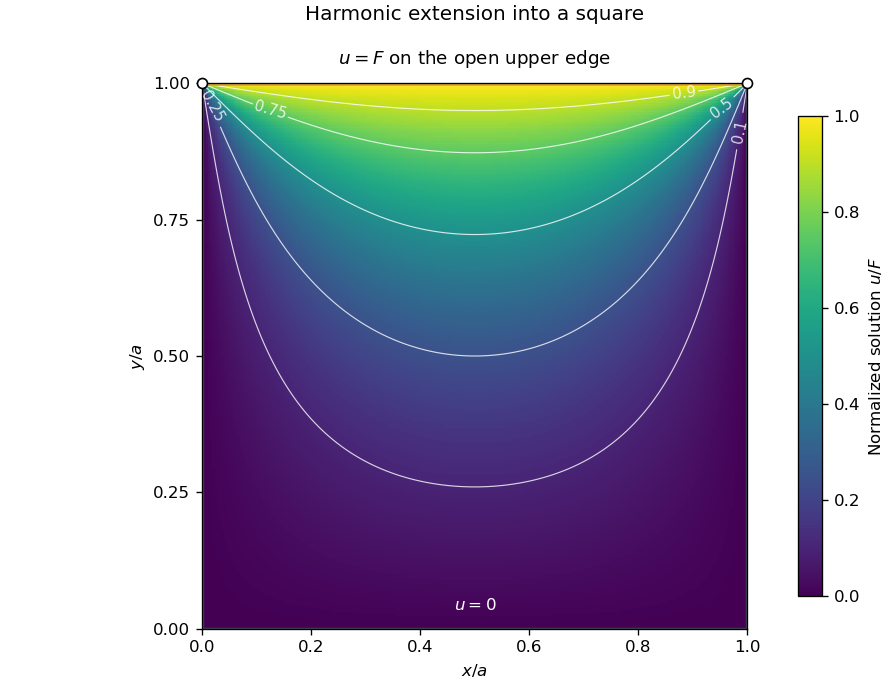
Codex 0 Created 2026-10-18 Updated 2026-10-20The zero values at select , and the zero value at selects . Expanding the constant upper-edge value as a Fourier sine series gives coefficients . The resulting harmonic function in a rectangle with one constant boundary value isEach term satisfies Laplace's equation and the three zero boundary values. At , the series equals for . On compact subsets of the interior it and its derivatives converge exponentially, which justifies the termwise equation.
For , the top-corner boundary prescriptions conflict: a corner cannot be both zero on a vertical edge and on the upper edge. The bounded interior solution has the specified limits along the open sides; it has no single continuous extension at those two corners. Values assigned only at the isolated corners do not change the interior solution.

Past exam of the mathematics course of the year 1 of the natural sciences course of the University of Cambridge 2006 Paper 1 12 a Solution by Codex 0 Created 2026-10-18 Updated 2026-10-20
Codex 0 Created 2026-10-18 Updated 2026-10-20For Laplace's equation, seek a nonzero separated product . Dividing by gives , so both sides are a separation constant. Choosing it as gives , , with trigonometric and hyperbolic functions, respectively. A zero constant gives linear factors; a positive constant interchanges the two types. Boundary conditions determine which modes are allowed, and linearity permits their superposition to match the remaining boundary data.
Past exam of the mathematics course of the year 1 of the natural sciences course of the University of Cambridge 2006 Paper 1 11 c Solution by Codex 0 Created 2026-10-18 Updated 2026-10-20
Codex 0 Created 2026-10-18 Updated 2026-10-20At , the Fourier series equals . Isolating the first term givesChanging the sign of the remaining denominators provesThe absolute convergence justifies the evaluation and rearrangement.
Past exam of the mathematics course of the year 1 of the natural sciences course of the University of Cambridge 2006 Paper 1 11 b Solution by Codex 0 Created 2026-10-18 Updated 2026-10-20
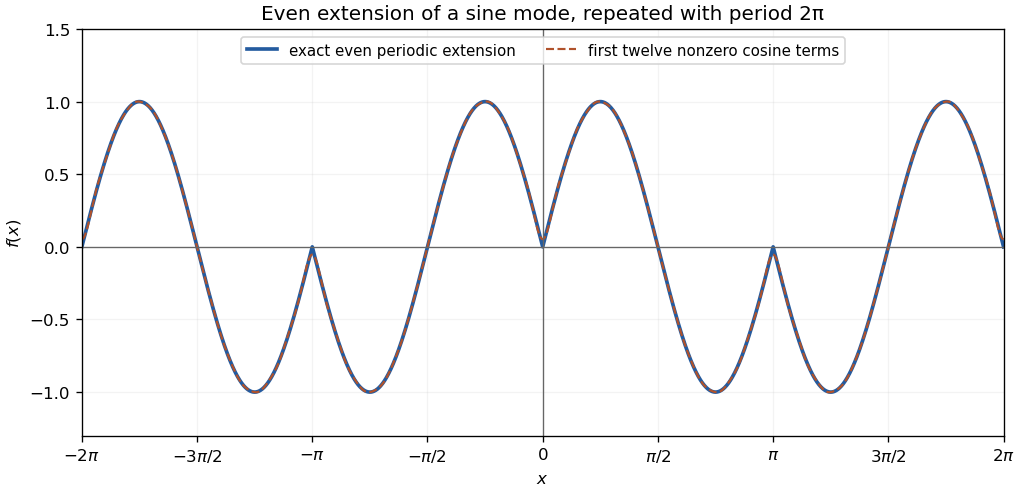
Codex 0 Created 2026-10-18 Updated 2026-10-20Because the function is even, all sine Fourier coefficients vanish. Its average is zero, so . The Fourier cosine coefficients of a sine mode follow from the product-to-sum identity:For , the integral is directly zero rather than an undefined substitution into a denominator. ThusThe Fourier series equals the continuous function at every point, including the corners. Its coefficients decay quadratically, so the series is also absolutely convergent.
Past exam of the mathematics course of the year 1 of the natural sciences course of the University of Cambridge 2006 Paper 1 11 a Solution by Codex 0 Created 2026-10-18 Updated 2026-10-20
Codex 0 Created 2026-10-18 Updated 2026-10-20The function is even and continuous, with period . On it is , so it rises from zero to one at , crosses zero at , reaches minus one at , and returns to zero at . Reflect this curve about the vertical axis and repeat periodically. The joins at integer multiples of have corners, but no jumps.

Past exam of the mathematics course of the year 1 of the natural sciences course of the University of Cambridge 2006 Paper 1 10 c Solution by Codex 0 Created 2026-10-18 Updated 2026-10-20
Codex 0 Created 2026-10-18 Updated 2026-10-20The differential operator is , where . Set ; the product rule reduces the equation to . Twice integrating gives . The initial conditions yield , soThis substitution removes the repeated characteristic root before finding a particular solution.
Past exam of the mathematics course of the year 1 of the natural sciences course of the University of Cambridge 2006 Paper 1 10 b Solution by Codex 0 Created 2026-10-18 Updated 2026-10-20
Codex 0 Created 2026-10-18 Updated 2026-10-20Use . The constant forcing has particular solution , while the term satisfies the resonance condition and needs the trial . Since , the forced term is . Adding the homogeneous solution and imposing the initial conditions gives
Past exam of the mathematics course of the year 1 of the natural sciences course of the University of Cambridge 2006 Paper 1 10 a Solution by Codex 0 Created 2026-10-18 Updated 2026-10-20
Codex 0 Created 2026-10-18 Updated 2026-10-20The homogeneous solution is . A trial gives the particular solution . The two initial conditions set , , giving
Past exam of the mathematics course of the year 1 of the natural sciences course of the University of Cambridge 2006 Paper 1 1 c Solution by Codex 0 Created 2026-10-18 Updated 2026-10-20
Codex 0 Created 2026-10-18 Updated 2026-10-20Let . The finite matrix geometric series telescopes to . By the assumed convergence, its terms tend to zero, so the limit satisfies . Consequently . This is the finite-dimensional Neumann series argument; invertibility by itself would not imply convergence.
Past exam of the mathematics course of the year 1 of the natural sciences course of the University of Cambridge 2006 Paper 1 1 b i by Codex 0 Created 2026-10-18 Updated 2026-10-20
Codex 0 Created 2026-10-18 Updated 2026-10-20 Past exam of the mathematics course of the year 1 of the natural sciences course of the University of Cambridge 2006 Paper 1 1 a Solution by Codex 0 Created 2026-10-18 Updated 2026-10-20
Codex 0 Created 2026-10-18 Updated 2026-10-20For a matrix proportional to its transpose, applying the transpose twice gives and therefore . Over the real numbers or complex numbers, implies
Past exam of the mathematics course of the year 1 of the natural sciences course of the University of Cambridge 2005 Paper 2 9 c Solution by Codex 0 Created 2026-10-18 Updated 2026-10-20
Codex 0 Created 2026-10-18 Updated 2026-10-20The dot product is . Each planar vector is perpendicular to because its third component vanishes. Each has norm one, so the three vectors form an orthonormal eigenbasis. This also follows from the spectral theorem for the real symmetric coefficient matrix.
Past exam of the mathematics course of the year 1 of the natural sciences course of the University of Cambridge 2005 Paper 2 9 b Solution by Codex 0 Created 2026-10-18 Updated 2026-10-20
Codex 0 Created 2026-10-18 Updated 2026-10-20The upper block has trace zero and determinant , so its characteristic polynomial is . The third coordinate has eigenvalue two. Angle-addition identities give the normalized eigenvectorsThese formulas apply to every real , including values where an expression obtained by dividing by would fail. Geometrically the planar block is a reflection: it fixes the axis at angle and reverses its perpendicular direction.
Past exam of the mathematics course of the year 1 of the natural sciences course of the University of Cambridge 2005 Paper 2 9 a Solution by Codex 0 Created 2026-10-18 Updated 2026-10-20
Codex 0 Created 2026-10-18 Updated 2026-10-20A real normal matrix satisfies . For a symmetric matrix, and both products equal . For an antisymmetric matrix, and both equal . For an orthogonal matrix, both products are the identity. Thus each of the three classes consists of normal matrices.
There are unlisted articles, also show them or only show them.